
Getting around Trieste: Info and Tips
Quick Guide to Getting Around the City


Trieste is a fascinating, elegant, and historically rich city, where getting around may seem complex at first, but becomes simple and enjoyable once you understand the layout of its neighborhoods and the available transportation options.
Overview
Getting around Trieste is generally easy, thanks to an efficient public transport network and a compact city that is very walkable. However, some historic areas and the seafront require a bit of orientation to move around comfortably.
The main advice is to combine different modes of transportation: walk in central areas such as Piazza Unità d’Italia or the Borgo Teresiano, use buses and trams for longer distances, and consider taxis or ride-sharing services only when necessary.
For a first approach to the city, it can be useful to join a guided walking tour or a free walking tour, perfect for orienting yourself, discovering hidden corners, and getting practical tips from locals (🔗learn more).
Trieste has varied terrain: some hilly areas like the Carso offer scenic routes and alternative connections, while the historic center and the seafront are flat and ideal for strolling. Funiculars such as the Opicina line or urban elevators can make getting around easier.
Finally, keep in mind that Trieste is very sea-oriented: the seafront and the port are key points, so planning pedestrian or cycling routes will allow you to experience the city more smoothly and enjoyably.
Getting There
Trieste is easily accessible both from Italy and abroad thanks to an efficient network of air, rail, and road connections. Its location on the northeastern border and its role as a port city make it a strategic point for travelers for tourism or work.
By plane
The Trieste – Friuli Venezia Giulia Airport (see more info 🔗) is about 33 km from the city center and is connected to several national and international destinations, including low-cost flights. From the airport, it is possible to reach the center by bus, taxi, private transfer, or rental car, with average travel times of 30–40 minutes.
✅ To search or book a flight to/from Trieste, you can consult Booking.com Flights.
From the Port of Trieste
The Port of Trieste (see more info 🔗) is one of the main commercial and tourist ports of the northern Adriatic. Thanks to connections with the city center via taxi, bus, and pedestrian routes, it is possible to reach Trieste quickly, whether arriving from cruises or ferries.
✅ You can check schedules, companies, and available maritime connections with the DirectFerries service.
By train
Trieste Centrale is the main railway station of the city and is connected to several Italian cities, including Venice, Udine, and Milan, via high-speed trains, Intercity, and regional services. The station is located near the center, making it easy to reach main tourist attractions on foot or by public transport.
✅ You can check routes, schedules, prices, and buy tickets via Trainline.
By car
Trieste is accessible via the main highways of northeastern Italy, including the A4 (Turin–Trieste) and the A23 (Udine–Tarvisio). Drivers should consider the presence of ZTL zones in the historic center and limit car use in central neighborhoods. It is recommended to use public parking or private facilities outside the center.
✅ For car rentals, you can consult Booking.com Cars.
By bus
Trieste is connected to other Italian and European cities via long-distance buses. The main stops are located near the central station and city center, perfectly integrated with urban public transport to quickly reach the seafront and main attractions.
✅ You can check routes, schedules, and purchase bus tickets with TrainLine.
By taxi or private transfer
Taxis and private transfer services allow you to reach Trieste from airports, stations, or nearby locations directly and comfortably. Travel times vary depending on the departure point and traffic. They are especially convenient for travelers with luggage or in groups.
✅ Recommended for connections from the airport or the Port of Trieste to the city center or surrounding hilly areas.
Getting Around on Foot
Exploring Trieste on foot is one of the best ways to discover the city, which is compact, flat in the downtown and waterfront areas, but features hilly zones offering stunning views. Walking allows you to discover historic corners, squares, and the port without using public transport.
Historic center
The historic center of Trieste is perfect for walking: areas such as Piazza Unità d’Italia, Via San Nicolò, Via Mazzini, and Borgo Teresiano are all reachable on foot. Distances are short, and the city is easily navigable by walking.
Waterfront and port
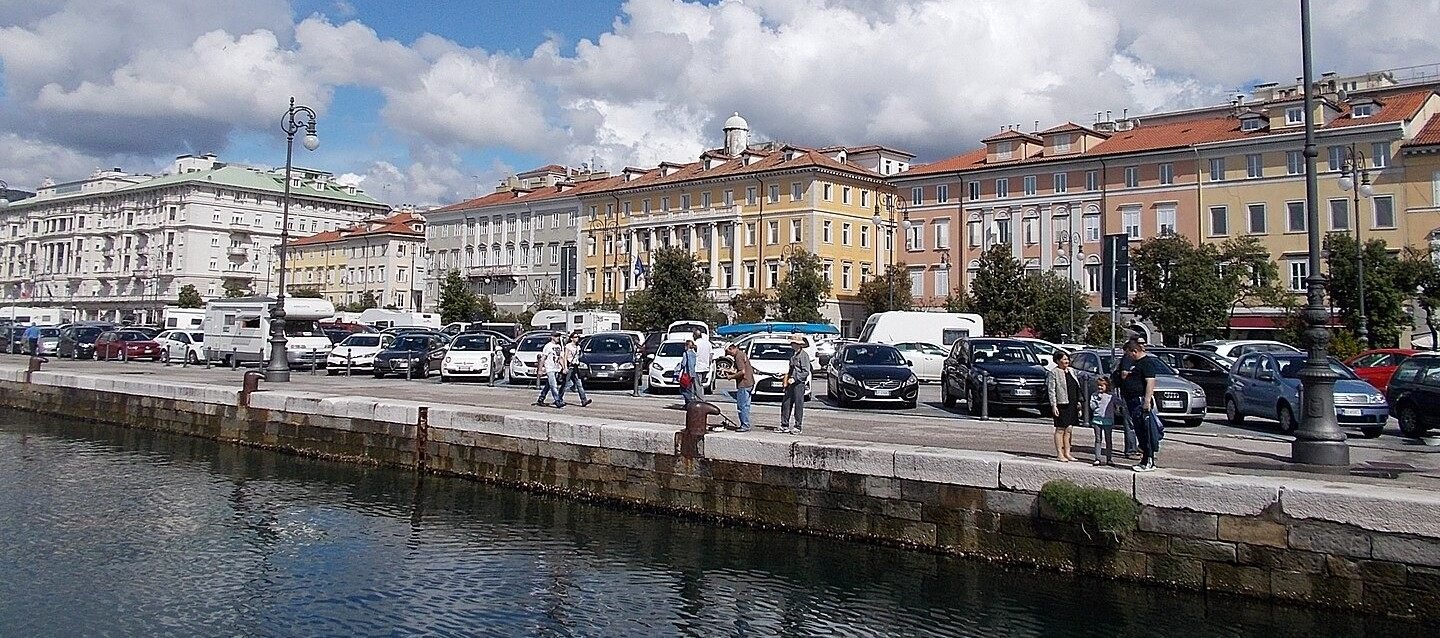
The Trieste waterfront and port area are ideal for scenic walks with unmatched views of the gulf and surrounding hills, making moving around pleasant even for those who want to take photos or stop at one of the many historic cafés.
Hilly areas
Some parts of the city, like the San Giusto hill, require more demanding walks. However, well-marked streets and paths allow you to enjoy unique views of the city and the sea.
Safety and livability
Trieste is generally safe and pedestrian-friendly. As in any city, it is advisable to be cautious in the evening or in isolated areas, but the city center and main tourist areas are well-frequented and well-lit.
Footwear and comfort
Streets in the center and along the waterfront are mostly paved or cobbled, while historic districts may have pebbles or stone blocks. Comfortable shoes are essential for moving easily and exploring the hilly areas without difficulty.
Urban experience
Walking through Trieste allows you to experience the city authentically: historic cafés, bookstores, markets, squares, and architectural corners become part of the travel experience, offering the chance to discover hidden gems and breathtaking sea views.
Public Transport
Public transport in Trieste allows easy movement between the historic center, the waterfront, residential neighborhoods, and the surrounding hilly areas. The system is mainly based on urban and suburban buses, with strategic connections to cover medium-long distances without using a private car.
Elevators and funiculars
Trieste is famous for its multi-level historic center and hills overlooking the city. To move around comfortably, you can use public elevators and funiculars, connected to several central and scenic areas. The main ones include the Opicina Funicular, the Castle Funicular, and the Barcola Elevator. These services provide quick connections between the waterfront, historic center, and hilly areas, saving time while offering panoramic views of the city and sea.
Urban and suburban buses
The bus network covers the entire city and surrounding areas, connecting the historic center, train station, port, and suburban districts. Main lines allow rapid transfers between tourist attractions and residential areas, while suburban lines link Trieste to nearby towns and the Karst region.
Main lines and strategic connections
Some lines run along central axes like Via Roma, Corso Italia, and the waterfront, facilitating quick transfers between the station, historic center, and port. Buses are particularly useful for visiting hilly areas or neighborhoods outside the pedestrian center.
Rail transport
Unlike other cities, Trieste does not have a metro. However, Trieste Centrale station is a key hub for regional and high-speed trains, allowing fast connections to Udine, Venice, and nearby towns.
Taxis and private transfers
Taxis and private transfer services are available at the station, airport, and city center. They are convenient for reaching hilly areas, the port, or locations less served by buses. It is advisable to check rates before departure.
Tickets and passes
The fare system includes single tickets, daily tickets, and passes valid throughout the urban network. Options are available for both tourists and residents. For up-to-date information on schedules and fares, consult the official website of Trieste public transport.
When to use public transport
Public transport is ideal for reaching suburban neighborhoods, the Karst, or hilly areas. In the historic center and along the waterfront, walking is often faster and allows you to enjoy views, squares, and the panorama over the gulf.
Getting Around by Car
Getting around Trieste by car can be useful in some situations, for example to reach locations outside the city center like Miramare Castle or the Carso area, but it requires attention for parking management, access restrictions, and traffic in some parts of the city.
Limited Traffic Zones (ZTL): in the historic center and in some areas near main attractions, there are limited traffic zones. Access to these areas is regulated and may require a permit from the municipality; entering with an unauthorized vehicle can result in automatic fines via cameras. It is recommended to check the ZTL zones before planning car trips.
Pedestrian areas and urban traffic: some streets in the center are pedestrian or subject to traffic restrictions, making it difficult to use the car directly near main attractions such as Piazza Unità d’Italia or the Rive. In these areas, it is generally better to park and continue on foot or by public transport.
Practical tips: since traffic and parking availability can be limited, especially during peak hours and tourist periods, it may be easier to leave the car in a structured parking lot or a less central area and reach the city center by bus or on foot.
Parking:
Trieste uses a colored line parking system. Blue lines are paid on weekdays and during regulated hours, while some white lines may be free or have time limits. Availability of spaces in the historic center is often limited, so planning ahead is recommended.
To make car travel easier, many visitors prefer structured parking lots or areas slightly outside the center, reachable also by city buses. Alternatively, parking in free residential areas and continuing on foot can be an option, but requires knowledge of local signage.
During special events such as the Barcolana regatta or other festivals, some streets may be closed to traffic and parking availability may decrease further: keep this in mind when planning your car itinerary.
🅿️ The box below shows our selection of strategic parking lots, chosen for their proximity to the starting points of our guides’ itineraries. This way, you can leave your car in central areas or well-connected to public transport, ideal to make the most of your visit.
| Parking | Type | Spaces |
|---|---|---|
| Area di parcheggio Molo 4 | Outdoor | 600 |
| Parcheggio Saba Maggiore | Multilevel | 590 |
| Interparking Italia Srl Park San Giusto | Multilevel | 300 |
| Parcheggio Saba Silos | Multilevel | 780 |
✅ For more options and online bookings, you can check the ParkingMyCar service, which allows you to find parking throughout the city.
FAQ
What is the best way to get around Trieste?
Combine multiple modes: walk in central areas, use buses and funiculars for longer distances, and limit car use to what’s necessary.
Is Trieste difficult to explore for first-time visitors?No, the city is compact and easily walkable, with excellent public transport connections.
📌 Learn more in the Overview section.
How do you reach Trieste city center from the airport?
By bus, taxi, private transfer, or rental car (approximately 30–40 minutes).
Is the Port of Trieste well connected to the city?Yes, taxis, buses, and pedestrian routes allow quick access to the city center.
Is Trieste well connected by train?Yes, Trieste Centrale connects the city to Udine, Venice, Milan, and other Italian cities.
📌 Learn more in the Getting There section.
What are the fastest public transport options in Trieste?
Buses cover the entire city, and funiculars or urban elevators are useful for overcoming elevation differences.
Are there integrated tickets?Yes, single, daily, and subscription tickets are valid on the urban and suburban network.
📌 Learn more in the Public Transport section.
Is it convenient to get around Trieste by car?
Only in certain situations, such as reaching Miramare Castle or the Karst region. In the historic center, cars are less practical due to ZTL zones and pedestrian areas.
Where is it best to park?In authorized public or private parking lots, preferably outside the historic center.
How to avoid fines and penalties?By checking ZTL zones, pedestrian areas, and allowed access times.
📌 Learn more in the Getting Around by Car section.