
Guide to Bari: what to see, do, eat
Travel Guide to the Best of the City


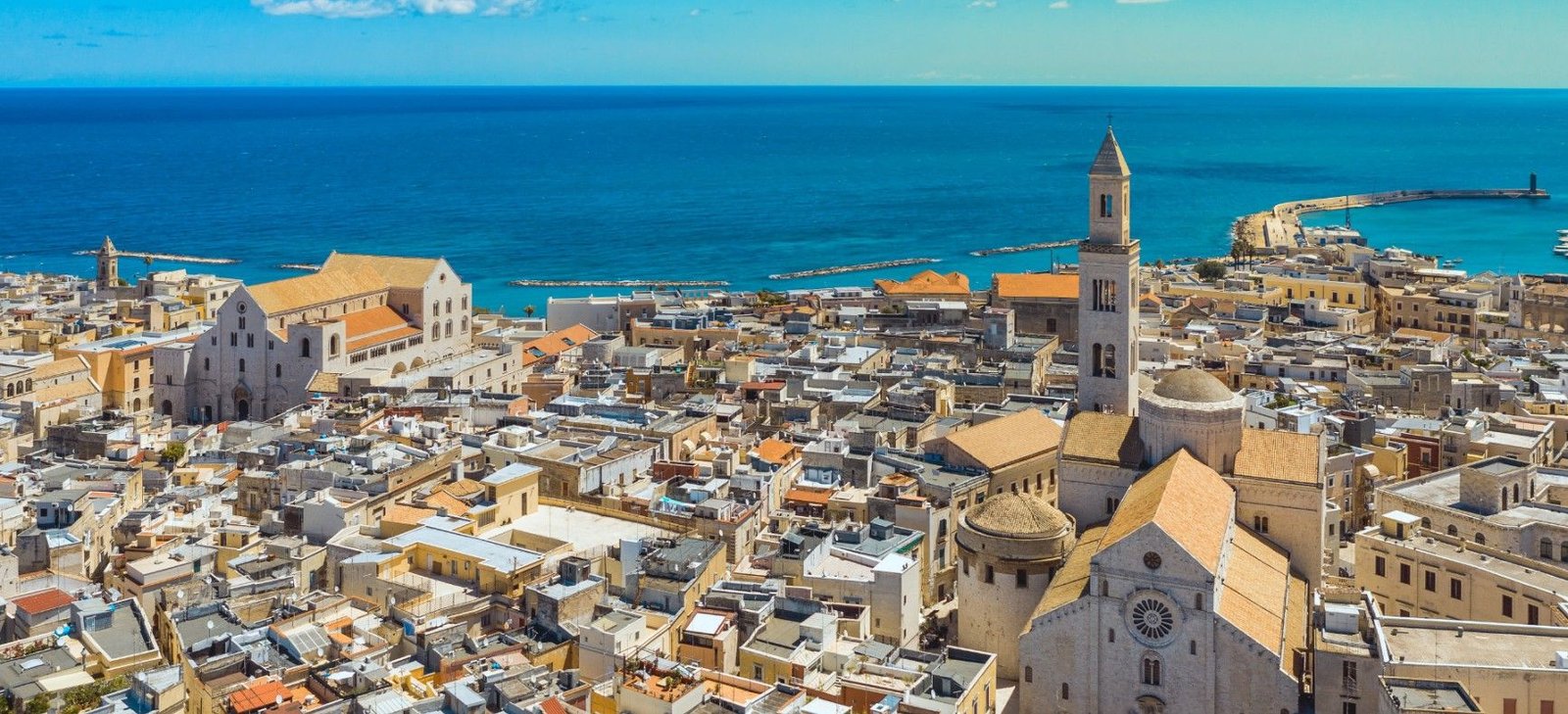
Bari is a fascinating city on the Adriatic Sea, where authentic traditions, picturesque alleys, and typical flavors blend between the historic center and the magnificent seafront.
📌 For a more complete overview of certain items, click on the links to detailed pages +🔗
- When to Go
- Getting There
- Getting Around +🔗
- Useful Tips
- What +🔗 and Where +🔗 to Eat
- Where to Sleep +🔗
Overview
📌 A large part of the references covered in this Overview section and in the Practical Info section, are summarized in the Orientation Table 📊 with further details on Wikipedia 🌐 and Google Maps ➡️ where available.
Bari, a lively capital city of Puglia overlooking the Adriatic Sea, is an authentic city rich in traditions, famous for its historic center, its port, and its local food culture. With over 300,000 inhabitants, it is one of the main cultural, commercial, and tourist hubs in Southern Italy.
GEOGRAPHY
Bari is located in the southeastern part of Italy, along the Adriatic Sea coast, and is the main urban center of Puglia.
The city stretches between the sea and the Apulian hinterland, in a predominantly flat area characterized by urban districts, modern neighborhoods, a commercial port, and scenic seafronts.
Its coastal position has made Bari one of the most important connection points between Southern Italy, the Balkans, and the eastern Mediterranean.
From satellite analysis of the territory, the main directions of the Bari area clearly emerge:
- North: the coastline continues towards seaside and port locations such as Molfetta, Giovinazzo and Barletta, with a highly urbanized area connected by the Adriatic rail and road network.
- North-West: the landscape opens towards the Apulian hinterland and the Alta Murgia area, characterized by countryside, small historic towns and connections to cities such as Andria and Foggia.
- West: routes towards the interior of the region develop, with connections to Matera, Altamura and Basilicata, crossing agricultural areas and hilly zones typical of the Murgia.
- South: the Adriatic coast continues towards popular tourist destinations such as Polignano a Mare, Monopoli and Brindisi, with cliffs, small harbors and seaside villages.
- South-East: the territory extends towards the Valle d’Itria and Salento, with connections to cities such as Lecce and locations famous for trulli, olive groves and seaside tourism.
- East: the Adriatic Sea opens up, a historic maritime link towards the Balkans, Greece and Eastern Europe. The port of Bari remains one of the main passenger and commercial hubs in Southern Italy.
The city is strategically connected to the main Southern Italy centers, including Napoli, Lecce, Brindisi and Taranto, as well as national connections to Roma, Bologna and Northern Italy.
Thanks to its international port, airport and high-speed rail network, Bari is one of the most important economic, tourist and commercial hubs of the Adriatic.
HISTORY
Bari is one of the most important cities in Southern Italy for its history, trade, and maritime connections, with ancient origins spanning the Peucetian era, Roman rule, Byzantine and Norman periods, up to the modern port and university city of today.
- Ancient origins: the area of Bari has been inhabited since pre-Roman times by the Peucetian people, who developed an early settlement thanks to its strategic position on the Adriatic Sea and its trade connections with the Eastern Mediterranean.
- Roman era: during Roman rule, Bari—known as Barium—became an important commercial port and a key hub along the Via Traiana, strengthening its strategic role in Adriatic maritime trade.
- Middle Ages: after the fall of the Roman Empire, the city experienced Byzantine, Lombard, and Saracen dominations, until the arrival of the Normans, who turned Bari into one of the main religious and commercial centers of Southern Italy, especially after the arrival of the relics of Saint Nicholas.
- Modern era: between the 16th and 18th centuries, Bari experienced urban and commercial development under Aragonese and later Bourbon rule, consolidating its role as a port and administrative center in Southern Italy.
- Contemporary era: with the unification of Italy and subsequent industrial and infrastructural development, Bari established itself as one of the main economic, university, and tourist centers of Puglia, becoming today a key connection point between Italy, the Balkans, and the Mediterranean.
MAIN ATTRACTIONS
The architecture of Bari reflects its long maritime and commercial history. The city center combines medieval, Romanesque, Norman, and modern elements, creating an authentic urban landscape made of historic alleys, squares, seafronts, and 19th-century districts:
- Basilica di San Nicola: one of the main religious symbols of the city and an important pilgrimage destination, famous for its Romanesque architecture and for housing the relics of Saint Nicholas.
- Castello Normanno-Svevo: an imposing medieval fortress overlooking the old town, built in the Norman period and later expanded by Frederick II.
- Cattedrale di San Sabino: a historic religious building in the heart of Bari Vecchia, characterized by elegant Romanesque forms and a long spiritual and cultural tradition.
Bari also offers an important cultural and museum scene:
- Teatro Petruzzelli: one of the most important opera houses in Italy, a symbol of Bari’s cultural life and venue for shows, concerts, and operas.
- Museo Archeologico di Santa Scolastica: an important exhibition space dedicated to the ancient history of the city and Puglia, with artifacts that tell the origins of the region.
- Pinacoteca Corrado Giaquinto: one of the main art museums in Puglia, featuring works ranging from the Middle Ages to modern art.
See also Experiences in Bari: Tours, Tickets and Useful Info
PARKS AND NATURE
Although Bari is a highly urbanized city developed along the Adriatic coast, it offers some green areas and natural spaces that allow for moments of relaxation through nature, walks, and outdoor activities.
- Parco naturale regionale Lama Balice is one of the main natural areas in the Bari metropolitan region. The park develops along a karstic “lama” typical of the Apulian territory and is characterized by Mediterranean vegetation, nature trails, and biodiversity areas, offering an important green space between Bari and Modugno.
- Urban parks and green areas located in different districts of the city help create spaces for relaxation and social life, offering areas dedicated to walking, outdoor activities, and breaks from the urban environment.
- Inland Bari territory around the city features countryside, olive groves, and landscapes typical of central Puglia, allowing visitors to discover a natural environment closely linked to the region’s agricultural traditions.
SEA AND BEACHES
Bari has a direct and continuous relationship with the sea, expressed especially through its seafronts and urban beach areas. The city experiences the sea as an integral part of daily life, with scenic walks, public spaces, and easily accessible beaches.
- Lungomare Araldo di Crollalanza is one of the most elegant and representative stretches of the city. Characterized by wide sidewalks, palm trees, and historic buildings, it is one of the symbolic places of Bari’s promenades and offers a continuous sea view.
- Lungomare Nazario Sauro extends along a wide coastal area, very popular with both residents and tourists. It is a lively urban space, ideal for walks and outdoor activities overlooking the Adriatic Sea.
- Pane e Pomodoro is the city’s main urban beach, a free-access beach easily reachable from the city center and very popular especially during the summer months.
- Lido San Francesco is one of the main equipped beach establishments in the city, well organized and ideal for those seeking comfort and full services.
- Spiaggia Torre Quetta is a modern seaside area that combines bathing facilities, public spaces, and events, making it one of the most dynamic spots in Bari’s summer life.
EVENTS & CELEBRATIONS
Bari is a lively city deeply connected to its religious, commercial, and cultural traditions. Throughout the year, it hosts events and celebrations that reflect its identity as a major Southern Italian hub, between the sea, faith, agriculture, and important national and international trade fairs.
- Festa di San Nicola (May) – The most important event in the city, dedicated to Bari’s patron saint. It takes place in May and combines religious celebrations, processions, folkloric events, and historical reenactments that attract pilgrims from all over the world.
- Fiera del Levante (September) – One of the most important trade fairs in the Mediterranean, it is a key reference point for economy, commerce, and innovation, featuring national and international exhibitors.
- Agrilevante (October) – An event dedicated to the agricultural sector and Mediterranean farming technologies, showcasing machinery and innovations linked to rural production and the agricultural world of Southern Italy.
📊 Orientation Table
In the table below you will find a summary of the main references, to best orient and organize your visit through our itineraries (see Itinerary Overview).
- Scroll the table down and to the right 📱🔄 Rotate your phone horizontally to get an overview of opening days, hours, prices of attractions, and for further details on Wikipedia 🌐 and Google Maps ➡️.
- ⚠️ Always check the opening days and hours of attractions through the Google Maps entries linked in the table. See also Itinerary Info.
- To see the explanation of each data column, click its title (e.g. Attractions Index, Ratings, Org, etc.) at the top of the table.
⏳ Caricamento tabella in corso…
📌 This table is updated every 6–12 months.
🛡️ The tables on Tourplan360.com are original content protected by copyright © and monitored through anti-plagiarism tracking systems.
Itinerary Overview
All the attractions selected in the table have been included in the two main itineraries designed to visit Bari depending on the time available.
To make your choice easier, below you will find a summary of the routes with information on times, distances, and main highlights, so you can easily identify the most suitable experience.
BARI IN 1 DAY
If you only have one day available, the itinerary is designed to focus on the heart of the city, between Bari Vecchia, the main historical monuments, and the cultural areas of the center. It is a compact route that allows you to experience the essence of the city through history, spirituality, and urban life.
The route is entirely on foot, with a fairly intense pace and a total duration of around 10 hours, ideal for those who want to see as much as possible in a short time.
Go to Bari in 1 day: Travel itinerary
BARI IN 3 DAYS
With three days available, the itinerary allows you to experience Bari in a more complete way, alternating between the historic center, the Murat district, and the seafront. During the first two days, you explore the main monuments, squares, and museums of the city, while the third day is dedicated to scenic walks and sea views.
The route is spread over several days and allows for a more relaxed experience, with enough time to appreciate both the historical and modern coastal sides of the city.
Go to Bari in 3 days: Travel itinerary
Practical Info
WHEN TO GO
Bari can be visited throughout the year, but each season offers a different experience thanks to its Mediterranean climate, traditional events, and varying livability of urban spaces and the historic center. The choice of period mainly affects the relationship with the sea, temperatures, and tourist crowds.
- Spring (April–June): one of the best times to visit Bari, with mild temperatures and bright days. Ideal for exploring Bari Vecchia, the seafronts, and the squares, when the city is pleasant and not yet crowded with summer tourism.
- Summer (July–August): a hot and very lively season, with the city becoming especially vibrant in the evening hours. It is the period when the sea and urban beaches take center stage, but the heat can make daytime sightseeing more challenging.
- Autumn (September–October): a very balanced period, with still pleasant weather and fewer tourists compared to summer. It is ideal for visiting the historic center and experiencing the city in a more authentic and relaxed way.
- Winter (November–March): the quietest and least touristy season, with mild temperatures compared to northern Italy. The historic center remains fully visitable and the atmosphere is more local and authentic, although some seaside activities are reduced.
GETTING THERE
Bari is an important transport hub in Southern Italy and is easily accessible both nationally and internationally. The city is served by an airport, port, railway network, and road connections that make it accessible all year round.
- By air: Bari is served by Bari Karol Wojtyła Airport, the main airport in Puglia, with both domestic and international connections. From the airport, the city center can be reached by train, bus, and taxi in a relatively short time.
- By sea: the Port of Bari is one of the most important in the Adriatic Sea and connects the city with Greece, Albania, Croatia, and other Mediterranean destinations, as well as commercial and cruise routes.
- By train: Bari Centrale station is one of the main railway hubs in Southern Italy, with high-speed connections to Rome, Naples, Milan, and other Italian cities, as well as regional lines connecting the whole of Puglia.
- By car: Bari is connected to the motorway network via the A14 (Bologna–Taranto) and the SS16 Adriatica highway, allowing easy access to major cities in Southern and Central Italy. Urban traffic is generally smooth, with some restrictions in central areas.
✅ To search for or book a flight you can check Booking.com Flights.
✅ You can check routes, schedules, prices and buy train or bus tickets with Trainline.
✅ For car rentals you can refer to Booking.com Cars.
GETTING AROUND
Bari is a medium-sized city with a rather compact central area, which makes getting around fairly easy both on foot and by public transport. The urban mobility system allows easy movement between the historic center, the modern district, and the main points of interest.
- On foot: Bari Vecchia and the surrounding areas are easily explored on foot. Many main attractions, such as churches, squares, and historic alleys, are concentrated in a relatively compact area.
- Public transport: buses and urban connections managed by the local transport system allow travel between the city center, districts, and the train station. They are especially useful for reaching more peripheral or less central areas.
- Urban train and light rail: Bari has railway connections that facilitate travel between the airport, city center, and nearby towns, making access to main routes faster.
- Car and parking: Bari’s historic center is subject to a limited traffic zone (ZTL), so car access is regulated. It is advisable to park in areas outside the center and continue on foot or by public transport to visit the main attractions. In Table > Parking and Mobility the best parking solutions are indicated.
See also Getting around Bari: Info and Tips
USEFUL TIPS
Pour visiter Bari de la manière la plus confortable et organisée possible, voici quelques conseils pratiques qui peuvent vous aider à profiter pleinement de la ville et à optimiser votre expérience de voyage.
- Chaussures confortables : fortement recommandées, surtout pour explorer Bari Vecchia, où le centre historique est composé de ruelles étroites, de pavés irréguliers et de nombreuses zones piétonnes.
- Eau et protection solaire : pendant les mois les plus chauds, il est important d’apporter de l’eau et de la crème solaire, surtout lors des promenades dans le centre-ville et les zones urbaines exposées au soleil.
- Respect des lieux religieux : une tenue appropriée et un comportement respectueux sont exigés dans les églises et basiliques, notamment dans des lieux très fréquentés comme la Basilica di San Nicola.
WHAT TO EAT
Bari cuisine is one of the most authentic expressions of Puglian gastronomic tradition, characterized by simple ingredients, intense flavors, and a strong connection with both the sea and the land. Among the must-try dishes we find:
- Orecchiette con le cime di rapa: the symbolic dish of Bari and Puglia, made with handmade fresh pasta and seasonal greens, representing the essence of local cuisine.
- Focaccia barese: soft and slightly crispy, topped with cherry tomatoes, olives, and extra virgin olive oil, it is one of the most beloved and widespread street foods in the city.
- Tiella barese (rice, potatoes, and mussels): a traditional seafood dish combining simple ingredients and rich flavors linked to the coastal territory.
- Panzerotti: a typical Bari street food, fried or baked, filled with tomato and mozzarella, perfect as a quick snack in the city center streets.
- Ricotta forte: a strong and intense-flavored dairy product, used as a condiment or accompaniment in various traditional recipes.
- Extra virgin olive oil from Terra di Bari: a local excellence, essential in regional cuisine and the base of almost all traditional preparations.
Street food and seafood tradition: Bari is famous for its street food culture, especially in the historic center, where focaccia, panzerotti, and baked goods are consumed daily.
A distinctive feature is also the consumption of raw seafood, served in local markets and fish shops, with extremely fresh products such as sea urchins, mussels, and prawns, representing a true gastronomic tradition of the city.
See also What to eat in Bari
WHERE TO EAT
Bari offers a varied gastronomic scene that combines authentic Apulian tradition, seafood cuisine, and contemporary dining. From historic restaurants in the city center to modern trattorias, the city allows visitors to discover local flavors in different settings, all strongly connected to the territory.
- Ai 2 Ghiottoni, a historic restaurant in Bari, offers traditional Apulian dishes and seafood specialties in a classic and well-established setting.
- Ristorante Biancofiore, an elegant venue in the city center, combines contemporary cuisine with Mediterranean tradition, with a strong focus on high-quality ingredients.
- Ristorante Il Sale, known for its seafood cuisine and use of fresh ingredients, is one of the most appreciated options for those seeking authentic local flavors.
- Terranima, a restaurant that enhances traditional Apulian cuisine with a modern approach and a strong local identity.
- Da Donato, a typical trattoria offering simple and traditional Bari dishes in an informal and authentic atmosphere.
See also Where to eat in Bari
WHERE TO SLEEP
Bari offers a variety of accommodation options, from hotels in the historic center to modern properties in the new city areas and well-connected districts.
Choosing the right area to stay is important to fully experience the city and move comfortably between attractions, the sea, and services.

Here are some of the main areas to stay in Bari, selected for their location, convenience, and atmosphere:
- Bari Vecchia: the historic heart of the city, ideal for those who want to stay among narrow streets, squares, and major landmarks such as the Basilica di San Nicola and the Cathedral.
- Lungomare and Murat: a central and elegant area, perfect for those seeking convenience, shops, restaurants, and easy access to both the sea and the historic center.
- Madonnella: a residential neighborhood close to the sea and the city center, appreciated for its tranquility and good accessibility to main attractions.
- Central Station: a practical and functional option for those arriving by train or wanting easy connections to other cities in Puglia.
See also Where to sleep in Bari: Info and Tips
FAQ
Among the must-see stops are the Basilica di San Nicola, the Cathedral of San Sabino, the Castello Normanno-Svevo, and the historic center of Bari Vecchia.
📌 Read more in the section Main Attractions.
Are there parks or green areas in Bari?
Yes, among the main green areas are the Lama Balice Regional Natural Park, as well as several urban gardens and public spaces spread between the city center and outskirts.
📌 Read more in the section Parks and Nature.
Is Bari suitable for a short visit?
Yes, the historic center is compact and allows visitors to see the main attractions even on 1- or 3-day itineraries, with the possibility of extending the visit to the sea and surrounding areas.
📌 Read more in the section Itinerary Overview.
What is the best time to visit Bari?
Spring and autumn offer mild temperatures and ideal conditions for visiting the city, while summer is perfect for enjoying the sea as well.
Is Bari easy to visit?Yes, the historic center is easily walkable and the main tourist areas are well connected to each other.
📌 Read more in the section When to Go.
Which typical dishes should I try in Bari?
Local specialties include orecchiette with turnip greens, focaccia barese, panzerotto, and raw seafood, a true symbol of Bari’s maritime tradition.
📌 Read more in the section What to eat.
Where to eat well in Bari?The best areas for local cuisine are Bari Vecchia, the seafront, and the Murat district, where you can find trattorias, fry shops, and seafood restaurants.
📌 Read more in the section Where to Eat.
What is the best area to stay in Bari?
The historic center is ideal for experiencing the authentic atmosphere, while the seafront and Murat district offer more modern and convenient options.
Are there budget hotels in Bari?Yes, many budget accommodations are available, especially near the station and in well-connected areas close to the center.
📌 Read more in the section Where to Sleep.
Where can I find days, hours, and prices of attractions?
All information is available in the table in dedicated columns.
Where can I find links and online information about attractions?The table also contains direct links to Google Maps ➡️ and Wikipedia 🌐 for each attraction.
📌 Check the Orientation Table 📊
See also
- Guide to Bari
- Itineraries: 1d, 3d
- Experiences, Getting Around
- Eating: What & Where
- Where to Sleep