
Getting around Bologna: Info and Tips
Quick Guide to Getting Around the City


Bologna is a compact, orderly, and welcoming city, where getting around is generally simple and intuitive, especially if you know the main means of transport and the key areas of the historic center.
- Overview
- Getting There
- Airport +🔗
- Road, Train
- Getting Around on Foot
- Public Transport
- Getting Around by Car
- FAQ
See also:
- Guide to Bologna
- Itineraries: 1d, 3d, CT1, CT2
- See: Attractions
- Do: Experiences
- Eat: Where and What
- Getting Around, Pass, Stay
Overview
Getting around Bologna is generally easy and pleasant, thanks to the city’s compact layout and a well-organized historic center. Most of the main attractions are located within the city walls, making travel quick and intuitive even for first-time visitors.
The main recommendation is to prefer walking in the historic center and use public transportation to reach more distant neighborhoods, the train station, or university areas. The use of a private car is generally discouraged, especially in central areas.
To get oriented quickly, joining a guided walking tour or a free walking tour can be very helpful. These tours are ideal for understanding the city’s layout, porticoes, and main landmarks, while also receiving practical tips from local guides.
One important aspect to consider is the presence of a very extensive Limited Traffic Zone (LTZ): access to the historic center is regulated and monitored, with electronic gates active at various times. Those arriving by car should pay close attention to permits and consider park-and-ride facilities or parking areas outside the city walls.
Finally, Bologna is a predominantly flat city, a feature that makes it particularly suitable for cycling and the use of sustainable mobility services, which are increasingly widespread and well integrated with public transport.
Getting There
Bologna is one of the best-connected cities in Italy, easily reachable both from within the country and from abroad thanks to an efficient network of air, rail, and road connections. Its strategic location in Northern Italy makes it a key hub for travelers visiting for tourism, study, or work.
By plane
Bologna Guglielmo Marconi Airport (see detailed guide 🔗) is located about 6 km from the city center and is served by numerous domestic and international flights, including low-cost connections. From the airport, the city center can be reached via the Marconi Express, bus, taxi, private transfer, or rental car, with average travel times of 15–30 minutes.
✅ To search for or book a flight to/from Bologna, you can check Booking.com Flights.
By train
Bologna Centrale is one of Italy’s main railway stations and is connected to major cities via high-speed trains, Intercity, and regional services. From here, it is easy to reach the historic center, university area, and outlying neighborhoods by public transport or on foot.
✅ You can check routes, schedules, prices, and purchase tickets with Trainline.
By car
Bologna can be reached via the main highways of Northern Italy, including the A1, A13, and A14. Those arriving by car should consider the presence of an extensive Limited Traffic Zone (LTZ) in the historic center; it is advisable to use park-and-ride facilities or parking structures outside the city walls.
✅ For car rental, you can refer to Booking.com Cars.
By bus
Bologna is also connected to many Italian and European cities by long-distance buses. The main stops are located near the railway station and are well integrated with the urban public transport system.
✅ You can check routes, schedules, prices, and purchase tickets with Trainline.
By taxi or private transfer
Taxis and private transfer services allow you to reach Bologna from airports, train stations, or nearby cities in a direct and comfortable way. Travel times vary depending on the departure point and traffic conditions.
Getting Around on Foot
Walking is one of the best ways to explore Bologna, a compact, flat city that is perfectly suited for walking. The historic center is concentrated, and many of the main attractions are located within short distances of each other.
Historic center
The historic center of Bologna is ideal to explore on foot: areas such as Piazza Maggiore, Via Indipendenza, the Quadrilatero, Via Zamboni and the Two Towers area can be visited entirely without using public transport. Distances are short and orientation is easy.
The porticoes: a unique advantage
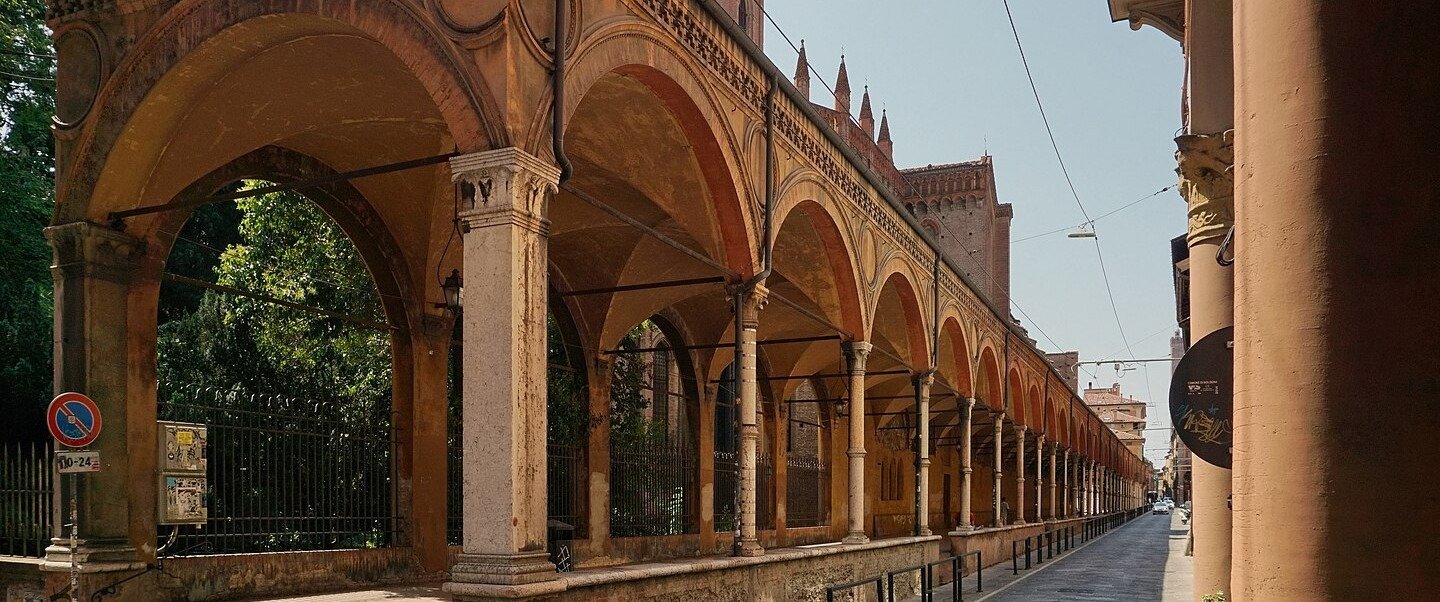
Bologna is famous for its porticoes, a UNESCO World Heritage Site, which make walking especially comfortable in every season. Walking under the porticoes allows you to move sheltered from rain and sun, making walking practical even in variable weather.
Distances and walking times
The main attractions in the center are easily reachable on foot: for example, it takes about 5 minutes to walk between Piazza Maggiore and the Two Towers, while from the railway station to the heart of the historic center it takes around 15–20 minutes.
Safety and livability
Bologna is generally a safe and pedestrian-friendly city. As in any large urban center, it is advisable to pay attention in crowded areas and during evening hours, especially near the station and along the busiest streets.
Footwear and comfort
The streets of the historic center alternate between asphalt, cobblestones and stone surfaces. Comfortable shoes are recommended to move easily, especially if you plan to walk for long periods under the porticoes or visit several neighborhoods in the same day.
Urban experience
Walking around Bologna allows you to experience the city in an authentic way: historic shops, bookstores, markets, cafés under the porticoes and architectural views make walking an integral part of the travel experience.
Public Transport
Bologna’s public transport system allows easy travel between the historic center, residential neighborhoods, and peripheral areas. The transport network is mainly based on urban and suburban buses, offering efficient solutions for medium- to long-distance trips without the need for a car.
Urban and suburban buses
The bus network covers the entire city extensively and represents the main form of public transport. Lines connect the historic center with the railway station, outer districts, and major points of interest. During peak hours, the service may be affected by traffic, but overall it remains reliable.
Main lines and strategic connections
Some routes run along the city’s most important axes, such as Via Indipendenza and the ring roads, making it easy to move quickly between the railway station, the historic center, and university areas. For visitors, buses are particularly useful for reaching less central districts.
Rail transport
Unlike other large Italian cities, Bologna does not have an urban metro system. However, the railway station is a key hub and allows the use of regional trains for quick trips to nearby towns or surrounding areas.
Taxis
Taxis are available in major squares, at the railway station, and in tourist areas. They are a convenient option in the evening, for direct trips, or when traveling with luggage. It is advisable to check fares or request a cost estimate before departure.
Tickets and passes
The fare system includes single tickets, daily tickets, and passes valid across the entire urban network. These options are useful for those planning to use public transport frequently during their stay. For up-to-date information on fares and schedules, it is recommended to consult the official public transport website.
When public transport is most useful
Public transport is particularly suitable for reaching peripheral areas, university zones far from the center, exhibition grounds, and residential neighborhoods. In the historic center, however, walking is often faster and more efficient.
Getting Around by Car
Getting around by car in Bologna can be useful in certain situations, but it requires attention, especially due to the presence of the Limited Traffic Zone (ZTL), numerous pedestrian areas and traffic during peak hours.
Limited Traffic Zone (ZTL)
The historic center of Bologna is entirely regulated by a ZTL active during specific hours, with access allowed only to residents and authorized vehicles. Unauthorized entry results in automatic fines via electronic gates. Before driving, it is essential to check schedules and restrictions.
Pedestrian areas and historic center
Many central areas, especially around the historic porticoes, Piazza Maggiore and the main shopping streets, are pedestrian-only or have heavily restricted traffic. In these cases, it is advisable to park outside the center and continue on foot or by public transport.
Practical driving tips
Driving in Bologna is generally more orderly than in other large cities, but it is still advisable to pay attention to ZTL signs, reserved lanes and electronic controls. Car use is mainly recommended for arrivals, departures or trips to peripheral areas.
⚠️ City 30 and road safety
Bologna has extended the City 30 concept across much of the city: the 30 km/h speed limit now applies to about 70% of urban roads, including many streets in the historic center. The goal is to improve safety, reduce noise and pollution, and promote sustainable mobility with bike lanes and pedestrian areas. Only some main roads maintain the 50 km/h limit.
Stops and Parking
The city offers numerous public and multi-storey car parks, many located near the historic center. In the box below we highlight five selected car parks: four centrally located and one outside the center, ideal as a park-and-ride facility.
⚠️ White and blue parking lines
In Bologna, white lines do not indicate free parking: they are generally reserved for residents with permits or subject to a parking disc. Only in very rare cases, clearly indicated by signs, is free parking allowed. Blue lines are paid from Monday to Saturday, from 8:00 a.m. to 8:00 p.m., and free in the evening, at night and on public holidays. Always checking vertical signage helps avoid unwanted fines.
🅿️ The box below shows our selection of strategic parking lots, chosen for their proximity to the starting points of our guides’ itineraries. This way, you can leave your car in central areas or well-connected to public transport, ideal to make the most of your visit.
✅ For additional options and online bookings, you can consult ParkingMyCar, which allows you to find parking throughout the city.
FAQ
What is the best way to get around Bologna?
The most effective approach is to combine different transport options: walk in the historic center, use public transport for longer distances, and limit car use to when it is truly necessary.
Is Bologna easy to explore for first-time visitors?Yes, the city is compact and well organized. Knowing the pedestrian areas and main landmarks makes getting around intuitive.
📌 Learn more in the Overview section.
How do you reach Bologna city center from the airport?
From Guglielmo Marconi Airport, you can reach the city center by Marconi Express, bus, taxi, private transfer, or rental car.
Is Bologna’s train station well connected to the rest of Italy?Yes, Bologna Centrale is served by high-speed trains, Intercity, and regional services from all over Italy, making travel within the city and to nearby areas very easy.
📌 Learn more in the Getting There section.
What are the main public transport options in Bologna?
Urban and suburban buses form the main public transport network. There is no underground metro yet, but regional trains quickly connect nearby areas.
Is it convenient to use public transport in the historic center?Walking is often faster, but public transport is useful for reaching peripheral areas, university districts, or the exhibition center.
Are there integrated tickets for multiple transport options?Yes, single tickets, day passes, and subscriptions valid across the entire urban network are available.
📌 Learn more in the Public Transport section.
Is it worth getting around Bologna by car?
Only in certain situations. Traffic, ZTL zones, pedestrian areas, and speed limits often make cars impractical in the historic center.
Where is the best place to park?In authorized public or multi-storey car parks, preferably outside the historic center, or in park-and-ride facilities when using public transport.
How do white and blue parking lines work?White lines are generally reserved for residents or regulated by parking discs, while blue lines are paid parking from Monday to Saturday (8 am–8 pm) and free in the evening, at night, and on public holidays. Always check signage to avoid fines.
What is “City 30”?It is a city-wide project that introduced a 30 km/h speed limit across most of Bologna (about 70%), aiming to improve safety, reduce noise and pollution, and promote sustainable mobility. Only a few main roads retain the 50 km/h limit.
📌 Learn more in the Getting Around by Car section.
See also
- Guide to Bologna
- Itineraries: 1d, 3d, CT1, CT2
- See: Attractions
- Do: Experiences
- Eat: Where and What
- Getting Around, Pass, Stay
Other Destinations
🔐 Some images on this page are used under Creative Commons licenses:
By PROPOLI87 – Florence, panoramic view from Piazzale Michelangelo – Own work – CC BY-SA 4.0 – Wikimedia Commons
By Kasa Fue – Venice, aerial view of the Grand Canal – Own work – CC BY-SA 4.0 – Wikimedia Commons
By https://www.pexels.com/u/ghostpresenter/ – Milan, Porta Nuova skyline – CC0 – Public Domain – Wikimedia Commons
By Armin Kleiner – Bologna, portico on Strada Maggiore overlooking the Basilica of Santa Maria dei Servi – CC BY-SA 4.0 – Wikimedia Commons