
Bologna Complete Tour – Part 1: travel itinerary
What to see, opening hours, prices, map


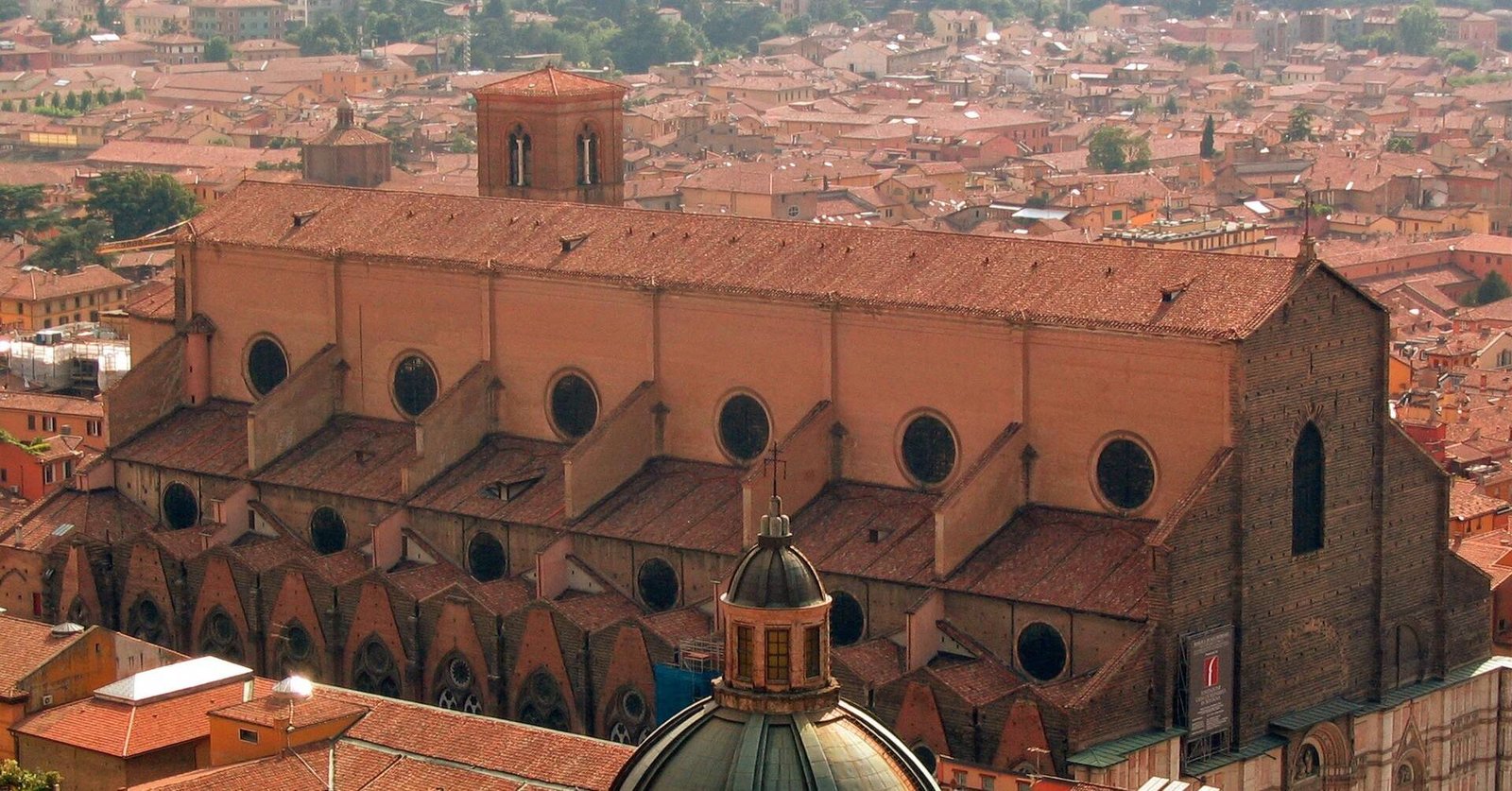
The monumental side façade of the unfinished Basilica di San Petronio, featured in the panoramic photo above, introduces this first part of the Complete Tour of Bologna.
- 📍 North Area and Montagnola
- 📍 Heart of the Historic Center
- 📍 Santo Stefano and Quadrilatero
- 📍 San Domenico and Carducci
See also:
- Complete Tour 2
- Guide to Bologna
- Itineraries: 1d, 3d, CT1
- See: Attractions
- Do: Experiences
- Eat: Where and What
- Getting Around, Pass, Stay
Overview
Bologna Complete Tour is a true 360-degree analysis of the city’s attractions, aimed at satisfying three key aspects:
- Going beyond mass tourist circuits
- Highlighting many hidden gems
- Experiencing the very essence of the city
This tour is designed both for those visiting the city for the first time and wishing to explore it in depth, and for anyone who has already been to Bologna (or even Bologna residents themselves) who wants to discover something new.
The itinerary is organized into eight routes evenly distributed between Part 1 and Part 2, of which seven are entirely dedicated to the historic center, and a final section designed to explore attractions located outside the city walls, therefore not reachable on foot.
📌 All walking routes are connected (shared stop 🧩), so you always have continuity if you want to skip one or more stops. See also Itinerary Info.
Routes: Maps, Descriptions, Details
NORTH AREA AND MONTAGNOLA
- Open Route Map📍
- Distance: 1,7* km on foot
- Time: 0,25* min. on foot
- Visit duration: 3 hours
- Stops: 10 main (X →I-X)* + 6 secondary
- Porta Galliera (X) → Scalinata del Pincio (A) → Parco della Montagnola (B) → Piazza VIII Agosto (C) → La Piccola Venezia (D) → Monumento a Giuseppe Garibaldi (E) → Teatro Arena del Sole (F) → Cattedrale Metropolitana di San Pietro (G) → Biblioteca Salaborsa (H) → Fontana del Nettuno (I-X)🧩
- For days, times, prices and other info see Itinerary Table 📊
* These values may differ from those shown on Google Maps, as they are continuously recalculated in real time. See also Itinerary Info and Navigator + See here for Shared Stop 🧩
Route Description
SUMMARY
This linear itinerary of 1.7 km to be covered on foot includes 10 main stops and 6 secondary stops, for a total visiting time of about 3 hours. Among the most interesting highlights are Porta Galliera, the charming Finestrella di Via Piella in the “Little Venice” area, the Cattedrale di San Pietro and the lively Piazza Nettuno area.
Expand STEP DETAIL ⬇️
⬇️ starting point
X. Porta Galliera
It is one of the ancient gates of the city walls of Bologna, located near the Central Station and Piazza XX Settembre. Built in the 14th century, it played a strategic role in the city’s defense, as one of the main entrances for those arriving from the north.
⬇️
A. Scalinata del Pincio
From Porta Galliera, we head towards the majestic Scalinata del Pincio, which connects Piazza XX Settembre with Parco della Montagnola. Built in the 19th century, this staircase is decorated with elegant balustrades and scenic fountains, and is one of the most picturesque spots in the city.
⬇️
B. Parco della Montagnola
Continuing on, we immerse ourselves in Parco della Montagnola, the oldest public garden in Bologna, designed during the Napoleonic era. A green oasis in the heart of the city, ideal for a short break before continuing the itinerary.
⬇️
C. Piazza VIII Agosto
Just a few steps away opens Piazza VIII Agosto, a symbolic place for the city, named after the historic uprising against the Austrians in 1848. At the center of the square stands the Monumento ai caduti dell’8 agosto 1848, which commemorates the Bolognese who fought for freedom. Here you can also find La Piazzola, one of the largest and oldest markets in Italy, with hundreds of stalls offering clothing, accessories, and handmade products.
⬇️
D. La Piccola Venezia
Continuing on, we enter one of the most charming corners of Bologna: La Piccola Venezia. From a small hidden window in Via Piella, we can admire a glimpse of the Canale delle Moline, one of the few remaining visible stretches of water that once crossed the city.
✨ An unexpected moment of surprise in the heart of Bologna: a hidden view that completely changes the perception of the city.
⬇️
E. Monumento a Giuseppe Garibaldi
Leaving La Piccola Venezia behind, we reach the Monumento a Giuseppe Garibaldi, located in a strategic area of the historic center. This equestrian statue honors the hero of the Risorgimento, who played a fundamental role in the unification of Italy.
⬇️
F. Teatro Arena del Sole
A few steps away is the Teatro Arena del Sole, one of the most important theaters in Bologna, built in 1810 and now home to major theatrical and cultural performances. Its monumental façade and rich program make it an interesting stop for lovers of theater and performing arts.
⬇️
G. Cattedrale Metropolitana di San Pietro
We continue towards the Cattedrale Metropolitana di San Pietro, one of the most important places of worship in Bologna. This imposing church preserves valuable works of art and is flanked by its Campanile, which, at 70 meters high, is the tallest in the city. Inside the cathedral is also the Museo di San Pietro, which houses precious sacred artworks.
📌 the Museo di San Pietro can be visited by reservation. You will find the phone number in the Google Maps card accessible via the link in the table.
⬇️
H. Biblioteca Salaborsa
Our penultimate stop is the Biblioteca Salaborsa, a place of culture and gathering located inside Palazzo d’Accursio. In addition to its elegant and modern spaces, Salaborsa hides beneath its glass floor the archaeological excavations of an ancient Roman city, visible to the public.
✨ A striking visual contrast: between modern spaces and transparent flooring, the ancient city emerges beneath your feet.
⬇️
I/X. Fontana del Nettuno
The itinerary concludes with one of the most famous symbols of Bologna: the Fontana del Nettuno. This magnificent 16th-century masterpiece, created by Giambologna, dominates the square of the same name and represents the Pope’s power over all seas. It is one of the city’s most iconic landmarks and a perfect ending to our walk.
HEART OF THE HISTORIC CENTER
- Open Route Map📍
- Distance: 0,8* km on foot
- Time: 0,11* min. on foot
- Visit duration: 7 hours
- Stops: 10 main (I-X →I-X)* + 14 secondary
- Fontana del Nettuno (I-X) → Palazzo Re Enzo (A) → Palazzo del Podestà (B) → Piazza Maggiore (C) → Palazzo d’Accursio (D) → Torre dell’Orologio (E) → Palazzo dei Notai (F) → Basilica di San Petronio (G) → Museo Civico Archeologico di Bologna (H) → Teatro Anatomico (I-X)🧩
- For days, times, prices and other info see Itinerary Table 📊
* These values may differ from those shown on Google Maps, as they are continuously recalculated in real time. See also Itinerary Info and Navigator + See here for Shared Stop 🧩
Route Description
SUMMARY
This linear itinerary of 0.8 km to be covered on foot unfolds in the heart of Bologna’s historic center. The experience includes 10 main stops and 14 secondary stops, offering an in-depth visit among the city’s most iconic and historically rich places. The total duration is about 7 hours, ideal for calmly immersing yourself in monuments, museums, and unique views. Among the unmissable stops are Piazza Maggiore, the Basilica di San Petronio, Palazzo d’Accursio and the Archiginnasio, true symbols of historic Bologna.
Expand STEP DETAIL ⬇️
I/X. Fontana del Nettuno is a shared stop 🧩 – See final stop of the previous route
⬇️ starting point
A. Palazzo Re Enzo
Our itinerary begins at Palazzo Re Enzo, located in the heart of Piazza del Nettuno. Built in the 13th century, the palace takes its name from King Enzo of Sardinia, son of Emperor Frederick II, who was imprisoned here for over twenty years. Today it is one of the main venues for events and exhibitions in the city, but its history is still clearly visible in its majestic halls.
📌 Palazzo Re Enzo is not open to visitors and can only be accessed during special events.
⬇️
B. Palazzo del Podestà
Right next to it we find Palazzo del Podestà, one of the oldest buildings in Bologna. Built in the 13th century as the seat of the city government, it is famous for its acoustic vault: if two people stand at opposite corners and whisper, their voices carry perfectly, creating a surprising sound effect.
📌 Palazzo del Podestà is not open to visitors and can only be accessed during special events.
⬇️
C. Piazza Maggiore
We proceed to Piazza Maggiore, the beating heart of the city. This magnificent square is surrounded by historic buildings and represents the main meeting point for locals. Events, concerts, and markets are held here, making the atmosphere always lively and dynamic.
⬇️
D. Palazzo d’Accursio
Overlooking the square is the majestic Palazzo d’Accursio, once the seat of the city government and today the Bologna City Hall. Inside, you will find the Collezioni Comunali d’Arte, a museum that collects paintings, sculptures, and furnishings illustrating the city’s history through the centuries.
⬇️
E. Torre dell’Orologio – Inside Palazzo d’Accursio is the Torre dell’Orologio, from which you can enjoy a spectacular view over Piazza Maggiore and the city rooftops. The climb is worth the effort, especially for those who want to admire Bologna from a privileged viewpoint.
⬇️
F. Palazzo dei Notai – In front of the Basilica di San Petronio stands Palazzo dei Notai, a splendid medieval building that was the seat of the powerful notaries’ guild. With its battlements and red-brick façade, it is a perfect example of Bolognese Gothic architecture.
📌 Palazzo dei Notai is not open to visitors.
⬇️
G. Basilica di San Petronio
Our next stop is the monumental Basilica di San Petronio. Although its façade remains unfinished, the interior is a Gothic masterpiece that houses the famous Cappella dei Magi, frescoed by Giovanni da Modena, with an impressive Last Judgment cycle. Next to the basilica, the Museo Diocesano di San Petronio preserves relics and artworks connected to the cathedral’s history.
✨ Entering the Basilica di San Petronio means stepping inside one of the largest Gothic churches in Europe, where light and silence enhance every detail.
⬇️
H. Museo Civico Archeologico di Bologna
Leaving Piazza Maggiore, we head to the Museo Civico Archeologico, one of the most important museums in Italy. Here you can admire extraordinary Etruscan, Roman, and Egyptian artifacts. A few steps away is the evocative Portico della Morte, once connected to the ancient Hospital of Death, where the sick and pilgrims were received.
⬇️
I/X. Teatro Anatomico
We continue to the Archiginnasio, the ancient university building of Bologna. Inside you will find two unmissable spaces:
- The Teatro Anatomico, a 17th-century wooden hall used for anatomy lectures, decorated with Baroque statues and carvings.
- The Sala dello Stabat Mater, named after the performance of Rossini’s work and today housing ancient manuscripts and frescoes.
- The Biblioteca Comunale dell’Archiginnasio, one of the most prestigious libraries in Italy, with an incredible collection of ancient volumes.
✨ The Teatro Anatomico is one of the most scenic and unusual spaces in Italy: wood, science, and anatomy blend into a timeless theatre of knowledge.
📌 visits to the Biblioteca Comunale dell’Archiginnasio require advance booking. You can find the phone number in the Google Maps listing via the link in the table.
Piazza Galvani
Leaving the Archiginnasio, we arrive in Piazza Galvani, dedicated to the famous Bolognese scientist Luigi Galvani, pioneer in the study of animal electricity. His statue stands at the center of the square.
We pass through the Portico del Pavaglione (UNESCO World Heritage), one of the most elegant arcades in the city, which leads us to Piazza Cavour and its scenic porticoes along Via Farini (UNESCO World Heritage).
Before concluding our itinerary, we make a short stop at the Panchina Lucio Dalla, dedicated to the great Bolognese singer-songwriter who narrated Bologna through his music. Finally, we explore Galleria Cavour, Bologna’s luxury street, home to the most prestigious high-fashion boutiques.
SANTO STEFANO AND QUADRILATERO
- Open Route Map📍
- Distance: 1,4* km on foot
- Time: 0,19* min. on foot
- Visit duration: 6 hours
- Stops: 10 main (I-X →I-X)* + 7 secondary
- Teatro Anatomico (I-X) → Complesso Santa Maria della Vita (A) → Mercato di Mezzo (B) → Palazzo Pepoli Campogrande (C) → Palazzo della Mercanzia (D) → Basilica di Santo Stefano (E) → Casa Isolani e Le Tre Frecce (F) → Museo Ottocento Bologna (G) → Museo internazionale e biblioteca della musica (H) → Chiesa dei Santi Vitale e Agricola in Arena (I-X)🧩
- For days, times, prices and other info see Itinerary Table 📊
* These values may differ from those shown on Google Maps, as they are continuously recalculated in real time. See also Itinerary Info and Navigator + See here for Shared Stop 🧩
Route Description
SUMMARY
This linear itinerary of 1.4 km to be covered on foot takes you on a journey through Bologna along a route that includes 10 main stops and 7 secondary stops, for a total duration of about 6 hours, ideal for calmly exploring some of the most fascinating places in the city. Among the unmissable stops are the Complesso di Santa Maria della Vita, Mercato di Mezzo, the evocative complex of Santo Stefano and the Museo della Musica, up to the historic Chiesa dei Santi Vitale e Agricola.
Expand STEP DETAIL ⬇️
I/X. Teatro Anatomico is a shared stop 🧩 – See final stop of the previous route
⬇️
A. Complesso Santa Maria della Vita
Our journey begins in the heart of Bologna with a visit to the Complesso di Santa Maria della Vita, one of the city’s most evocative churches. Here you will find the Oratorio di Santa Maria della Vita, which houses the famous Compianto di Nicolò dell’Arca, a terracotta sculptural group of extraordinary emotional intensity. Just a few steps away, the Museo della Sanità e dell’Assistenza tells the story of historical healthcare in the city, with ancient medical tools and historical documents.
⬇️
B. Mercato di Mezzo
After this immersion in art and history, it’s time to discover the authentic flavors of Bologna at the Mercato di Mezzo. This covered market, located in the heart of the Quadrilatero, is the perfect place to taste local specialties, from tortellini to mortadella, in a lively and genuine atmosphere.
⬇️
C. Palazzo Pepoli Campogrande
Continuing our walk, we reach Palazzo Pepoli Campogrande, an elegant Baroque building featuring spectacular frescoes. A short distance away is the Museo della Storia di Bologna, an immersive experience that retraces the city’s past, from its Etruscan origins to the present day, through multimedia installations and historical collections.
⬇️
D. Palazzo della Mercanzia
A symbol of Bologna’s historical economic importance, the Palazzo della Mercanzia dominates Piazza della Mercanzia with its impressive Gothic architecture. Long the seat of the Chamber of Commerce, it represents the city’s deep connection with trade and craftsmanship.
⬇️
E. Basilica di Santo Stefano
One of the most evocative places in the city is the Complesso di Santo Stefano, also known as the Seven Churches. This fascinating religious complex is a true journey through time, with architectural elements ranging from the early Christian period to the Middle Ages. The Museo di Santo Stefano preserves valuable artifacts linked to the history of the complex. The visit ends with a walk in Piazza Santo Stefano (UNESCO World Heritage), one of the most picturesque squares in Bologna, surrounded by historic buildings and characteristic arcades.
⬇️
F. Casa Isolani e Le Tre Frecce
We move to Strada Maggiore, where Casa Isolani stands, one of the rare surviving examples of medieval wooden architecture in the city. Here you can find the famous detail of the Tre Frecce, three arrows embedded in the ceiling of the portico, linked to an ancient local tradition and various interpretations that add mystery and charm to the place.
⬇️
G. Museo Ottocento Bologna
For art lovers, the Museo Ottocento Bologna is an unmissable stop. Located in an elegant building, it houses a rich collection of 19th-century Bolognese artworks, including paintings and sculptures by local artists who shaped the Romantic and Realist periods.
⬇️
H. Museo internazionale e biblioteca della musica
We continue with a visit to the Museo internazionale e biblioteca della musica, housed in the beautiful Palazzo Sanguinetti. This museum preserves ancient musical instruments, rare scores, and documents related to Bologna’s musical tradition, with a special focus on the great composers who left their mark on the city.
⬇️
I/X. Chiesa dei Santi Vitale e Agricola in Arena
The itinerary concludes with a visit to the Chiesa dei Santi Vitale e Agricola, the oldest church in Bologna. Located in an area that once hosted a Roman arena, the church preserves architectural and decorative elements from the early Christian period, offering a final fascinating glimpse into the city’s religious origins.
✨ A simple and silent place where the religious origins of the city still feel intact.
SAN DOMENICO AND CARDUCCI
- Open Route Map📍
- Distance: 3,1* km on foot
- Time: 0,43* min. on foot
- Visit duration: 6 hours
- Stops: 10 main (I-X →I-X)* + 4 secondary
- Chiesa dei Santi Vitale e Agricola in Arena (I-X) → Museo civico d’arte industriale (A) → Basilica di Santa Maria dei Servi (B) → Palazzo Hercolani (C) → Porta Maggiore (D) → Casa Carducci (E) → Museo Morandi (F) → Chiesa di San Giovanni in Monte (G) → Basilica Patriarcale di San Domenico (H) → Reale Collegio di Spagna (I-X)🧩
- For days, times, prices and other info see Itinerary Table 📊
* These values may differ from those shown on Google Maps, as they are continuously recalculated in real time. See also Itinerary Info and Navigator + See here for Shared Stop 🧩
Route Description
SUMMARY
This linear itinerary of 3.1 km to be covered on foot follows a route made up of 10 main stops and 4 secondary stops, offering a rich journey through art, culture and history. The total duration is about 6 hours. Among the most interesting highlights are the Museo Civico d’Arte Industriale Davia Bargellini, the Basilica di Santa Maria dei Servi, Casa Carducci, the Museo Morandi and the Basilica di San Domenico, ending at the evocative Reale Collegio di Spagna.
Expand STEP DETAIL ⬇️
I/X. Chiesa dei Santi Vitale e Agricola in Arena is a shared stop 🧩 – See final stop of the previous route
⬇️
A. Museo Civico d’Arte Industriale Davia Bargellini
We begin this itinerary with a visit to the Museo Civico d’Arte Industriale Davia Bargellini, housed inside Palazzo Davia Bargellini. This museum offers a precious collection of antique furniture, ceramics, paintings, and musical instruments, showcasing the evolution of applied arts and Bolognese craftsmanship between the 17th and 19th centuries.
⬇️
B. Basilica di Santa Maria dei Servi
A few steps away, we immerse ourselves in the solemn atmosphere of the Basilica di Santa Maria dei Servi, a Gothic masterpiece with an elegant portico facing one of the most characteristic squares in the city. Inside the basilica are valuable works of art, including a Madonna and Child attributed to Cimabue.
✨ The Gothic portico introduces a suspended atmosphere, where the interior light makes every pictorial detail feel remarkably intimate.
⬇️
C. Palazzo Hercolani
Continuing along Strada Maggiore, we encounter the majestic Palazzo Hercolani, now the seat of the Faculty of Political Science of the University of Bologna. This 18th-century building is famous for its richly decorated interiors, especially the magnificent Sala degli Specchi, frescoed with mythological and allegorical scenes.
⬇️
D. Porta Maggiore
We then reach Porta Maggiore, one of the most important city gates, part of Bologna’s ancient medieval walls. From here began the historic Via Emilia, which connected Bologna to Rimini, making it a strategic point for trade and travel since Roman times.
⬇️
E. Casa Carducci
The next stop is Casa Carducci, the home of the famous poet Giosuè Carducci, now turned into a museum. Here we can admire manuscripts, memorabilia, and personal belongings of the poet. Inside the house is also the Museo del Risorgimento di Bologna, which collects documents and testimonies related to Italian unification. Near the house stands the Monumento a Giosuè Carducci, a monumental statue by sculptor Leonardo Bistolfi.
⬇️
F. Museo Morandi
Continuing toward the city center, we head to the Museo Morandi, dedicated to Giorgio Morandi, one of the most important Italian painters of the 20th century. The collection includes numerous paintings and etchings by the artist, renowned for his still lifes and his masterful use of light and color.
✨ A quiet and contemplative museum, where Morandi’s still lifes transform simplicity into pure visual poetry.
⬇️
G. Chiesa di San Giovanni in Monte
Our itinerary continues with a visit to the Chiesa di San Giovanni in Monte, an elegant Renaissance building known for its refined architecture and the frescoes preserved inside. Next to the church, the Museo di San Giovanni in Monte preserves precious artworks, including paintings and sculptures from ancient Bolognese monasteries.
📌 the Museo di San Giovanni in Monte is visitable by reservation. You will find the phone number in the Google Maps listing via the link in the table.
⬇️
H. Basilica Patriarcale di San Domenico
An unmissable stop of our tour is the Basilica di San Domenico, one of the most important places of worship in the city, housing the remains of Saint Dominic, founder of the Dominican Order. Inside the basilica are sculptural masterpieces by Niccolò dell’Arca and Michelangelo. Attached to the basilica, the Museo di San Domenico preserves liturgical objects, artworks, and documents related to the history of the order.
✨ Here sculpture reaches an almost theatrical level: the works of Michelangelo and Niccolò dell’Arca still seem “alive” within the sacred space.
⬇️
I/X. Reale Collegio di Spagna – We conclude our itinerary with a visit to the Reale Collegio di Spagna, one of the oldest and most prestigious institutions in Bologna. Founded in the 14th century to host Spanish students of the University of Bologna, this college still preserves splendid frescoes and a striking Gothic architecture.
📌 the Reale Collegio di Spagna is visitable on request. You will find the phone number in the Google Maps listing via the link in the table.
Eating
During this tour in Bologna, we recommend alternating visits with enjoyable food breaks, to discover one of the richest culinary traditions in Italy. Between stops, you can taste great classics such as tagliatelle al ragù, tortellini in brodo and cotoletta alla bolognese, but also other typical specialties like lasagna verde al forno, gramigna with sausage and the traditional friggione. There are also plenty of street food options in the historic center, including crescentine, tigelle and local cured meats (see also What to eat in Bologna).
The itinerary is perfectly suited for several strategic stops distributed along the different routes:
- In the first route, between Montagnola and via Indipendenza, you can stop at Trattoria Serghei, ideal for authentic and no-frills cuisine.
- In the second route, in the heart of Piazza Maggiore, a break at Tamburini is perfect for a quick lunch featuring local specialties.
- In the third route, between Quadrilatero and Santo Stefano, you can choose Ristorante da Nello for a more traditional experience in an elegant setting.
- In the fourth route, towards Porta Maggiore, a valid alternative is Trattoria di Via Serra, one of the most appreciated in the city, although slightly outside the center.
For more ideas and insights, also check Where to eat in Bologna.
Sleeping
To fully enjoy this first part of the Bologna Complete Tour, the ideal choice is to stay in the historic center, particularly between Piazza Maggiore, the Due Torri and via dell’Indipendenza. This area allows you to move entirely on foot along all the tour routes, experiencing the city both during the day among monuments and museums, and in the evening among restaurants, illuminated squares and a lively, authentic atmosphere.

Alternatively, you can choose a strategic location close to the different tour itineraries:
- For the first route, the Central Station and Montagnola area is ideal for convenience and connections.
- For the second route, the Piazza Maggiore and Quadrilatero area is the most central, convenient and full of services.
- For the third route, the Strada Maggiore and Santo Stefano area offers an elegant and historic atmosphere in the heart of the city.
- For the fourth route, the area between Via Zamboni and Porta Maggiore is perfect for those looking for a young, university and dynamic environment.
For more information and practical tips, you can also check Where to sleep in Bologna: Info and Tips.
📊 Itinerary Table
The following table shows all the stops of the four routes of the Bologna Complete Tour – Part 1, to help you best organize your visit.
- Scroll the table down and to the right 📱🔄 Rotate your phone horizontally to get an overview of opening days, hours, prices of attractions, and for further details on Wikipedia 🌐 and Google Maps ➡️.
- ⚠️ Always check the opening days and hours of attractions through the Google Maps entries linked in the table. See also Itinerary Info.
- To see the explanation of each data column, click its title (e.g. Attractions Index, Ratings, Org, etc.) at the top of the table.
⏳ Caricamento tabella in corso…
📌 This table is updated every 6–12 months.
🛡️ The tables on Tourplan360.com are original content protected by copyright © and monitored through anti-plagiarism tracking systems.
FAQ
Yes. The four itineraries of Bologna Complete Tour – Part 1 are connected to each other, so you can remove stops or change their order while always maintaining continuity of movement. This allows you to adapt the route based on your interests and the time you have available.
📌 See also Itinerary Info
Can these itineraries be done on foot?
Yes, all four itineraries in Part 1 are designed to be completed on foot, as they are entirely focused on the historic center of Bologna.
📌 See also Getting around Bologna
Is it worth booking the main attractions in advance?
During peak tourist periods, it is advisable to book in advance or join guided tours to avoid queues and secure entry.
How much time is needed to complete Part 1 of the tour?
Part 1 of the Bologna Complete Tour requires approximately 22 hours of visits.
Where can I find opening days, hours, and prices for attractions?
All updated information is available in the Itinerary Table 📊, with direct links to Google Maps and Wikipedia for further details.
See also
- Complete Tour 2
- Bologna in 1 Day
- Bologna in 3 Days
- Guide to Bologna
- See: Attractions
- Do: Experiences
- Eat: Where and What
- Getting Around, Pass, Stay
Other Destinations
🔐 Some images on this page are used under Creative Commons licenses:
By PROPOLI87 – Florence, panoramic view from Piazzale Michelangelo – Own work – CC BY-SA 4.0 – Wikimedia Commons
By Kasa Fue – Venice, aerial view of the Grand Canal – Own work – CC BY-SA 4.0 – Wikimedia Commons
By https://www.pexels.com/u/ghostpresenter/ – Milan, Porta Nuova skyline – CC0 – Public Domain – Wikimedia Commons
By ZeWrestler (presumed attribution) – Bologna, Basilica of San Petronio seen from the Asinelli Tower – Presumed own work – Pubblico dominio – Wikimedia Commons