
Turin in 3 days: Travel itinerary
What to see, opening hours, prices, map


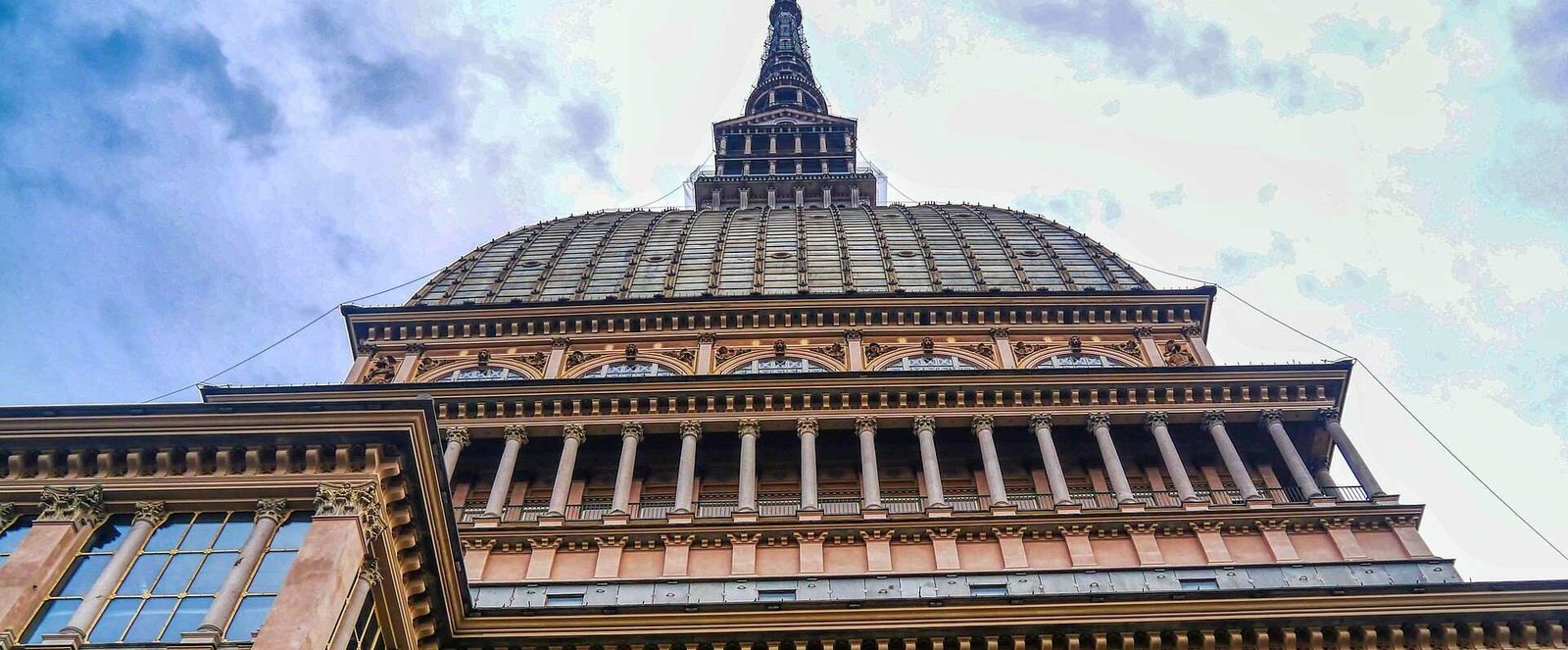
The close-up view above of the Mole Antonelliana, the undisputed symbol of Turin, is the perfect introduction to this Turin in 3 Days itinerary.
See also:
- Turin in 1 day
- Guide to Turin
- Itineraries: 3d, CT1, CT2
- See: Attractions
- Do: Experiences
- Eat: Where and What
- Getting Around, Pass, Stay
Route Description
Visiting Turin in three days is ideal to enjoy the city with the right balance of art, history, and relaxation. This 5.5 km fully pedestrian itinerary has been designed to be comprehensive but not tiring, with about 6 hours of sightseeing per day.
The route, with 10 main stops and 25 secondary ones, includes most of Turin’s key attractions, including:
- Palazzo Reale, symbol of Savoy power
- Mole Antonelliana, icon of the city and home of the National Cinema Museum
- Museo Egizio, one of the most important in the world outside Egypt
- Palazzo Madama, ancient noble residence that preserves centuries of history
- Palazzo Carignano, birthplace of the first Italian Parliament
- La GAM Torino, the most important modern art gallery in Piedmont
Moreover, almost all UNESCO sites in the city are included along the route, making the cultural experience even richer. With a relaxed yet well-organized pace, Turin will surprise you with its elegance, its gastronomic tradition, and its lively atmosphere.
📌 The Google Maps route is the same for all 3 days
TURIN IN 3 DAYS
- Open Route Map📍
- Distance: 5.5 km on foot
- Time: 1 hr 18 min on foot
- Visit duration: 19 hours
- Stops: 10 main (X → I)* + 25 secondary
- Duomo di Torino (X) → Palazzo Reale di Torino (A) → Palazzo Carignano (C) → Mole Antonelliana (D) → Pinacoteca Albertina (E) → Museo Egizio di Torino (F) → Gallerie d’Italia Torino / Palazzo Turinetti (G) → GAM Torino (H) → Museo della Sindone (I)
- For days, times, prices and other info see Itinerary Table 📊
* These values may differ from those shown on Google Maps, as they are continuously recalculated in real time. See also Itinerary Info and Navigator + See here for Shared Stop 🧩
Steps Details
📌 All the stops summarized here are structured in the Itinerary Table 📊 with days, opening hours, prices, and Wikipedia 🌐 and Google Maps insights.
Day 1
⬇️ starting point
X. Duomo di Torino
The journey begins at the Duomo di Torino (National Monument), the main church of the city, famous for housing the Cappella della Sacra Sindone, a Baroque masterpiece by Guarino Guarini and a symbol of Turin’s spirituality. The Duomo, dedicated to Saint John the Baptist, features an elegant Renaissance façade and a sober interior, distinguished by the presence of the Tomb of Blessed Pier Giorgio Frassati.
Attached to the Duomo is the Museo Diocesano di Torino, which preserves an important collection of sacred artworks, including paintings, sculptures, and ancient manuscripts. The museum is housed within the archaeological excavations of the Roman city of Augusta Taurinorum, allowing visitors to admire the remains of the ancient episcopal area and immerse themselves in the historical roots of the city.
✨ The light filtering into the Cappella della Sacra Sindone creates an almost unreal, suspended atmosphere that can only truly be felt inside the Duomo.
❌ Entrance depends on the opening hours of the Chapel of the Holy Shroud; access is not always guaranteed during religious celebrations.
⬇️
A. Palazzo Reale di Torino
Leaving the Duomo behind, the route continues toward Palazzo Reale di Torino, the most important residence of the Savoy dynasty and one of the finest examples of Baroque architecture in Italy. Declared a UNESCO World Heritage site, the palace stands out for its lavish interiors, decorated with gilded stuccoes, frescoes, and precious furnishings that testify to the power of the House of Savoy.
✨ Entering the Royal Palace means standing in front of one of the most spectacular Savoy residences in Europe.
Inside the Royal Palace complex, several priceless collections can be found:
- Galleria Sabauda, which preserves masterpieces by artists such as Mantegna, Van Dyck, Rembrandt, and Rubens, offering an overview of European painting from the Renaissance to the Baroque period.
- Museo di Antichità, which exhibits archaeological finds from the Piedmont region and from the Savoy private collections.
- Armeria Reale, one of the richest collections of weapons and armor in Europe, with pieces dating back to the Middle Ages and the Renaissance.
- Galleria Archeologica a Palazzo Reale, which explores the ancient history of the city through exhibitions dedicated to the Roman and pre-Roman periods.
Outside the palace are the Giardini Reali di Torino, designed by André Le Nôtre, the same architect responsible for the gardens of Versailles.
Walking through the elegant flowerbeds and fountains, visitors can admire the striking Monumento nazionale al Carabiniere, a tribute to the Carabinieri corps, and the scenic Fontana delle Nereidi e dei Tritoni, which adds an artistic touch to the entire complex.
✨ The Giardini Reali offer an elegant moment of relaxation in the institutional heart of the city, with perfect geometries and scenic perspectives.
❌ The entire royal complex requires a significant amount of visiting time, but this itinerary already accounts for approximately 270 minutes to explore the palace, museums, and armory calmly.
Book one of the recommended experiences here:
✅ Turin: skip-the-line guided tour of the Royal Palace
✅ Royal Palace of Turin: entry and guided tour
Day 2
⬇️
B. Palazzo Madama
The day begins with Palazzo Madama (UNESCO World Heritage), one of the city’s most emblematic residences, telling the story of Turin through the centuries. Originally a Roman fortress, it was transformed into the Castello degli Acaja and later became a sumptuous Baroque residence thanks to the work of Filippo Juvarra.
Inside the palace are important cultural institutions:
- Biblioteca Reale di Torino, home to precious manuscripts and drawings by Leonardo da Vinci, including the famous Self-Portrait.
- Aula del Senato di Palazzo Madama (National Monument), the historic seat of the first Senate of the Kingdom of Italy, a key location for Italian politics during the 19th century.
- Museo d’Arte Antica di Torino, which preserves an extraordinary collection of sculptures, paintings, and decorative arts from the Middle Ages to the Baroque period.
✨ The palace’s dual soul — medieval fortress and Baroque residence — is already clearly visible from the façade: two eras captured in a single glance.
❌ Some internal sections are highly museum-oriented and can be shortened in the case of a fast-paced itinerary.
Near Palazzo Madama stands the Archivio di Stato di Torino, an important institution preserving highly valuable historical documents related to the House of Savoy and Italian history.
Crossing Piazza Castello, the monumental heart of the city, visitors can admire the Teatro Regio, designed by Carlo Mollino and considered one of Italy’s leading opera houses. The square is also home to the Monumento al Duca d’Aosta, dedicated to General Emanuele Filiberto of Savoy.
For a break immersed in Turin’s traditions, visitors can stop at two historic cafés:
- Caffè Baratti & Milano, famous for its chocolates and elegant 19th-century atmosphere.
- Caffè Mulassano, birthplace of the tramezzino sandwich, preserving refined interiors and timeless charm.
✨ Sitting in a historic Turin café overlooking Piazza Castello is one of the most authentic experiences to enjoy in the city center.
⬇️
C. Palazzo Carignano
The itinerary continues toward Palazzo Carignano (UNESCO World Heritage), one of Turin’s Baroque jewels and a symbolic place of the Italian Risorgimento, as it was the seat of the first Parliament of the Kingdom of Italy. Today, the palace houses the Museo Nazionale del Risorgimento Italiano, which tells the story of Italy’s unification through memorabilia, documents, and period paintings.
✨ The undulating red-brick façade of Palazzo Carignano is one of the most unique examples of European Baroque architecture: it almost seems to “move” in the daylight.
❌ Access to the museum and historic rooms may be limited during peak hours and busy days.
In front of Palazzo Carignano lies Piazza Carignano, dominated by the Monumento a Vincenzo Gioberti, the philosopher and politician who played a major role in Italian unification. For an exclusive gastronomic experience, nearby visitors will find the Ristorante del Cambio, a historic restaurant frequented by Cavour and still considered one of the city’s most prestigious dining venues.
Continuing onward, the route reaches Piazza Carlo Alberto, one of Turin’s most scenic squares, dominated by the equestrian statue of the Monumento a Carlo Alberto, the king who initiated the process of national unification.
⬇️
D. Mole Antonelliana
The day concludes with a visit to the Mole Antonelliana, the undisputed symbol of Turin. Designed by Alessandro Antonelli as a synagogue, it now houses the Museo Nazionale del Cinema, one of the world’s most important museums dedicated to the seventh art. Through an interactive route, the museum allows visitors to discover the history of cinema, from the earliest magic lanterns to modern filmmaking technologies.
✨ We intentionally left the Mole as the final attraction of this second day because at sunset the panoramic view from the dome becomes especially breathtaking.
❌ The panoramic elevator can have long queues in the evening and at weekends.
❌ In this itinerary, approximately 60 minutes are allocated to the National Cinema Museum, but enthusiasts may need more time to explore all the museum’s installations and sections at a leisurely pace.
Book one of the recommended experiences here:
✅ Turin: National Cinema Museum and Mole Antonelliana Tour
✅ Turin: Cinema Museum and Mole Antonelliana Elevator Tour
✅ Turin: National Cinema Museum and Bus Tour
Day 3
⬇️
E. Pinacoteca Albertina
The day begins with a visit to the Pinacoteca Albertina, one of Turin’s most prestigious artistic institutions. Located inside the Accademia Albertina di Belle Arti, the gallery houses a rich collection of works ranging from the 15th to the 20th century, including paintings by artists such as Defendente Ferrari, Giuseppe Pietro Bagetti, and Francesco Hayez. In addition to painting masterpieces, the museum preserves precious drawings and engravings, offering an interesting overview of the evolution of art in Piedmont.
⬇️
F. Museo Egizio di Torino
The route continues with a visit to the Museo Egizio di Torino, considered one of the most important Egyptology museums in the world after the one in Cairo. With a collection of more than 30,000 artifacts, the museum allows visitors to explore the history of Ancient Egypt through statues, sarcophagi, papyri, and perfectly preserved funerary objects.
Among the most significant pieces are the statue of Ramses II, the Papyrus of the Gold Mines, and the evocative reconstruction of the tomb of Kha and Merit, offering a unique glimpse into daily life during the pharaonic era.
✨ Some rooms of the Egyptian Museum seem to transport you directly to Ancient Egypt, creating almost cinematic atmospheres.
✨ The close presence of monumental statues creates a visual impact that goes beyond a simple museum visit.
❌ During the middle hours of the day, the entrance can be very crowded, especially on weekends and public holidays.
❌ The visit can easily exceed the planned 2 hours if you follow the complete route.
Book one of the recommended experiences here:
✅ Turin Egyptian Museum: guided tour
✅ Turin Egyptian Museum: guided tour and priority entry
✅ Turin: small-group guided tour of the Egyptian Museum with priority entry
⬇️
G. Gallerie d’Italia Torino
Continuing along the itinerary, visitors arrive at Gallerie d’Italia Torino, housed inside the historic Palazzo Turinetti, the legal headquarters of Intesa Sanpaolo. The museum offers a fascinating exhibition route dedicated to contemporary art and photography, with particular attention to social and cultural themes. The elegantly restored rooms host permanent collections and temporary exhibitions, providing an innovative perspective on the relationship between art, finance, and society.
⬇️
H. GAM Torino
The fourth stop is dedicated to visiting the GAM – Galleria Civica d’Arte Moderna e Contemporanea di Torino, the city’s main modern art museum. The GAM preserves an extraordinary collection of works spanning from the 19th century to the present day, featuring masterpieces by artists such as Giovanni Fattori, Giacomo Balla, Giorgio De Chirico, and Lucio Fontana. The museum also offers spaces dedicated to photography, video art, and multimedia installations, making it an unmissable stop for contemporary art enthusiasts.
⬇️
I. Museo della Sindone
The final stop of the itinerary is the Museo della Sindone, a place that gathers documents and scientific studies related to the famous relic preserved inside the Duomo di Torino. The museum retraces the history of the Holy Shroud through reconstructions, photographs, and scientific analyses, offering an in-depth perspective on one of Christianity’s greatest mysteries.
Dinner
During your 3-day itinerary, each evening can become the perfect opportunity to discover Piedmontese cuisine in the historic city center, between Piazza Castello and Via Po, where you can taste some of the most iconic dishes of the local tradition.
- Vitello tonnato, a great Piedmontese classic served cold, elegant and delicate, perfect as an appetizer in any traditional dinner.
- Agnolotti del plin, typical stuffed pasta from the Langhe area, often served with roast sauce or butter and sage to enhance its rustic tradition.
- Bollito misto alla piemontese, the ultimate convivial dish, made of different cuts of meat served with the traditional regional sauces.
- Bagna cauda, an intense and social specialty based on garlic and anchovies, enjoyed with seasonal vegetables in a typical Piedmontese ritual.
- Bonet, a symbolic dessert of Turin tradition, made with cocoa, amaretti biscuits, and rum, with a soft texture and lingering taste.
See also What to eat in Turin
Among the most recommended restaurants in the center of Turin, ideal for one or more evenings of your itinerary, you will find some of the finest expressions of Piedmontese cuisine, blending tradition and contemporary cooking.
- Del Cambio, a historic fine dining restaurant in Turin, a symbol of the city’s haute cuisine, elegant and perfect for a refined gastronomic experience.
- Ristorante Consorzio, a benchmark for contemporary Piedmontese cuisine, offering traditional dishes reinterpreted in a modern way with great attention to the quality of ingredients.
- Tre Galline, one of the most historic trattorias in Turin, ideal for those seeking authentic flavors and traditional recipes in a warm and typical atmosphere.
- L’Acino, a small and carefully curated restaurant known for its creative Piedmontese cuisine and intimate atmosphere in the heart of the city.
- Scannabue Caffè Restaurant, informal atmosphere and authentic cuisine, highly appreciated for well-executed traditional dishes and excellent value for money.
See also Where to eat in Turin
Sleeping
To make the most of a Turin in 3 Days itinerary, choosing the right accommodation can truly make a difference, especially to reduce travel time and experience the city more smoothly between visits, museums, and evenings in the historic center.
The most strategic option remains the historic center, in particular the area between Piazza Castello, Via Po, and Piazza San Carlo: from here you can easily reach on foot most of the main attractions along the route, such as Palazzo Reale, Palazzo Madama, and the Mole Antonelliana, making the most of your time over the three days.

Alternatively, the area around Porta Nuova and San Salvario is a more dynamic and contemporary choice: well connected to the rest of the city, it offers a wide range of hotels, B&Bs, and restaurants, as well as a lively nightlife, ideal for those who want to combine cultural visits with leisure time.
For those seeking a more local and authentic experience, the Quadrilatero Romano area is also an excellent option, thanks to its historic venues, traditional restaurants, and a more intimate yet very characteristic atmosphere.
For more detailed advice on areas and accommodations, you can consult the complete guide Where to sleep in Turin: Info and Tips.
📊 Itinerary Table
In the table below you will find all the attractions included in the itinerary, designed to enhance and better guide your three-day visit to Turin:
- Scroll the table down and to the right 📱🔄 Rotate your phone horizontally to get an overview of opening days, hours, prices of attractions, and for further details on Wikipedia 🌐 and Google Maps ➡️.
- ⚠️ Always check the opening days and hours of attractions through the Google Maps entries linked in the table. See also Itinerary Info.
- To see the explanation of each data column, click its title (e.g. Attractions Index, Ratings, Org, etc.) at the top of the table.
⏳ Caricamento tabella in corso…
📌 This table is updated every 6–12 months.
🛡️ The tables on Tourplan360.com are original content protected by copyright © and monitored through anti-plagiarism tracking systems.
FAQ
You can open the Route Map 📍 directly from here. Alternatively, you can check the dedicated section with all the details.
📌 See the Route Description
How much time do I need to visit Turin in 3 days?
The itinerary allows you to visit the main attractions in about 19 hours, distributed across approximately 6 hours per day.
Can this Turin itinerary be done on foot?
Yes. The route is about 5 km long through the historic center.
📌 See also Getting around Turin: Info and Tips
Is it worth booking the main attractions in advance?
During peak tourist periods, it is advisable to book in advance or join guided tours to avoid queues and ensure entry.
📌 See also Experiences in Turin
Is it possible to do this itinerary in less time?
Yes. In less time you can visit only some of the main attractions. You can adjust the stops depending on your interests.
Where can I find opening days, times, and prices for the attractions?
All updated information is available in the dedicated itinerary table, which also includes direct links to Google Maps ➡️ and Wikipedia 🌐 for each attraction.
📌 See the Itinerary Table 📊
See also
- Turin in 1 day
- Complete Tour P1 + P2
- Guide to Turin
- See: Attractions
- Do: Experiences
- Eat: Where and What
- Getting Around, Pass, Stay
Other Destinations
🔐 Some images on this page are used under Creative Commons licenses:
By Maurizio Beatrici – Genoa, port and Lanterna from Castello d’Albertis – Own work – CC BY-SA 4.0 – Wikimedia Commons
By https://www.pexels.com/u/ghostpresenter/ – Milan, Porta Nuova skyline – CC0 – Public Domain – Wikimedia Commons
By Alexis Courthoud – Aosta, panoramic view of the Ancient Roman Theatre – Own work – CC BY-SA 4.0 – Wikimedia Commons
By Zairon – Turin, Mole Antonelliana seen from the street below – Own work – CC BY-SA 4.0 – Wikimedia Commons