
Colosseum in 1 day: what to see and complete itinerary
Travel guide, opening hours, prices, map


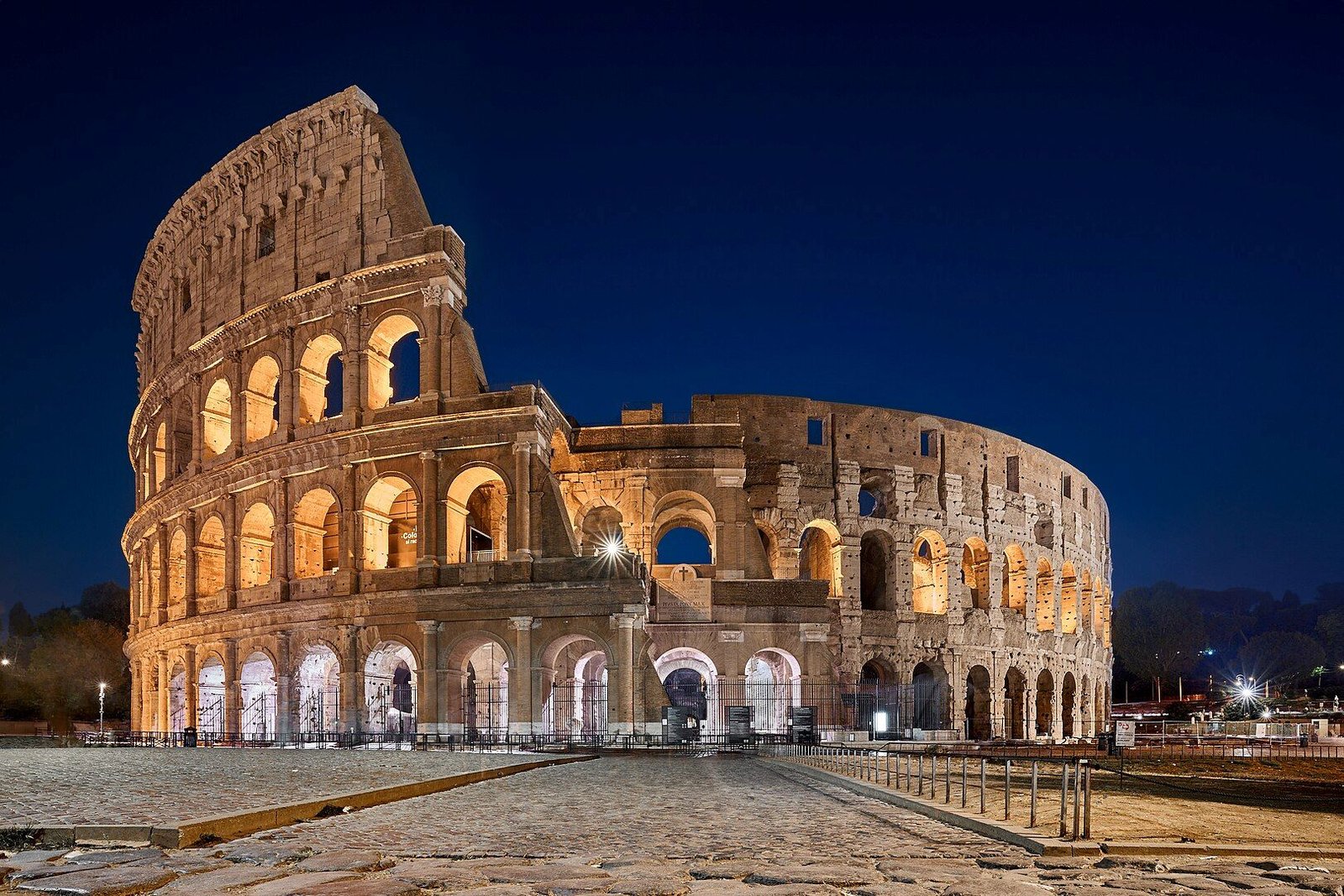
The magnificent image above, showing the Colosseum illuminated at dusk 📱🔄️, introduces this itinerary to discover one of the most iconic places in the world.
See also:
- Vatican in 1 day
- Guide to Rome
- Itineraries: 1d, 3d, CT1, CT2
- See: Attractions
- Do: Experiences
- Eat: Where and What
- Getting Around, Pass, Stay
Route Description
This itinerary has been designed to allow you to visit in just one day some of the most representative archaeological attractions of ancient Rome.
The route, linear and entirely on foot, crosses the main areas of the Parco Archeologico del Colosseo, offering a complete experience of approximately 10 hours, from morning until late afternoon.
💡 We will start at 8:30 from the Foro Romano, chosen as a strategic starting point to avoid the busiest times at the Colosseo. After visiting the Domus Aurea, the route will lead us towards Rome’s iconic amphitheatre, with a following stop at the Palatino.
The itinerary ends at the Archaeological Area of the Circo Massimo, the final optional stop to complete an unforgettable day.
📌 As this is a unique experience and, for many, possibly a once-in-a-lifetime opportunity, we strongly recommend the Visite Guidate that we have carefully selected to enhance every aspect of your visit.
COLOSSEUM IN 1 DAY
- Open Route Map📍
- Distance: 3,5* km on foot
- Time: 0,51* min. on foot
- Visit duration: 10 hours
- Stops: 7 main ones (X → F)* + 36 secondary ones
- Foro Romano (X) → Domus Aurea (A) → Colosseo (B) → Domus Tiberiana (C) → Domus Flavia / Palazzo di Domiziano (D) → Stadio Palatino / Palazzo di Domiziano (E) → Area Archeologica Circo Massimo (F)
- For days, times, prices and other info see Itinerary Table 📊
* These values may differ from those shown on Google Maps, as they are continuously recalculated in real time. See also Itinerary Info and Navigator + See here for Shared Stop 🧩
Steps Details
📌 All the stops summarized here are structured in the Itinerary Table 📊 with days, opening hours, prices, and Wikipedia 🌐 and Google Maps insights.
Foro Romano
⬇️ starting point
The Foro Romano was the beating heart of the political, religious and commercial life of ancient Rome. Located between the Palatino and the Campidoglio, it hosted temples, basilicas, triumphal arches and other buildings that represented Roman power and culture.
The Foro was a meeting place for citizens, senators, merchants and priests who gathered for business, religious ceremonies and political discussions. Among the most important structures are:
- Tabularium: Located on the Campidoglio, the Tabularium was the state archive of ancient Rome. From its position, visitors can enjoy a panoramic view of the Foro Romano.
- Carcere Mamertino: This ancient prison is known for having hosted, according to tradition, Saint Peter and Saint Paul before their martyrdom.
- Tempio di Saturno and Arco di Settimio Severo: Two of the most symbolic monuments of the Foro, they represent respectively the wealth of Rome and imperial greatness. The Arco di Settimio Severo celebrates the victories of the emperor in the East.
- Portico degli Dei Consenti and Colonna di Foca: The Portico degli Dei Consenti housed statues of the twelve Olympian deities. The Colonna di Foca, on the other hand, is one of the last monuments erected in the Foro, dedicated to the Byzantine emperor Foca.
- Curia Iulia and Basilica Giulia: The Curia was the seat of the Roman Senate, while the Basilica Giulia was an important centre of judicial and political administration.
💡 We have deliberately started from the Foro Romano instead of the Colosseo, because one of the access ticket offices for the Parco Archeologico del Colosseo is located here, and it is usually much less crowded than the main one.
We recommend entering from here, where queues are often shorter compared to the main entrance of the Colosseo.
❌ The Foro Romano is much more complex than it may seem. A guided tour can make the difference between simply looking at ruins and understanding the heart of ancient Rome.
Book one of the recommended experiences here:
✅ Guided tour of the Colosseo arena, Foro Romano and Palatino
Domus Aurea
⬇️
The Domus Aurea (“Golden House”) was the magnificent residence built by Emperor Nero after the fire of Rome in 64 AD, on a vast area that included the current Colle Oppio and extended as far as the Palatino and the Celio.
Designed to impress, the villa was characterized by enormous spaces, ceilings decorated with extraordinary frescoes, marble statues and gilded decorations that reflected the light, making the residence resemble a “golden palace”.
Among its most iconic elements was the colossal octagonal hall with a dome and a system that allowed the room to rotate, recreating the movement of the sun.
This residence was not used for a long time: after Nero’s fall, the following emperors attempted to erase its memory, and some of its parts were even buried and reused as foundations for new constructions, including the Terme di Traiano.
Today, the Domus Aurea is only partially accessible, but guided tours allow visitors to discover some rooms and the magnificent frescoes, restored and preserved, which inspired Renaissance artists such as Raffaello.
✨ Entering the Domus Aurea is a completely different experience compared to open-air monuments.
❌ The temperature inside the site, even in summer, is quite low (10°). A sweatshirt is recommended even if it is very hot outside.
❌ Visits are available only at scheduled time slots: book in advance to avoid having to modify the entire itinerary.
Book one of the recommended experiences here:
✅ Guided tour of the Domus Aurea and virtual reality experience
Colosseo
⬇️
The Colosseo, whose real name is Anfiteatro Flavio, is the most famous symbol of ancient Rome. Built in the 1st century AD under the emperors of the Flavian dynasty, it could accommodate up to 50,000 spectators.
The Colosseo was mainly used for public spectacles, such as gladiator fights, hunts with exotic animals and executions.
This impressive amphitheatre, approximately 50 metres high and built entirely of stone and concrete, represented an engineering masterpiece of the Roman era, with a complex system of entrances, stairs and galleries for spectators.
Today, the Colosseo is one of the most visited tourist sites in the world, a testimony to the greatness and fascination of ancient Rome. By visiting it, you can explore the internal areas, including the arena and the underground passages, where gladiators and animals once waited to enter the scene.
- Museo del Colosseo: the Museo del Colosseo tells the history of the building and the activities that took place there.
- Arco di Costantino: Just a few steps from the Colosseo stands the Arco di Costantino, dedicated to the emperor’s victory over Massenzio.
- Meta Sudans: The Meta Sudans, now in ruins, was an ancient fountain that served as a meeting point.
💡 If you have followed our recommendations, entering at 08:30 from the entrance of the Foro Romano and after the subsequent visit to the Domus Aurea, around 12:30 you should be near the Colosseo. This is a strategic visiting time because the strong tourist flow decreases during the lunch break.
❌ The most requested visits, especially those including the underground areas and arena, often sell out. If you have already chosen your travel date, book in advance.
Book one of the recommended experiences here:
✅ Colosseo, Foro Romano and Palatino: priority entrance tour
✅ Colosseo: underground areas and ancient Rome tour
Palatino
⬇️
The Palatino is one of the most historically significant places in Rome and plays a central role both in Roman mythology and in the history of the Empire.
According to legend, it was precisely on this hill that Romolo founded Rome in 753 BC after tracing the city’s boundaries and killing his brother Remo. This makes the Palatino the symbolic heart of the city and the place of its mythical origin.
During the period of the Roman Empire, the Palatino became the privileged residential district of the emperors, rich in palaces and luxurious villas such as the Domus Augustana, the Domus Flavia and the Domus Tiberiana.
These palaces, with their majestic halls, courtyards and gardens, represented the power and splendour of imperial Rome. The Casa di Livia, probably the residence of Augustus’ wife, and the Casa di Augusto feature well-preserved frescoes that reveal the decorative refinement of the time.
In addition to the imperial palaces, the Palatino housed important religious structures, including the Tempio della Magna Mater (the goddess Cybele) and the very ancient Capanne Romulee, which are believed to represent the first dwellings of archaic Rome.
- Domus Augustana and Stadio Palatino: Located on the Palatino, these buildings formed the imperial residence and a stadium used for gladiator training and athletic competitions.
- Domus Flavia and Museo Palatino: The Domus Flavia represents the official residence of the emperors. The Museo Palatino displays numerous artefacts found on the Palatino, telling the story of ancient Rome.
✨ From the Colle Palatino you can enjoy one of the most spectacular views over the Foro Romano, with a unique perspective of the heart of ancient Rome.
❌ The ticket for Colosseo, Foro and Palatino does not include some “super sites”, including the Casa di Augusto and the Museo Palatino. Therefore, when you are at the ticket office, specify that you also want to visit these sites.
Book one of the recommended experiences here:
✅ Tickets and Guided Tours for the Colle Palatino
Circo Massimo
⬇️
The Circo Massimo is one of the oldest and most important monuments in Rome, famous for being the largest stadium of antiquity dedicated to chariot races, spectacles and public celebrations.
Located in the valley between the Palatino and the Aventino, the Circo Massimo could accommodate up to 250,000 spectators, an extraordinary capacity for its time, which demonstrates the importance of these events for the Romans.
Originally built during the royal period (around the 6th century BC) and later expanded and embellished under various emperors, the Circo Massimo measured approximately 600 metres in length and 140 metres in width.
In the centre of the track stood the spina, a long barrier decorated with statues, columns and obelisks that the chariots had to circle during the competitions.
Chariot races, organized by magistrates and emperors, were among the most anticipated and celebrated events in the city, involving drivers, horses and spectators in an atmosphere of intense competition.
💡 After approximately 9 hours of visiting, the Circo Massimo represents an optional stop. If your available time is limited or you wish to visit the previous attractions at a more relaxed pace, you can easily postpone this visit.
❌ The Area Archeologica del Circo Massimo is located outside the Parco Archeologico del Colosseo and requires a dedicated ticket. Check availability and access procedures before your visit.
Book one of the recommended experiences here:
✅ Terme di Caracalla and Circo Massimo: private or group tour
✅ Guided tour of the Terme di Caracalla and the Circo Massimo
Dinner
After a day immersed in the history of ancient Rome, the best way to end the itinerary is with dinner in a typical Roman trattoria, where you can taste the great classics of Capitoline cuisine. Among the specialities not to be missed are:
- Supplì, the famous Roman appetiser with a stringy mozzarella heart;
- Spaghetti alla carbonara, a symbol of Roman culinary tradition;
- Coda alla vaccinara, one of the most authentic dishes of traditional Roman cuisine;
- Maritozzo, the quintessential Roman dessert, perfect to end the day.
To enjoy these specialities, you can stop at some of the most appreciated restaurants in the area, such as Checchino dal 1887, a historic venue in the Testaccio district, Felice a Testaccio, famous for traditional Roman cuisine, or Flavio al Velavevodetto, one of the reference points of Capitoline gastronomy.
For a complete overview of where and what to eat in Rome, visit our dedicated guides: Where and What to eat in Rome.
Sleeping
To make the most of this itinerary, the ideal choice for accommodation is the area between the Colosseo, the rione Monti and the Circo Massimo, perfect for reaching all the main attractions of the Parco Archeologico del Colosseo on foot.
By staying in this area, you can experience one of the most iconic places in Rome even in the evening and early morning hours, when the tourist flow decreases and the atmosphere becomes particularly charming.
Alternatively, the neighbourhoods of Celio and Aventino represent an excellent solution for those who prefer a quieter setting, while still remaining a short distance from the itinerary and well connected to the historic centre.
For more information on where to stay in the city, you can consult our dedicated guide: Where to sleep in Rome: Info and Tips.

📊 Itinerary Table
In the table below you will find all the attractions included in the itinerary, to enhance and better guide your one-day visit to the Colosseo:
- Scroll the table down and to the right 📱🔄 Rotate your phone horizontally to get an overview of opening days, hours, prices of attractions, and for further details on Wikipedia 🌐 and Google Maps ➡️.
- ⚠️ Always check the opening days and hours of attractions through the Google Maps entries linked in the table. See also Itinerary Info.
- To see the explanation of each data column, click its title (e.g. Attractions Index, Ratings, Org, etc.) at the top of the table.
⏳ Caricamento tabella in corso…
📌 This table is updated every 6–12 months.
🛡️ The tables on Tourplan360.com are original content protected by copyright © and monitored through anti-plagiarism tracking systems.
FAQ
You can open the Route Map📍 also from here. Alternatively, you can consult the dedicated section with all the details.
📌 See the Route Description
How long does it take to visit the Colosseum in one day?
The itinerary allows you to visit the Colosseum Archaeological Park and its main attractions in about 10 hours.
Can this Colosseum itinerary be done on foot?
Yes. The route is entirely pedestrian and covers approximately 3.5 km inside and around the Colosseum Archaeological Park.
📌 See also Getting around Rome
Is it worth booking the main attractions in advance?
Yes. As one of the most visited archaeological sites in the world, it is highly recommended to book tickets in advance or join guided tours to avoid long waits and enjoy a more complete experience.
📌 See also Experiences in Rome
Is it possible to do this itinerary in half a day?
Yes. In half a day, it is possible to visit only the main attractions. You can adapt the route according to the time available and your interests.
Where can I find opening days, times and ticket prices for the attractions?
All updated information is available in the dedicated itinerary table, which also includes direct links to Google Maps ➡️ and Wikipedia 🌐 for each attraction.
📌 See the Itinerary Table 📊
See also
- Rome in 1 day
- Rome in 3 days
- Vatican in 1 day
- Complete Tour: P1 + P2
- Guide to Rome
- See: Attractions
- Do: Experiences
- Eat: Where and What
- Getting Around, Pass, Stay
Other Destinations
🔐 Some images on this page are used under Creative Commons licenses:
By Richard Nevell – Naples, panoramic view of the city and Mount Vesuvius – Own work – CC BY-SA 4.0 – Wikimedia Commons
By PROPOLI87 – Florence, panorama from Piazzale Michelangelo – Own work – CC BY-SA 4.0 – Wikimedia Commons
By Luca Aless – Venice, panoramic view of Doge’s Palace and St. Mark’s Campanile – Own work – CC BY-SA 4.0 – Wikimedia Commons
By © Anil Öztas – Rome, the Colosseum illuminated at night – Own work – CC BY-SA 4.0 – Wikimedia Commons

,_Kolosseum_--_2024_--_0610.jpg)