
Milan Complete Tour – Part 2: Travel itinerary
What to see, opening hours, prices, map


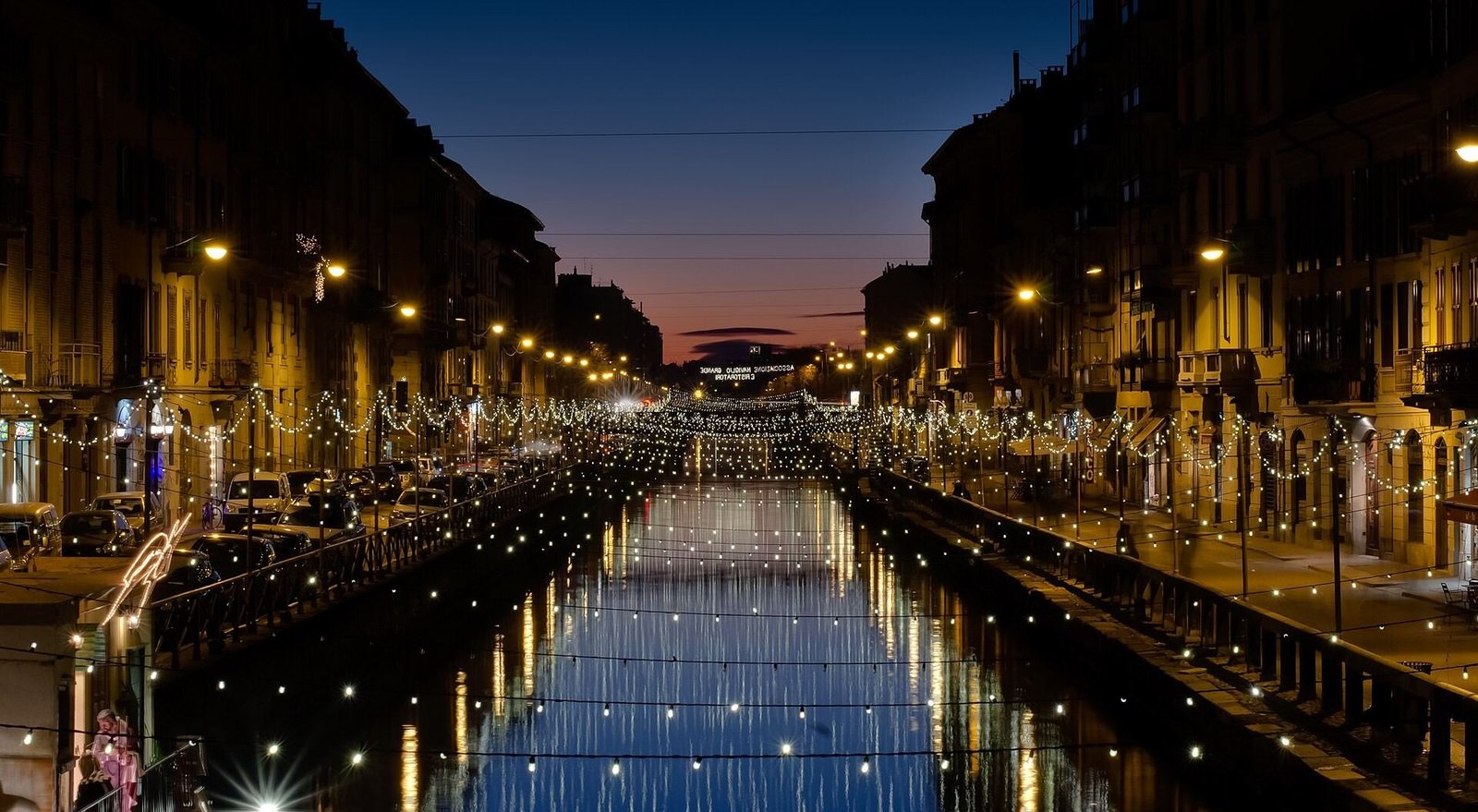
The lights of the Navigli reflecting on the water at dusk 📱🔄️ are one of the attractions of this second part of the Milan Complet Tour.
See also:
- Complete Tour 1
- Guide to Milan
- Itineraries: 1d, 3d, CT2
- See: Attractions
- Do: Experiences
- Eat: Where and What
- Getting Around, Pass, Stay
Overview
📌 Click on the route names to access the short description and the details of the stops ⬇️
Milan Complete Tour – Part 2 continues the exploration of the city by moving beyond the historic center, toward broader and more diverse areas where Milan reveals its more layered identity: between historic districts, contemporary hubs, sports zones, and religious complexes immersed in the urban outskirts.
The route is organized into four thematic areas that allow you to read Milan through very different urban identities:
Ticinese and Navigli – The first itinerary runs along historic canals and regenerated working-class neighborhoods, where early Christian basilicas, Roman remains, and the life of the Navigli tell the story of the most authentic and lived-in Milan.
Villa Reale – The second route crosses the eastern and historic area of the city, among noble residences, large monumental avenues, and important religious complexes representing aristocratic and cultural Milan.
Milan Nord – The third itinerary moves toward contemporary and vertical Milan, among modern architecture, cultural hubs, and districts symbolizing the city’s urban and technological transformation.
Milan Outskirts – The final route explores the outer areas of the city, where sport, spirituality, and contemporary art intertwine in a less touristy but highly identity-rich urban narrative.
Routes: Maps, Descriptions, Details
TICINESE and NAVIGLI
- Open Route Map📍
- Distance: 5,3* km on foot
- Time: 1,12* min. on foot
- Visit duration: 7 hours
- Stops: 10 main (X →I)* + 9 secondary
- Basilica di San Lorenzo Maggiore (X) → Antiquarium di Milano “A. Levi” (A) → Basilica di Sant’Eufemia (B) → Basilica di Sant’Eustorgio (C) → Arco di Porta Ticinese (D) → Naviglio Pavese (E) → Naviglio Grande (F) → Spazio Alda Merini Casa Museo (G) → Navigli Milano (H) → MUDEC Museo delle Culture (I)
- For days, times, prices and other info see Itinerary Table 📊
* These values may differ from those shown on Google Maps, as they are continuously recalculated in real time. See also Itinerary Info and Navigator + See here for Shared Stop 🧩
Route Description
SUMMARY
This itinerary develops in the Ticinese e Navigli area, one of the most authentic and characteristic districts of Milan, where early Christian basilicas, Roman remains, and ancient canals intertwine in a route rich in history, art, and evocative atmospheres. The tour connects iconic landmarks such as the Basilica di San Lorenzo Maggiore, the Basilica di Sant’Eustorgio, and the lively system of Navigli, up to the modern MUDEC – Museo delle Culture.
The route, entirely on foot, extends for 5.3 km and includes 10 main stops plus 9 sub-stops, for a total visiting time of about 7 hours.
Expand STEP DETAIL ⬇️
📌 All the stops summarized here are structured in the Itinerary Table 📊 with days, opening hours, prices, and Wikipedia 🌐 and Google Maps insights.
⬇️ starting point
X. Basilica di San Lorenzo Maggiore
The tour begins with the majestic Basilica di San Lorenzo Maggiore, one of the oldest in Milan, dating back to the 4th century. Next to it, the Cappella di Sant’Aquilino preserves extraordinary early Christian mosaics.
In front of the basilica stand the famous Colonne di San Lorenzo, a Roman colonnade of sixteen columns representing one of the city’s historical symbols. Here, Piazza Vetra once served as a market place and venue for public events.
✨ Entering here means crossing nearly 1700 years of history in a single glance, among Roman columns and silences that tell the story of the oldest Milan.
❌ During peak hours it can be more crowded due to its proximity to the Navigli district.
⬇️
A. Antiquarium di Milano “A. Levi”
The route continues with a visit to the Antiquarium di Milano “A. Levi”, a small archaeological museum housing evidence of ancient Mediolanum. Nearby are the remains of the Anfiteatro romano di Milano, once one of the largest in the Roman Empire, used for gladiatorial shows and public entertainment.
⬇️
B. Basilica di Sant’Eufemia
Next, you reach the Basilica di Sant’Eufemia, a small Milanese gem founded in the 5th century and later remodeled. Its interior fascinates with neo-Gothic and Liberty-style decorations in vivid colors.
⬇️
C. Basilica di Sant’Eustorgio
A key stop is the visit to the Basilica di Sant’Eustorgio, which, beyond its millenary history, houses the stunning Cappella Portinari, a Renaissance masterpiece of Lombardy with frescoes by Vincenzo Foppa.
The Museo di Sant’Eustorgio displays artworks and historical artifacts from the church, while the evocative Chiostri di Sant’Eustorgio offer a peaceful corner. Nearby, the Museo Diocesano presents a collection of sacred art and hosts prestigious temporary exhibitions.
✨ One of Milan’s most atmospheric basilicas, where art and spirituality blend in a surprising balance.
❌ Possible waiting times during religious events.
⬇️
D. Arco di Porta Ticinese
Continuing on, you encounter the Arco di Porta Ticinese, an imposing neoclassical structure built in the 19th century by Luigi Cagnola. Behind it opens Piazza XXIV Maggio, recently redeveloped, serving as the gateway to the lively Navigli district.
⬇️
E. Naviglio Pavese
The itinerary continues along the Naviglio Pavese, one of the artificial canals that once connected Milan to the Po River. The route runs alongside murals, artisan workshops, and picturesque corners of old Milan.
✨ A water route offering authentic and less touristy views, perfect for a slower and more genuine Milan.
⬇️
F. Naviglio Grande
Arriving at the Naviglio Grande, you immerse yourself in the heart of Milanese life. Once an ancient goods transport canal, today it is one of the most vibrant areas, filled with bars, restaurants, and art galleries. The “case di ringhiera”, iron bridges, and lively atmosphere make it one of the city’s most iconic places.
⬇️
G. Spazio Alda Merini Casa Museo
In the heart of the Navigli lies Spazio Alda Merini, a place dedicated to the great Milanese poet. This house museum offers a glimpse into her life, with photos, manuscripts, and personal objects.
📌 Spazio Alda Merini Casa Museo can be visited by reservation. You will find the phone number in the Google Maps listing accessible from the table link.
⬇️
H. Navigli Milano
Continuing along the Navigli, you discover an authentic side of Milan, among hidden courtyards, small artisan shops, and traditional restaurants. Here, every last Sunday of the month, the famous Antiques Market takes place.
✨ End the tour with an aperitivo on the Navigli, enjoying the lights reflecting on the water.
❌ Very crowded area during weekends and events.
⬇️
I. MUDEC – Museo delle Culture
The tour ends at the MUDEC – Museo delle Culture, a modern space designed by David Chipperfield.
- The museum hosts permanent collections and internationally renowned exhibitions.
- The glass-and-concrete building is a true architectural artwork.
- The internal restaurant offers a high-level gastronomic experience, perfect to conclude the tour.
VILLA REALE
- Open Route Map📍
- Distance: 4,3* km on foot
- Time: 0,58* min. on foot
- Visit duration: 9 hours
- Stops: 10 main (X →I)* + 12 secondary
- Villa Reale di Milano (X) → Villa Necchi Campiglio (A) → Basilica di San Babila (B) → Basilica di San Carlo al Corso (C) → Basilica di Santo Stefano Maggiore (D) → Chiesa di Sant’Antonio Abate (E) → Basilica di San Nazaro in Brolo (F) → Ca’ Granda (G) → Chiesa di San Pietro in Gessate (H) → Rotonda della Besana (I)
- For days, times, prices and other info see Itinerary Table 📊
* These values may differ from those shown on Google Maps, as they are continuously recalculated in real time. See also Itinerary Info and Navigator + See here for Shared Stop 🧩
Route Description
SUMMARY
The elegant area of Villa Reale and the eastern historic center of Milan is the focus of this seventh and final walking itinerary, among noble residences, historic basilicas, and grand monumental avenues. The tour connects iconic landmarks such as the Villa Reale di Milano, Corso Venezia, Villa Necchi Campiglio, the ancient basilicas of the center, and the evocative Rotonda della Besana.
The route, entirely on foot, extends for 4.3 km and includes 10 main stops plus 12 sub-stops, for a total visiting time of about 9 hours.
Expand STEP DETAIL ⬇️
📌 All the stops summarized here are structured in the Itinerary Table 📊 with days, opening hours, prices, and Wikipedia 🌐 and Google Maps insights.
⬇️ starting point
X. Villa Reale di Milano
The itinerary begins at the magnificent Villa Reale di Milano, an 18th-century neoclassical masterpiece, today home to the GAM – Galleria d’Arte Moderna. Inside, visitors can admire works by famous artists such as Hayez, Canova, and Boccioni. The villa is surrounded by the beautiful Giardino di Villa Reale, a green oasis with ponds and neoclassical statues, ideal for a relaxing break.
Just a short walk away are the Giardini Pubblici Indro Montanelli, the first public park in Milan, which hosts the Palazzo Dugnani, a 17th-century noble residence, and the Museo Civico di Storia Naturale, one of the most important museums in Italy for its rich collection of fossils and minerals.
📌 Palazzo Dugnani can be visited upon request. You will find the phone number in the Google Maps listing accessible from the table link.
⬇️
A. Villa Necchi Campiglio
Continuing south, you visit the stunning Villa Necchi Campiglio, a 1930s historic residence designed by Piero Portaluppi. Perfectly preserved, the villa offers a glimpse into the lifestyle of Milan’s upper bourgeoisie, with original furnishings, artworks, and a charming garden with a swimming pool.
📌 Villa Necchi Campiglio can be visited by reservation. You will find the phone number in the Google Maps listing accessible from the table link.
⬇️
B. Basilica di San Babila
From here, you reach the Basilica di San Babila, one of the city’s landmarks, with its austere neo-Romanesque façade. The church faces Piazza San Babila, from which begins the famous Corso Venezia, an elegant boulevard lined with historic buildings and luxury boutiques, leading to Porta Venezia, one of the old city gates, characterized by imposing neoclassical architecture.
⬇️
C. Basilica di San Carlo al Corso
A few steps away stands the Basilica di San Carlo al Corso, inspired by Rome’s Pantheon, with its majestic dome. Inside, it preserves valuable frescoes and artworks.
⬇️
D. Basilica di Santo Stefano Maggiore
The itinerary continues with the Basilica di Santo Stefano Maggiore, a place rich in history, where Saint Charles Borromeo was baptized in 1476. Next to it is the evocative Santuario di San Bernardino alle Ossa, known for its unsettling Cappella delle Ossa, decorated with human skulls and bones arranged in artistic patterns, a truly unique attraction.
✨ One of Milan’s most unusual experiences: a chapel that truly leaves visitors speechless.
❌ Small spaces: possible queues on weekends and very short visit times.
⬇️
E. Chiesa di Sant’Antonio Abate
Continuing along the route, you encounter the Chiesa di Sant’Antonio Abate, a small Baroque gem with a surprisingly rich interior filled with 17th-century frescoes by artists such as Legnanino and Procaccini.
⬇️
F. Basilica di San Nazaro in Brolo
A short distance away is the Basilica di San Nazaro in Brolo, one of the oldest churches in Milan, founded by Saint Ambrose in the 4th century. Next to the basilica is an interesting archaeological area with remains of the ancient baptistery and early Christian structures.
⬇️
G. Ca’ Granda
Nearby stands the Ca’ Granda, once a Renaissance hospital and today the seat of the University of Milan. Its Chiostro Richiniano, designed by Filarete, is an architectural masterpiece. Inside, the museum I Tesori della Ca’ Granda displays an extraordinary collection of artworks and historical artifacts.
⬇️
H. Chiesa di San Pietro in Gessate
The itinerary continues with the Chiesa di San Pietro in Gessate, an important Renaissance church characterized by beautiful frescoes by Bergognone.
⬇️
I. Rotonda della Besana
The route ends at the charming Rotonda della Besana, a Baroque complex with a circular portico surrounded by a large garden. Today it hosts the MUBA – Museo dei Bambini, but it is also a perfect place to relax after an intense day of exploration.
NORTH MILAN
- Open Route Map📍
- Distance: 14,8* km by car
- Time: 0,57* min. by car
- Visit duration: 5 hours
- Stops: 10 main (X →I-X)* + 3 secondary
- Stazione di Milano Centrale (X) → Museo delle Illusioni (A) → Casa Museo Boschi Di Stefano (B) → Politecnico di Milano (C) → Orto Botanico Città Studi (D) → Terrazza Belvedere Palazzo Lombardia (E) → Bosco Verticale (F) → ADI Design Museum (G) → Cimitero Monumentale di Milano (H) → CityLife Shopping District (I-X)🧩
- For days, times, prices and other info see Itinerary Table 📊
* These values may differ from those shown on Google Maps, as they are continuously recalculated in real time. See also Itinerary Info and Navigator + See here for Shared Stop 🧩
Route Description
SUMMARY
This is the first of the two driving routes dedicated to discovering Milan beyond the historic center, focusing in this case on the Milano Nord area, where contemporary architecture, cultural hubs, and districts symbolizing the city’s urban transformation alternate.
The route extends for 14.8 km by car and includes 10 main stops plus 3 sub-stops, for a total visiting time of about 5 hours.
Expand STEP DETAIL ⬇️
📌 All the stops summarized here are structured in the Itinerary Table 📊 with days, opening hours, prices, and Wikipedia 🌐 and Google Maps insights.
⬇️ starting point
X. Stazione di Milano Centrale
The tour begins at Stazione di Milano Centrale, one of the most important railway hubs in Europe and a monumental architectural masterpiece of the 20th century. Admire the grandeur of its façade and the magnificent main hall, characterized by Art Deco and Liberty-style elements.
✨ A monumental gateway to the city that looks more like a royal palace than a train station.
❌ Constant passenger flow: quick passage recommended, especially during peak hours.
⬇️
A. Museo delle Illusioni
The second stop of the tour is the Museo delle Illusioni, an interactive and fun experience that plays with perspective, light, and mirrors to create surprising optical effects. Perfect for families and science enthusiasts, the museum features over 70 installations that stimulate perception and imagination.
⬇️
B. Casa Museo Boschi Di Stefano
Next, you visit the Casa Museo Boschi Di Stefano, a hidden gem in Milan. This former private residence houses an extraordinary collection of 20th-century artworks, with paintings by artists such as De Chirico, Fontana, and Morandi. The intimate atmosphere of the house allows visitors to fully immerse themselves in the art and the history of the Boschi Di Stefano family.
⬇️
C. Politecnico di Milano
The route continues toward Piazza Leonardo da Vinci, the beating heart of the university district Città Studi, home to the historic Politecnico di Milano, one of the most prestigious universities in Europe for engineering and architecture. The square is characterized by imposing neo-Renaissance architecture and a lively student atmosphere.
⬇️
D. Orto Botanico Città Studi
A few steps from the Politecnico lies the Orto Botanico Città Studi, a small green jewel hidden in the urban chaos. Here you can admire over 300 species of plants and flowers in a peaceful environment, perfect for a short break surrounded by nature.
⬇️
E. Terrazza Belvedere Palazzo Lombardia
The route continues toward the modern Palazzo Lombardia, the regional headquarters, where you can reach the Terrazza Belvedere located on the 39th floor. From here, you can enjoy a breathtaking panoramic view over all of Milan, with the city skyline stretching all the way to the Alps on clear days.
❌ Access depends on weather conditions and there may be queues on weekends.
⬇️
F. Bosco Verticale
The next stop is the Bosco Verticale, one of the symbols of contemporary Milan. This innovative residential complex, designed by Stefano Boeri, is famous for its façade covered with over 900 trees and 20,000 plants, creating a true urban ecosystem. The Quartiere Isola, where it is located, is one of the trendiest areas in Milan, full of restaurants, alternative cafés, and design boutiques.
❌ Very busy area during evening hours and tourist weekends.
⬇️
G. ADI Design Museum
A short distance away is the ADI Design Museum, dedicated to the history of Italian design and the Compasso d’Oro collection, the most important industrial design award. Here you can admire iconic objects that have shaped design history, from furniture to household appliances.
⬇️
H. Cimitero Monumentale di Milano
The tour continues with a visit to the majestic Cimitero Monumentale, a true open-air museum. This place hosts spectacular funerary monuments created by world-famous artists and architects, making it a landmark for art and history lovers. Here lie notable figures such as Alessandro Manzoni, Giorgio Gaber, and Alda Merini.
❌ If you explore all the monuments, the visit may exceed the estimated 60 minutes.
⬇️
I/X. CityLife Shopping District
The tour ends at CityLife Shopping District, the largest urban shopping district in Italy, located in the modern CityLife area, dominated by skyscrapers designed by Zaha Hadid, Arata Isozaki, and Daniel Libeskind. In addition to shopping, the area offers restaurants, cinemas, and large green spaces, perfect for relaxing after the tour.
✨ A futuristic district where architecture and urban life merge into a cinematic landscape.
❌ Very active area in the evening: high pedestrian and commercial traffic during weekends.
MILAN OUTSKIRTS
- Open Route Map📍
- Distance: 83* km by car
- Time: 2,29* min. by car
- Visit duration: 10 hours split over 2 days, 7 on the first and 3 on the second.
- Stops: 10 main (I-X →I)* + 5 secondary
- CityLife Shopping District (I-X)🧩 → Museo Popoli e Culture (A) → Stadio San Siro (B) → Casa Milan – Museo Mondo Milan (C) → Certosa di Garegnano (D) → GASC Galleria d’Arte Sacra Contemporanei (E) → Pirelli HangarBicocca (F) → Castello di Peschiera Borromeo (G) → Abbazia di Chiaravalle (H) → Chiesa di San Cristoforo sul Naviglio (I)
- For days, times, prices and other info see Itinerary Table 📊
* These values may differ from those shown on Google Maps, as they are continuously recalculated in real time. See also Itinerary Info and Navigator + See here for Shared Stop 🧩
Route Description
SUMMARY
This second driving route dedicated to discovering the outskirts of Milan crosses areas linked to sport, spirituality, and contemporary art, connecting some of the most unique and least touristy places in the urban territory.
Along the route you will encounter key stops such as Stadio San Siro, Certosa di Garegnano, Pirelli HangarBicocca, and the Abbazia di Chiaravalle, which best represent the contrast between historic and contemporary Milan.
The route extends for 83 km by car and includes 10 main stops plus 4 sub-stops, for a total visiting time of about 10 hours spread over 2 days.
Expand STEP DETAIL ⬇️
📌 All the stops summarized here are structured in the Itinerary Table 📊 with days, opening hours, prices, and Wikipedia 🌐 and Google Maps insights.
Day 1
I/X. CityLife Shopping District is a shared stop🧩 – See final stop of the previous itinerary.
⬇️
A. Museo Popoli e Culture
The tour begins with a visit to the Museo Popoli e Culture, located inside the PIME (Pontifical Institute for Foreign Missions). This ethnographic museum offers a unique collection of artifacts from Asia, Africa, Latin America, and Oceania, showcasing the cultures and traditions of the peoples with whom missionaries have lived.
⬇️
B. Stadio San Siro
The route continues to the legendary Stadio San Siro, the temple of Italian football and home of AC Milan and Inter. After admiring its iconic structure, visit the Museo di San Siro, which tells the history of Milan football through memorabilia, historic jerseys, and trophies. For sports fans, it is possible to take a tour of the locker rooms and the tunnel leading to the pitch.
❌ Match days: access and traffic significantly slowed.
⬇️
C. Casa Milan
For football lovers, the next stop is Casa Milan, the headquarters of the Rossoneri club. Here you will find the Museo Mondo Milan, which retraces the history of the team through interactive exhibits, emotional videos, and trophies won over the years.
⬇️
D. Certosa di Garegnano
After the football excitement, the atmosphere changes with a visit to the peaceful Certosa di Garegnano, a 14th-century monastery known for its stunning interior frescoes, comparable to those of the Sistine Chapel. This quiet corner is one of Milan’s hidden gems.
⬇️
E. GASC Galleria d’Arte Sacra Contemporanea
Continuing on, you reach the GASC – Galleria d’Arte Sacra Contemporanea, which hosts a rich collection of modern and contemporary religious artworks. An interesting fusion of spirituality and artistic experimentation.
⬇️
F. Pirelli HangarBicocca
The final stop of the day is Pirelli HangarBicocca, one of the most important contemporary art spaces in Europe. This former industrial warehouse hosts large-scale installations and temporary exhibitions by internationally renowned artists, including Anselm Kiefer’s iconic work The Seven Heavenly Palaces.
✨ One of the largest contemporary art spaces in Europe, where installations become a physical experience.
❌ Temporary exhibitions: variable attendance with peaks on weekends and during special events.
Day 2
⬇️
G. Castello di Peschiera Borromeo
The second day begins with a visit to the Castello di Peschiera Borromeo, a medieval fortress located just outside Milan. Surrounded by a picturesque landscape, this castle offers a fascinating glimpse into the history of the Lombard nobility.
📌 The Castello di Peschiera Borromeo can be visited upon request. You will find the phone number in the Google Maps listing via the table link.
⬇️
H. Abbazia di Chiaravalle
The journey continues with one of the most spiritual stops: the Abbazia di Chiaravalle, a masterpiece of Cistercian architecture. In addition to the main church, highlights include the Cappella di San Bernardo, the atmospheric cloister, the working medieval mill, and the famous Torre Ciribiciaccola, the symbol of the monastery.
✨ The monastic complex conveys an absolute sense of timeless peace.
⬇️
I. Chiesa di San Cristoforo sul Naviglio
The final stop before dinner is the picturesque Chiesa di San Cristoforo sul Naviglio, a small Gothic gem overlooking the Naviglio Grande. This place of worship, with its distinctive terracotta decorations and double bell tower, is one of the most romantic spots in Milan.
✨ One of the most poetic views of the Navigli, especially at sunset when the water reflects the light.
Eating
During the itineraries of this second part of the Milano Tour Completo, cuisine becomes an integral part of the journey and is mainly focused on historic areas, cultural districts, and contemporary zones, where it is possible to alternate visits and gastronomic breaks without interrupting the flow of the trip.
- Southern area / Ticinese e Navigli: Trattoria La Pesa dal 1902 – one of the oldest trattorias in Milan, a symbol of authentic Lombard cuisine.
- Southern area / Navigli: Trattoria del Nuovo Macello – historic Milanese cuisine, strong traditional identity and classic recipes.
- Eastern area / Porta Vittoria: Masuelli San Marco – a city institution of Milanese cuisine, with a historic and rigorous approach.
- Eastern area / Porta Venezia: Trattoria Milanese – Dal 1933 – a reference point for traditional Lombard cuisine without modern influences.
- Northern area / Centrale: Trattoria Tagiura – simple and authentic atmosphere, neighborhood Milanese cuisine.
- Northern area / Isola and outskirts: Da Berti – historic trattoria with a strong link to popular Milanese tradition.
See also Where to eat in Milan.
Milanese cuisine is thus integrated into the city’s different itineraries, alternating historic restaurants, authentic trattorias, and contemporary interpretations, with signature dishes such as:
- Cotoletta alla milanese, one of the most iconic dishes of the city’s tradition.
- Risotto alla milanese, with saffron, the absolute symbol of local cuisine.
- Ossobuco alla milanese, a historic dish of Lombard tradition.
- Cassœula, a typical winter recipe of Milanese popular cuisine.
- Mondeghili, traditional meatballs born from “leftover” cooking.
- Trippa alla milanese, one of the oldest dishes of the city.
- Gorgonzola, Taleggio and Quartirolo Lombardo, excellence of local dairy production.
See also What to eat in Milan.
Sleeping
For the second part of Milano Tour Completo, which develops between the outskirts, historic districts, and modern areas of the city, the choice of accommodation changes depending on travel logistics, which become longer and spread across different zones.
In the Ticinese e Navigli area, staying overnight means experiencing the most authentic and lively side of Milan: an ideal area for those who want to end their days among canals, venues, and a vibrant atmosphere, with accommodation options spread between Naviglio Grande and the Darsena, perfect for those who enjoy walking even in the evening.

For the Villa Reale e Porta Venezia area, the location is strategic for connecting the city center with the eastern part of the route: here you will find elegant hotels and historic residences, ideal for those who want to stay in a central yet quieter area, well connected by metro and main lines to all the cultural stops of the itinerary.
In the Milano Nord (Centrale, Isola, Bicocca) area, the best option is to stay near major transport hubs such as Stazione Centrale or Porta Garibaldi: a modern and functional area, perfect for managing travel toward Bosco Verticale, Bicocca, CityLife, and the contemporary stops of the route.
For the outer part of the journey, between San Siro, Chiaravalle and Peschiera Borromeo, it is advisable to choose accommodations close to main connecting roads or near peripheral metro stops: a practical solution to reduce travel times toward the stadium, abbeys, and castles, optimizing the day’s visits.
For more updated advice on areas and accommodations, you can consult the full guide on Where to sleep in Milan: Info and Tips.
📊 Itinerary Table
The table below shows all the stops of the four routes of Milano Complete Tour – Part 2, to help you optimize your visit as effectively as possible.
- Scroll the table down and to the right 📱🔄 Rotate your phone horizontally to get an overview of opening days, hours, prices of attractions, and for further details on Wikipedia 🌐 and Google Maps ➡️.
- ⚠️ Always check the opening days and hours of attractions through the Google Maps entries linked in the table. See also Itinerary Info.
- To see the explanation of each data column, click its title (e.g. Attractions Index, Ratings, Org, etc.) at the top of the table.
⏳ Caricamento tabella in corso…
📌 This table is updated every 6–12 months.
🛡️ The tables on Tourplan360.com are original content protected by copyright © and monitored through anti-plagiarism tracking systems.
FAQ
Yes. In the four itineraries of Milan Complete Tour – Part 2 you can remove stops or change their order while always maintaining continuity of movement. This allows you to adapt the route based on your interests and available time.
📌 See also Itinerary Info
Can these itineraries be done on foot?
Only the first two of the four itineraries in Part 2 are designed to be done on foot, while the others are intended to be done by car.
📌 See also Getting around Milan
Is it worth booking the main attractions?
During peak tourist periods, it is advisable to book in advance or join guided tours to avoid queues and ensure entry.
📌 See also Experiences in Milan
How long does it take to complete Part 2 of the tour?
Milan Complete Tour Part 2 requires about 31 hours of visiting time spread over approximately 5 days.
Where can I find days, opening hours and prices of attractions?
All updated information is available in the Itinerary Table 📊, with direct links to Google Maps and Wikipedia for further details.
See also
- Complete Tour 1
- Milan in 1 day
- Milan in 3 days
- Guide to Milan
- See: Attractions
- Do: Experiences
- Eat: Where and What
- Getting Around, Pass, Stay
Other Destinations
🔐 Some images on this page are used under Creative Commons licenses:
By Maurizio Beatrici – Genoa, port and Lanterna from Castello d’Albertis – Own work – CC BY-SA 4.0 – Wikimedia Commons
By Hpnx9420 – Turin, view from Monte dei Cappuccini – Own work – CC BY 3.0 – Wikimedia Commons
By Alexis Courthoud – Aosta, panoramic view of the Ancient Roman Theatre – Own work – CC BY-SA 4.0 – Wikimedia Commons
By Harmishhk from Munich, Germany – Milan, Navigli district at sunset – Own work – CC BY 2.0 – WikiCommons
.jpg)