
Trieste in 3 days: travel itinerary
What to see, opening hours, prices, map


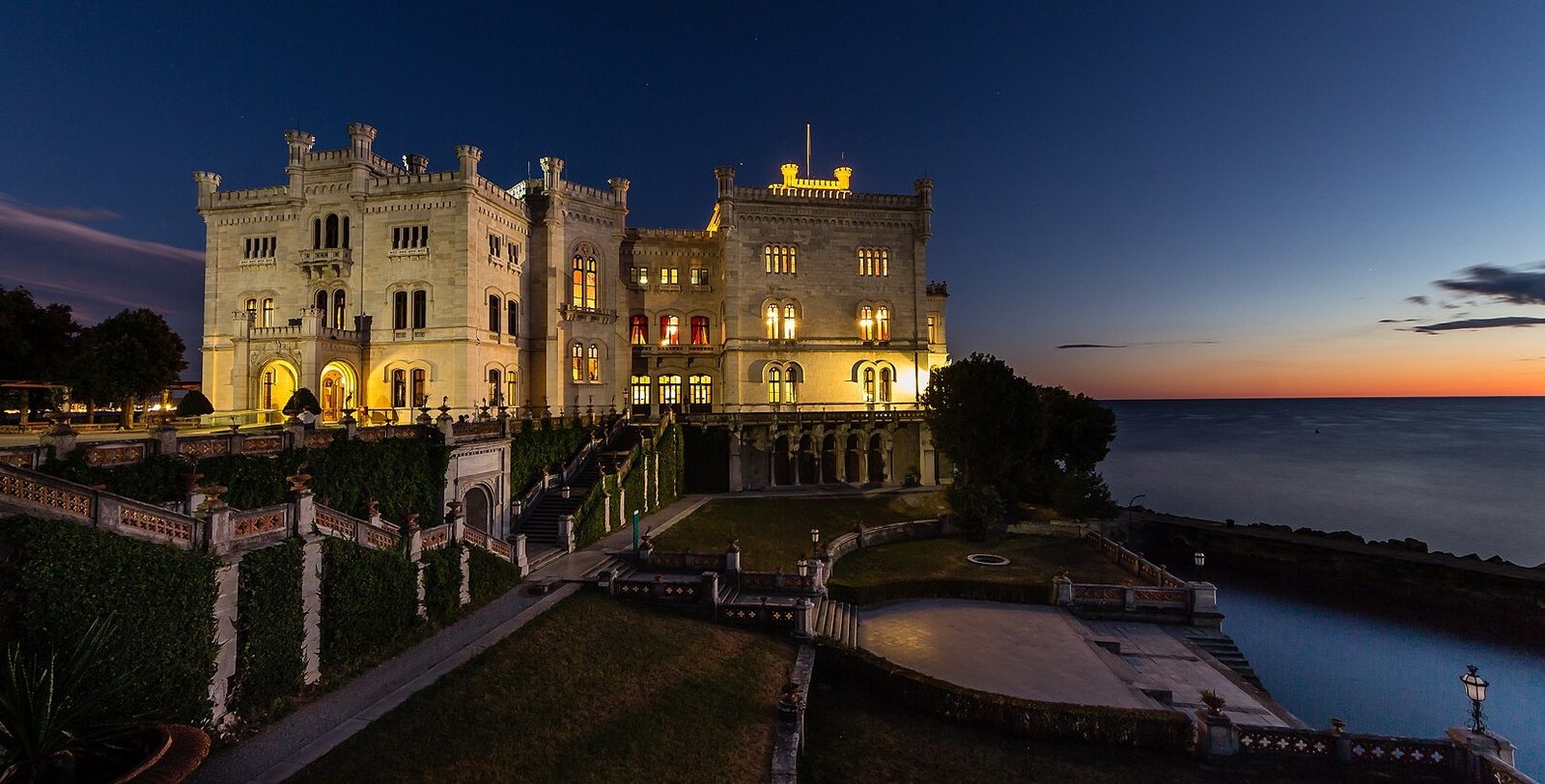
The beautiful image above, depicting Miramare Castle at dusk, spectacularly introduces this itinerary that will guide you through the most iconic places in Trieste.
📱 Rotate your phone horizontally to fully enjoy the evocative potential of the panoramic image above
See also:
- Trieste Travel Guide
- Itineraries: 1d, 3d, CT
- Experiences, Getting Around
- Eating: Where & What
- Where to Sleep
Routes: Maps, Descriptions, Details
To discover Trieste at its best and fully appreciate its beauty, we have designed a 3-day itinerary, divided into two days dedicated to exploring the historic center on foot, and a third day focused on discovering the wonders surrounding the city with a car route.
This program has been carefully planned to allow for a complete visit without rushing, giving you time to soak in the local atmosphere and perhaps stop at one of the famous historic cafés, once frequented by artists and writers such as James Joyce, Italo Svevo, and Umberto Saba.
📌 The two walking routes in the historic center (red and green) are connected 🧩, meaning the end point of one is the starting point of the other, ensuring a continuous flow in case you wish to skip one or more stops
TRIESTE IN 3 DAYS > 1 DAY
- Open Route Map📍
- Distance: 2,6* km on foot
- Time: 0,37* min. on foot
- Visit duration: 5 hours
- Stops: 10 main (X →I-X)* + 0 secondary
- Cattedrale di San Giusto (X) → Museo d’Antichità “J.J. Winckelmann” (A) → Basilica di San Silvestro (B) → Arco di Riccardo (C) → Museo Joyce (D) → Basilica paleocristiana Madonna del Mare (E) → Museo Civico Sartorio (F) → Museo Revoltella (G) → Acquario Marino di Trieste (H) → Civico Museo d’Arte Orientale (I-X)🧩
- For days, times, prices and other info see Itinerary Table 📊
* These values may differ from those shown on Google Maps, as they are continuously recalculated in real time. See also Itinerary Info and Navigator + See here for Shared Stop 🧩
Route Description
SUMMARY
This itinerary, consisting of 10 stops to explore on foot, allows you to discover Trieste through history, art, and archaeology, along a comfortable route of about 2.6 km. Among the must-see highlights are the Cattedrale di San Giusto with its mosaics, the Arco di Riccardo, a symbol of ancient Roman Tergeste, and the Museo Revoltella, with its collections of modern and contemporary art.
Expand STEP DETAIL ⬇️
⬇️ starting point
X. Cattedrale di San Giusto
The itinerary begins at the majestic Cattedrale di San Giusto (National Monument), located on the homonymous hill. This Romanesque church combines two ancient basilicas and boasts splendid Byzantine mosaics. From the terrace in front, you can enjoy a spectacular view of the city and the sea.
✨ A breathtaking view that turns the visit into a visual poem. The terrace is perfect for capturing sunset shots, when the light illuminates both the mosaics and the sea.
⬇️
A. Museo d’Antichità “J.J. Winckelmann”
Adjacent to the cathedral is the Museo d’Antichità “J.J. Winckelmann”, which houses Roman archaeological finds and tells the story of the city through its ancient testimonies.
⬇️
B. Basilica di San Silvestro
Descending from the Colle di San Giusto, you encounter the Basilica di San Silvestro (National Monument), one of Trieste’s oldest churches, characterized by simple and austere architecture.
⬇️
C. Arco di Riccardo
Just a short walk away is the Arco di Riccardo, an ancient Roman gate dating back to the 1st century BC, which was part of the city walls during the imperial era.
✨ Walking beneath this millenary arch feels like stepping back in time, hearing the echoes of ancient Rome.
⬇️
D. Museo Joyce
Trieste is linked to the figure of James Joyce, who lived here for over ten years. The Museo Joyce narrates his life and his connection to the city, featuring letters, manuscripts, and personal items of the writer.
📌 The Museo Joyce is temporarily closed to the public.
⬇️
E. Basilica paleocristiana di via Madonna del Mare
One of Trieste’s lesser-known gems is the Basilica paleocristiana di via Madonna del Mare, which preserves remains of mosaics and structures dating back to the early centuries of Christianity.
⬇️
F. Museo Civico Sartorio
The tour continues with a visit to the Museo Civico Sartorio, an elegant noble residence turned museum, featuring a collection of paintings, ceramics, and period furnishings.
⬇️
G. Museo Revoltella
One of the city’s most prestigious museums is the Museo Revoltella, which houses a rich collection of modern and contemporary art. The museum spans multiple floors and includes works by Italian and European artists from the 19th century onwards.
⬇️
H. Acquario Marino di Trieste
The day concludes with a visit to the Acquario Marino di Trieste, which hosts a wide range of Adriatic marine species and provides an interesting overview of the local marine ecosystem.
📌 The Acquario Marino di Trieste is currently closed to the public.
⬇️
I/X 🧩 – Civico Museo d’Arte Orientale is a shared stop – See initial stop of the next route
TRIESTE IN 3 DAYS > DAY 2
- Open Route Map📍
- Distance: 1,7* km on foot
- Time: 0,24* min. on foot
- Visit duration: 6 hours
- Stops: 10 main (I-X →I)* + 9 secondary
- Civico Museo d’Arte Orientale (I-X)🧩 → Piazza Unità d’Italia (A) → Teatro Verdi Trieste (B) → Chiesa greco-ortodossa di San Nicolò (C) → Piazza della Borsa Trieste (D) → Teatro Romano di Trieste (E) → Chiesa Serbo-Ortodossa di San Spiridione (F) → Canal Grande di Trieste (G) → Museo Teatrale C. Schmidl (H) → Borgo Teresiano (I)
- For days, times, prices and other info see Itinerary Table 📊
* These values may differ from those shown on Google Maps, as they are continuously recalculated in real time. See also Itinerary Info and Navigator + See here for Shared Stop 🧩
Route Description
SUMMARY
This itinerary, consisting of 10 stops to explore on foot, offers a glimpse of Trieste through history, art, and sea views. It begins at the Civico Museo d’Arte Orientale, continuing towards the stunning Piazza Unità d’Italia with its elegant buildings. Other iconic highlights include the Teatro Romano and the Borgo Teresiano, the historical and architectural heart of the city.
Expand STEP DETAIL ⬇️
⬇️
I-X 🧩. Civico Museo d’Arte Orientale
Our itinerary begins with a visit to the Civico Museo d’Arte Orientale, one of the most fascinating museums in Trieste. Housed in Palazzo Leo, the museum preserves precious collections of Japanese and Chinese art, including prints, ceramics, and oriental weapons, reflecting Trieste’s historical trade links with Asia.
⬇️
A. Piazza Unità d’Italia and its historic buildings
This magnificent square overlooking the sea is the true symbol of Trieste, a place of rare beauty surrounded by elegant buildings reflecting the city’s Austro-Hungarian past. Here we can admire:
- Palazzo della Luogotenenza austriaca, with its imposing neoclassical façade.
- Palazzo del Municipio, featuring its clock tower and the statue of Micheze and Jacheze.
- Palazzo del Lloyd Triestino, refined headquarters of the shipping company founded in 1833.
- Fontana dei Quattro Continenti, decorated with allegorical figures representing Asia, Africa, Europe, and America.
- Statua di Carlo VI, celebrating the Austrian emperor who made Trieste a free port.
- Caffè degli Specchi, a historic intellectual meeting place once frequented by Joyce and Svevo.
✨ Strolling through Piazza Unità d’Italia feels like stepping into a living painting, with the buildings reflecting the light on the sea and telling the story of Trieste.
⬇️
B. Teatro Verdi Trieste and Molo Audace
Just a short walk from the square is the Teatro Verdi, one of Italy’s main opera houses, inaugurated in 1801 and famous for hosting some of Verdi’s early performances. A little further, the Molo Audace stretches into the sea, offering stunning panoramic views of Trieste and the Gulf.
📌 The Teatro Verdi Trieste can be visited by reservation. You can find the phone number in the Google Maps card accessible from the table link.
⬇️
C. Chiesa Greco-Ortodossa di San Nicolò
Trieste has always been a multicultural city, and this church is a splendid testimony. Dedicated to Saint Nicholas, protector of sailors, the church is a baroque gem with richly decorated interiors. Attached to the church, the Museo della Comunità Greco-Orientale preserves documents and artworks about the Greek presence in the city.
⬇️
D. Piazza della Borsa Trieste
Once the hub of Trieste’s economic activity, this square is dominated by the Palazzo della Borsa Vecchia, built in 1806 in neoclassical style, along with other elegant Austro-Hungarian residences.
⬇️
E. Teatro Romano di Trieste
An unmissable stop to discover ancient Tergeste romana. This theater, dating back to the 1st century AD, could host up to 6,000 spectators and still serves today as an important venue for cultural events and open-air performances.
✨ From the ancient Roman Theatre, you can still sense the echoes of cheers and applause from 6,000 spectators two thousand years ago, an emotion suspended in time.
⬇️
F. Chiesa Serbo-Ortodossa di San Spiridione
Another testimony to Trieste’s multiculturalism is this beautiful Serbian Orthodox church, easily recognizable by its blue domes. Inside, there are precious icons and golden mosaics of extraordinary beauty.
⬇️
G. Canal Grande di Trieste and Ponte Rosso
Walking along the Canal Grande, one can admire one of the city’s most picturesque views. Built in the 18th century to promote trade, the canal is lined with historic buildings and cafés. The Ponte Rosso, one of the most characteristic, hosts a statue of James Joyce, the Irish writer who lived in Trieste for over a decade.
⬇️
H. Palazzo Gopcevich – Museo Teatrale Carlo Schmidl
This sumptuous palace houses the Museo Teatrale Carlo Schmidl, dedicated to the history of opera and theater in Trieste. Here you can admire costumes, sets, and musical instruments belonging to the most famous artists who performed on Trieste’s stages.
⬇️
I. Borgo Teresiano
The itinerary concludes in the heart of the Borgo Teresiano, one of the city’s most elegant districts, commissioned by Empress Maria Theresa of Austria in the 18th century to expand Trieste. Here are some of the most refined buildings of the city, including Palazzo Aedes (nicknamed “Palazzo Tergesteo”) and the Church of Sant’Antonio Nuovo, overlooking the Canal Grande with its neoclassical façade.
TRIESTE IN 3 DAYS > DAY 3
- Open Route Map📍
- Distance: 14,7* km by car
- Time: 0,29* min. by car
- Visit duration: 7 hours
- Stops: 4 main (X →C)* + 3 secondary
- Grotta Gigante (X) → Strada Napoleonica (A) → Faro della Vittoria (B) → Castello di Miramare (C)
- For days, times, prices and other info see Itinerary Table 📊
* These values may differ from those shown on Google Maps, as they are continuously recalculated in real time. See also Itinerary Info and Navigator + See here for Shared Stop 🧩
Route Description
SUMMARY
This itinerary, consisting of 4 stops to explore by car, allows you to discover the surroundings of Trieste along scenic routes and places of great historical interest. It starts from the incredible Grotta Gigante, continues along the panoramic Strada Napoleonica where you can admire the Faro della Vittoria, and ends with the evocative Castello di Miramare, offering a complete journey through nature, history, and the sea.
Expand STEP DETAIL ⬇️
⬇️ starting point
X. Grotta Gigante
The day begins with one of the most spectacular natural wonders of the area: the Grotta Gigante, one of the largest tourist caves in the world. With a height of over 100 meters and a length of about 280 meters, this underground cavity is a true natural cathedral, enriched with millenary stalactites and stalagmites. Next to the cave is the Museo Scientifico Speleologico, offering fascinating insights into the geology of the Karst region and the history of speleological explorations.
⬇️
A. Strada Napoleonica
Leaving Grotta Gigante, the journey continues along the Strada Napoleonica, one of the most scenic routes in Friuli Venezia Giulia. This road, connecting Opicina to the city, offers breathtaking views of the Gulf of Trieste and its surroundings, making it an ideal stop for a short photo break or a refreshing walk immersed in nature.
⬇️
B. Faro della Vittoria
Continuing the tour, you reach the majestic Faro della Vittoria, one of Trieste’s iconic symbols. Built in 1927 to celebrate Italy’s victory in World War I, this imposing lighthouse over 60 meters high dominates the city and the port, offering an extraordinary viewpoint. From its top, accessible to visitors, you can enjoy a breathtaking panorama encompassing the sea and surrounding mountains.
⬇️
C. Castello di Miramare
The final stop of the journey is one of Trieste’s most iconic landmarks: the Castello di Miramare, a splendid seaside residence built in the second half of the 19th century at the behest of Archduke Ferdinand Maximilian of Austria.
In addition to the richly decorated interiors with original furniture and furnishings, the castle is surrounded by a magnificent 22-hectare park, perfect for a stroll among English and Italian gardens, with exotic plants and picturesque views.
✨ One of the best times to admire it is at sunset, when the sun colors the sea and gardens in warm, enchanting tones.
Within the park is also the BioMA – Biodiversitario Marino, an interactive museum dedicated to the flora and fauna of the marine ecosystem of the Gulf of Trieste, a perfect attraction for both adults and children.
📌 Visiting the Castello di Miramare requires a reservation. The phone number is available on the Google Maps listing accessible via the link in the table.
Eating
After exploring the historic center and the main attractions of Trieste, the best way to end the day is with a gastronomic break in the city’s most authentic venues, savoring the typical flavors of Triestine tradition. Among the dishes to try are:
- Sardoni in savor, prepared according to the local recipe
- Brodetto di pesce from the Adriatic coast
- Pinza triestina, perfect for dessert
To enjoy them, you can stop at the Antico Caffè San Marco, ideal for a sweet break or a coffee in the city center, at Buffet da Pepi, renowned for its brodetto di pesce, or at Trattoria Nerodiseppia, just a few steps from the Canal Grande and the main squares.
For a complete overview of where and what to eat in Trieste, visit our dedicated guides: Where to eat in Trieste and What to eat in Trieste.
Sleeping
To make the most of Trieste during the three-day itinerary, the most practical choice is to stay in the city center, near Piazza Unità d’Italia, Via Roma, or the Canal Grande. Here you’ll find hotels, boutiques, and guesthouses that allow you to reach many main attractions on foot, from historic squares to museums, making daily itinerary transfers convenient.

If you prefer a quieter stay, the seafront and Borgo Teresiano area offers central yet more secluded accommodations, ideal for those who want to explore the city at a relaxed pace and enjoy the maritime atmosphere, without sacrificing proximity to the most scenic and cultural stops. For further suggestions, see also Where to sleep in Trieste: Info & Tips.
📊 Itinerary Table
In the table below you’ll find all the attractions included in the itinerary, to make the most of your three-day visit to Trieste:
- Scroll the table down and to the right 📱🔄 Rotate your phone horizontally to get an overview of opening days, hours, prices of attractions, and for further details on Wikipedia 🌐 and Google Maps ➡️.
- ⚠️ Always check the opening days and hours of attractions through the Google Maps entries linked in the table. See also Itinerary Info and/or Navigator Info.
- To see the explanation of each data column, click its title (e.g. Attractions Index, Ratings, Org, etc.) at the top of the table.
⏳ Caricamento tabella in corso…
📌 This table is updated every 6–12 months.
🛡️ The tables on Tourplan360.com are original content protected by copyright © and monitored through anti-plagiarism tracking systems.
FAQ
The itinerary is spread over 3 days: the first two are dedicated to exploring the historic center on foot, through squares, museums, and monuments, while the third day is done by car to visit the peripheral attractions.
What does the first day itinerary include?
The first day is dedicated to the historic center, among historic buildings and museums. Check the 📍 first day map and the route description.
What does the second day itinerary include?
The second day continues in the heart of the city, through iconic squares and characteristic neighborhoods. Check the 📍 second day map and the route description.
What does the third day itinerary include?
The third day is dedicated to attractions outside the center, between nature and coastal views, to visit by car. Check the 📍 third day map and the route description.
Should I book the main attractions in advance?
Yes, especially during peak periods, to avoid queues and optimize your time. You can check all available activities and attractions in the dedicated section: See Experiences in Trieste.
Where can I find days, times, and prices of attractions?
All details are in the single table, valid for all attractions included in the three-day visit.
📌 Check the Itinerary Table 📊
See also
- Trieste Travel Guide
- Itineraries: 1d, 3d, CT
- Experiences, Getting Around
- Eating: Where & What
- Where to Sleep