
Perugia in 3 days: travel itinerary
What to see, opening hours, prices, map


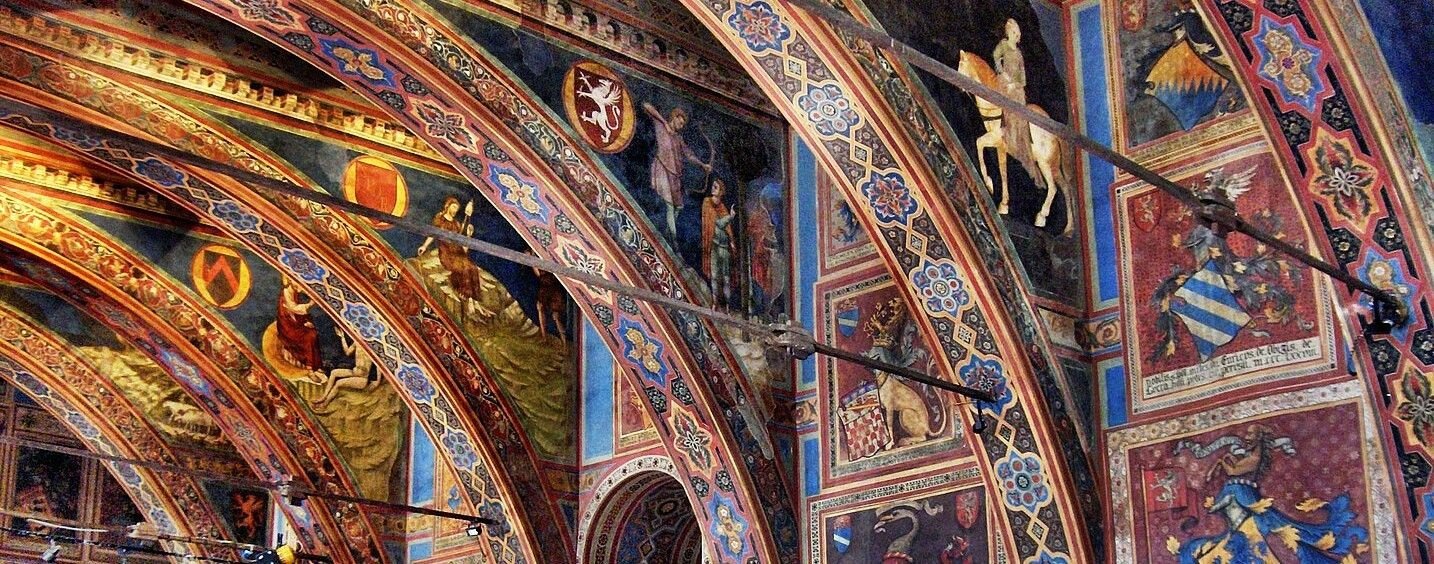
The magnificent frescoed vaults of the Palazzo dei Priori shown above 📱🔄️ are one of the most evocative attractions you will discover in this itinerary dedicated to Perugia in 3 days.
- 📍 Heart of Perugia
- 📍 Sant’Angelo and Confraternities
- 📍 Rocca Paolina and San Domenico
- 📍 San Pietro and Botanical Gardens
- 📍 Perugia beyond the walls
See also:
Overview
If you have 3 days to visit Perugia, this guide will help you organise your stay in the simplest and most practical way. We have divided the city into 5 itineraries, for a total visiting time of around 28 hours, so you can either follow the full tour or choose only the routes that interest you most.
The first four itineraries take place entirely in the historic centre, while the fifth is dedicated to attractions located beyond the city walls, easily reachable by car or public transport:
- Heart of Perugia – The route dedicated to the city’s main symbols, among monumental squares, historic palaces, artistic masterpieces and traces of ancient Perugia, with iconic stops such as the Palazzo dei Priori and the Fontana Maggiore. Go to the route.
- Sant’Angelo and Confraternities – An itinerary that leads you to discover the most authentic side of Perugia, crossing ancient villages, churches, oratories and medieval fortifications in an atmosphere rich in history and traditions. Go to the route.
- Rocca Paolina and San Domenico – A route that combines landmark monuments, important museums and traces of the city’s past, featuring the spectacular Rocca Paolina and the monumental area of San Domenico. Go to the route.
- San Pietro and Botanical Gardens – A more relaxing itinerary that combines spirituality, nature and green spaces, guiding you through monumental complexes, ancient orchards and evocative historic gardens. Go to the route.
- Perugia beyond the walls – The route dedicated to the lesser-known treasures of the city, among archaeological sites, historic villas, castles and places of great cultural interest located in the outskirts of Perugia. Go to the route.
📌 All walking routes are connected (shared stop 🧩), so you always have continuity if you want to skip one or more stops. See also Itinerary Info.
Routes: Maps, Descriptions, Details
HEART OF PERUGIA
- Open Route Map📍
- Distance: 1.5 km on foot
- Time: 0.25 min. on foot
- Visit duration: 6 hours
- Stops: 10 main (X → I-X)* + 8 secondary
- Palazzo dei Priori (X) → Cattedrale di San Lorenzo (A) → Acquedotto medievale di Perugia (B) → Pozzo Etrusco (C) → Palazzo Sorbello (D) → Cappella di San Severo (E) → Porta Sole (F) → Arco Etrusco (G) → Palazzo Gallenga Stuart (H) → Chiesa di Sant’Agostino (I-X)🧩
- For days, times, prices and other info see Itinerary Table 📊
* These values may differ from those shown on Google Maps, as they are continuously recalculated in real time. See also Itinerary Info and Navigator + See here for Shared Stop 🧩
Route Description
SUMMARY
The first itinerary unfolds through the monumental heart of Perugia and includes some of the city’s most iconic attractions. In approximately 6 hours, you can explore the majestic Palazzo dei Priori, the famous Fontana Maggiore, and the ancient Pozzo Etrusco, while walking through monumental squares, historic palaces, and remarkable remains from the Etruscan and medieval periods.
Expand STEP DETAIL ⬇️
📌 All the stops summarized here are structured in the Itinerary Table 📊 with days, opening hours, prices, and Wikipedia 🌐 and Google Maps insights.
⬇️ starting point
X. Palazzo dei Priori
The tour begins from the majestic Palazzo dei Priori, one of the symbolic buildings of Perugia, home to the City Hall and the prestigious Galleria Nazionale dell’Umbria, which preserves masterpieces by artists such as Perugino, Pinturicchio, and Piero della Francesca.
Inside the palace you will also find the magnificent Collegio del Cambio, with Renaissance frescoes by Perugino, and the evocative Collegio della Mercanzia, a testimony to the powerful medieval guild of merchants.
✨ Entering here means crossing centuries of art and power within a single complex: every room gives the sensation of a journey into the heart of the Umbrian Renaissance.
⬇️
A. Cattedrale di San Lorenzo
Continuing on, you arrive at Piazza IV Novembre, the beating heart of Perugia, dominated by the Cattedrale di San Lorenzo, the city’s main place of worship. Next to the cathedral is the Museo Capitolare di San Lorenzo, which preserves important sacred artworks and historical documents.
From here, you can access Perugia Sotterranea – Area Archeologica, a fascinating route beneath the city that reveals ancient Roman and medieval structures. In the center of the square stands the Fontana Maggiore, a Gothic masterpiece by Nicola and Giovanni Pisano, one of the most famous symbols of Perugia.
✨ This is the place where Perugia shows its true soul: just a few steps are enough to move from medieval masterpieces to hidden underground evidence.
❌ During peak hours and city events the square is very crowded: visiting early in the morning is recommended.
⬇️
B. Acquedotto medievale di Perugia
Leaving the square, the route continues towards the Acquedotto medievale di Perugia, an extraordinary engineering work that once supplied water to the city. Today, this elevated walkway offers a unique perspective over Perugia and its rooftops.
⬇️
C. Pozzo Etrusco
A few steps away is the Pozzo Etrusco, an impressive hydraulic structure dating back to the 3rd century BC, showcasing the engineering skill of the Etruscans. Descending into this ancient well, you can admire the original stone structure, still perfectly preserved today.
✨ Descending into the heart of the Etruscan water system is almost a physical experience: cold, silence, and absolute vertical depth.
❌ A very interesting stop but optional if time is limited.
⬇️
D. Palazzo Sorbello
The visit continues to Palazzo Sorbello, an elegant noble residence hosting the Casa Museo Sorbello, where you can admire collections of manuscripts, paintings, porcelain, and period furnishings, telling the story of Perugian aristocratic life through the centuries.
⬇️
E. Cappella di San Severo
The next stop is the Cappella di San Severo, a small but extraordinary artistic gem that preserves a unique fresco created by Raffaello and Perugino, two of the greatest masters of the Renaissance.
⬇️
F. Porta Sole
Going up towards Porta Sole, you reach the highest point of the city, offering a spectacular panoramic view over Perugia and the Umbrian hills. This spot is perfect for a photo break and to admire the surrounding landscape.
✨ The view rewards every step of the climb: on clear days, the gaze stretches across the Umbrian hills to the horizon.
❌ The climb is steady and demanding: if you are on a tight itinerary, consider a short break before continuing.
⬇️
G. Arco Etrusco
The route continues to the Arco Etrusco, one of the ancient city gates, built over 2,200 years ago and still perfectly preserved. This remarkable example of Etruscan architecture is one of the most important testimonies of Perugia’s glorious past.
⬇️
H. Palazzo Gallenga Stuart
The tour ends in front of Palazzo Gallenga Stuart, home to the Università per Stranieri di Perugia, an internationally renowned institution welcoming students from all over the world to study Italian language and culture.
📌 Palazzo Gallenga Stuart can be visited by reservation. The phone number can be found in the Google Maps listing linked in the table.
⬇️
I/X. Chiesa di Sant’Agostino is a shared stop 🧩 – see next itinerary starting point
SANT’ANGELO AND CONFRATERNITIES
- Open Route Map📍
- Distance: 3.1 km on foot
- Time: 0.50 min. on foot
- Visit duration: 6 hours
- Stops: 10 main (I-X → I-X)* + 7 secondary
- Chiesa di Sant’Agostino (I-X)🧩 → Cassero di Porta Sant’Angelo – Museo (A) → Tempio Chiesa di San Michele Arcangelo (B) → Museo-Laboratorio di tessitura a mano (C) → Museo dell’Accademia “P. Vannucci” (D) → Chiesa di San Francesco al Prato (E) → Torre degli Sciri (F) → Chiesa di San Filippo Neri (G) → Chiesa del Gesù (H) → Palazzo Baldeschi al Corso (I-X)🧩
- For days, times, prices and other info see Itinerary Table 📊
* These values may differ from those shown on Google Maps, as they are continuously recalculated in real time. See also Itinerary Info and Navigator + See here for Shared Stop 🧩
Route Description
SUMMARY
This itinerary leads you through the most authentic side of Perugia, among historic districts, churches, and ancient confraternities. This linear route of approximately 6 hours includes fascinating landmarks such as the Tempio Chiesa di San Michele Arcangelo, the Cassero di Porta Sant’Angelo, and the panoramic Torre degli Sciri, offering a unique insight into the city’s religious and defensive history.
Expand STEP DETAIL ⬇️
📌 All the stops summarized here are structured in the Itinerary Table 📊 with days, opening hours, prices, and Wikipedia 🌐 and Google Maps insights.
I/X. Chiesa di Sant’Agostino
The itinerary begins at the Chiesa di Sant’Agostino, one of the most important religious buildings in the city, characterized by an imposing façade and frescoed interiors. Next to it is the Oratorio della Confraternita di Sant’Agostino, a small artistic gem worth visiting for its Baroque decorations.
✨ The interior surprises with its unexpected decorative richness: a church that, from its austere exterior, transforms into an intense and immersive artistic environment.
📌 The Oratorio della Confraternita di Sant’Agostino can be visited by reservation. You can find the phone number in the Google Maps listing linked in the table.
⬇️
A. Cassero di Porta Sant’Angelo
Continuing on, you reach the Cassero di Porta Sant’Angelo, one of the best-preserved medieval gates of Perugia. Here you will also find the Museo delle Mura e delle Porte Urbiche, which offers an interesting overview of the city’s defensive structures and provides a beautiful panoramic view from above.
❌ The climb and museum visit may take longer than expected compared to a simple photo stop.
⬇️
B. Tempio Chiesa di San Michele Arcangelo
One of the oldest churches in Perugia, the Tempio di San Michele Arcangelo stands out for its distinctive circular plan and early Christian influences, making it a unique architectural gem of great charm.
✨ Its almost primitive atmosphere makes this building one of the most mysterious and ancient places along the entire urban itinerary.
⬇️
C. Museo-Laboratorio di tessitura a mano
This museum-workshop allows visitors to discover the ancient art of hand weaving, a tradition still alive in Perugia. Here you can observe traditional looms up close and admire precious textile artifacts.
⬇️
D. Museo dell’Accademia “P. Vannucci”
The Academy of Fine Arts “Pietro Vannucci” hosts a museum that collects valuable artworks created by Umbrian artists and students of the institution. A place of interest for lovers of art and local history.
⬇️
E. Chiesa di San Francesco al Prato
The Chiesa di San Francesco al Prato is one of the most important examples of Umbrian Gothic architecture. Just a few steps away is the Oratorio di San Bernardino, famous for its magnificent Renaissance façade decorated by Agostino di Duccio.
⬇️
F. Torre degli Sciri
The Torre degli Sciri, one of the few remaining intact medieval towers in Perugia, offers a spectacular view over the city. Next to it is the Oratorio di San Francesco dei Nobili, a small but precious religious building with beautiful frescoes.
✨ Climbing the tower offers one of the most authentic panoramic views of Perugia, with a rare vertical perspective in the historic center.
📌 The Oratorio di San Francesco dei Nobili can be visited by request. You can find the phone number in the Google Maps listing linked in the table.
⬇️
G. Chiesa di San Filippo Neri
Built in the 17th century, the Chiesa di San Filippo Neri stands out for its majestic Baroque façade and richly decorated interiors. A masterpiece of architecture and sacred art.
✨ The scenic impact of the Baroque façade suddenly appears among the city streets, creating a striking contrast with the urban context.
❌ Visiting hours are strict: if it is closed, you risk missing one of the most scenic stops of the itinerary.
⬇️
H. Chiesa del Gesù
The final stop of the route is the Chiesa del Gesù, flanked by three oratories of extraordinary historical and artistic value: the Oratorio della Congregazione dei Nobili, the Oratorio della Congregazione degli Artisti, and the Oratorio dei Contadini o dei Coloni.
✨ A unique complex where architecture, art, and confraternities intertwine across interconnected sacred spaces, creating the feeling of a hidden “religious citadel.”
❌ Interesting historical oratories but optional if time is limited at the end of the itinerary.
📌 Visits to all three oratories are by reservation. You can find the phone number in the Google Maps listing linked in the table.
⬇️
I/X. Palazzo Baldeschi al Corso is a shared stop 🧩 – see the starting point of the next itinerary
ROCCA PAOLINA AND SAN DOMENICO
- Open Route Map📍
- Distance: 2.9 km on foot
- Time: 0.41 min. on foot
- Visit duration: 7 hours
- Stops: 10 main (I-X → I-X)* + 10 secondary
- Palazzo Baldeschi al Corso (I-X)🧩 → Collegio della Sapienza (A) → Teatro della Sapienza Vecchia (B) → Studio Caselli – Museum of Artistic Stained Glass (C) → Rocca Paolina (D) → Porta Marzia (E) → Chiesa di Sant’Ercolano (F) → Museo Civico di Palazzo della Penna (G) → Museo Archeologico Nazionale dell’Umbria (H) → Complesso monumentale di Santa Giuliana (I-X)🧩
- For days, times, prices and other info see Itinerary Table 📊
* These values may differ from those shown on Google Maps, as they are continuously recalculated in real time. See also Itinerary Info and Navigator + See here for Shared Stop 🧩
Route Description
SUMMARY
The third itinerary combines landmark monuments and important city museums in a route lasting approximately 7 hours. Its highlights include the spectacular Rocca Paolina, the outstanding Museo Archeologico Nazionale dell’Umbria, and the monumental Basilica di San Domenico, the heart of one of Perugia’s most fascinating historic areas.
Expand STEP DETAIL ⬇️
📌 All the stops summarized here are structured in the Itinerary Table 📊 with days, opening hours, prices, and Wikipedia 🌐 and Google Maps insights.
I/X. Palazzo Baldeschi al Corso
The route begins at Palazzo Baldeschi al Corso, one of the most fascinating historic buildings in Perugia, home to the Collezione Marabottini, a museum that collects artworks from different periods, donated by the collector Alessandro Marabottini.
Just a few steps away is the Teatro del Pavone, an elegant 19th-century theatre that has hosted important performances in Perugia’s cultural scene.
❌ The theatre is not always open to visitors: without an event scheduled, you may only see it from the outside.
⬇️
A. Collegio della Sapienza
Continuing along the route, you reach the Collegio della Sapienza, an important educational institution founded in the 16th century. The building, of great historical and architectural value, represents a key piece of the city’s educational heritage.
⬇️
B. Teatro della Sapienza Vecchia
Nearby is the Teatro della Sapienza Vecchia, a small medieval theatre linked to the University of Perugia. This site reflects the city’s long-standing cultural and theatrical tradition.
📌 The Teatro della Sapienza Vecchia can be visited on request. You will find the phone number in the Google Maps listing accessible via the table link.
⬇️
C. Studio Caselli
An interesting stop on the tour is the Museo delle vetrate artistiche, located at the Studio Moretti Caselli. Here you can admire magnificent stained-glass artworks and discover the techniques behind this still-living artisanal tradition.
✨ Here light becomes artistic material: painted glass transforms craftsmanship into pure visual magic.
📌 The Museo delle vetrate artistiche can be visited by reservation. You will find the phone number in the Google Maps listing accessible via the table link.
⬇️
D. Rocca Paolina
One of the most important symbols of Perugia is undoubtedly the Rocca Paolina, a majestic fortress built in the 16th century by order of Pope Paul III. Inside it is the Museo della Rocca Paolina, which allows visitors to explore underground spaces and discover the city’s history through atmospheric passages among ancient walls and secret corridors.
✨ The experience is immersive: dim lighting, ancient stone, and silence transform the walk into something almost theatrical.
⬇️
E. Porta Marzia
Passing through the Rocca Paolina, you reach Porta Marzia, an ancient Etruscan gate incorporated into the papal fortress. This imposing entrance still preserves decorations and inscriptions that testify to its strategic importance in antiquity.
⬇️
F. Chiesa di Sant’Ercolano
This stop includes several points of interest:
- Chiesa di Sant’Ercolano, a religious building dedicated to the city’s patron saint, with an octagonal structure and a scenic panoramic position.
- Scalette di Sant’Ercolano, a characteristic staircase connecting the church to the city center.
- Arco di Sant’Ercolano, another ancient city gate that shows the urban evolution of Perugia.
- Piazza Italia, one of the most important squares in Perugia, a meeting point for residents and visitors.
- Statua Equestre di Vittorio Emanuele II, a monumental statue dedicated to the first King of Italy, located in the heart of the city.
✨ The descent through church, stairways, and square creates a dramatic urban transition that reflects the layered history of the city.
❌ The area is very busy: during peak hours it becomes more of a transit point than a place to linger.
⬇️
G. Museo Civico di Palazzo della Penna
Continuing the itinerary, you arrive at Palazzo della Penna, an elegant historic residence that houses the Museo Civico di Palazzo della Penna. The museum features important contemporary artworks and temporary exhibitions that enrich Perugia’s cultural landscape.
⬇️
H. Museo Archeologico Nazionale dell’Umbria
The final stop of the route is the Museo Archeologico Nazionale dell’Umbria, one of the most important museums in the region, preserving Etruscan, Roman, and medieval artifacts. Next to the museum stands the Basilica di San Domenico, one of the city’s most imposing churches, featuring Gothic architecture and a beautiful cloister connected to the museum.
✨ A powerful finale: from Etruscan relics to Gothic grandeur, a single site that encapsulates centuries of Umbrian civilization.
❌ Extensive and complex visit: it may take longer than the 90 minutes estimated in the itinerary table.
📌 According to our latest itinerary update, the Museo Archeologico Nazionale dell’Umbria is currently closed for renovation works. Please check its status on the Google Maps listing via the table link.
⬇️
I/X. Complesso monumentale di Santa Giuliana is a shared stop 🧩 – see the starting point of the next itinerary
SAN PIETRO AND BOTANICAL GARDENS
- Open Route Map📍
- Distance: 2.3 km on foot
- Time: 0.33 min. on foot
- Visit duration: 3 hours
- Stops: 8 main (I-X → G)* + 2 secondary
- Complesso monumentale di Santa Giuliana (I-X)🧩 → Porta San Pietro (A) → Giardini del Frontone (B) → Basilica e Abbazia di San Pietro (C) → Orto Medievale di Perugia (D) → Porta San Costanzo (E) → Chiesa di San Costanzo (F) → Orto Botanico di Perugia (G)
- For days, times, prices and other info see Itinerary Table 📊
* These values may differ from those shown on Google Maps, as they are continuously recalculated in real time. See also Itinerary Info and Navigator + See here for Shared Stop 🧩
Route Description
SUMMARY
This more relaxing itinerary, surrounded by greenery, takes approximately 3 hours to complete. Its main highlights include the Basilica e Abbazia di San Pietro, the charming Giardini del Frontone, and the Orto Botanico di Perugia, perfect for discovering the city’s most peaceful and contemplative side.
Expand STEP DETAIL ⬇️
📌 All the stops summarized here are structured in the Itinerary Table 📊 with days, opening hours, prices, and Wikipedia 🌐 and Google Maps insights.
I/X. Complesso monumentale di Santa Giuliana
The Complesso di Santa Giuliana is one of the most significant places in Perugia. Dating back to the 13th century, it is a magnificent example of medieval religious architecture. The structure hosts the monastery of the Clarisse nuns and is famous for its cloister and fascinating rooms.
✨ A monastic complex that immediately conveys a sense of suspended silence, where medieval architecture seems to isolate you from the rhythm of the city.
⬇️
A. Porta San Pietro
One of Perugia’s historic gates, which once served as an entrance to the old city. Porta San Pietro is a testimony to medieval Perugia, with an imposing structure and a strategic position that provided access to the southern area of the city. Its impressive architecture is paired with a breathtaking view of the surroundings.
✨ One of the most scenic gates of medieval Perugia, offering a breathtaking view of the surrounding landscape.
⬇️
B. Giardini del Frontone
The Giardini del Frontone are a public park offering a green space to relax. Inside, you will find the Monumento ai caduti del XX Giugno 1859, a tribute to the people of Perugia who lost their lives during the war of independence. This is a place that combines natural beauty with historical memory.
⬇️
C. Basilica e Abbazia di San Pietro
The Basilica e Abbazia di San Pietro (National Monument) is another example of sacred art dominating the city. Founded in the 10th century, the basilica is a place of great spirituality and history. Its Romanesque architecture, cloister, and bell tower are a fascinating testimony to Perugia’s religious past.
⬇️
D. Orto Medievale di Perugia
The Orto Medievale di Perugia is a peaceful corner that recalls the ancient agricultural traditions of the city. In addition to a variety of plants typical of the medieval era, it also features a majestic Ginkgo Biloba, a symbol of longevity and resilience. This garden is a perfect place to explore the flora that characterized Umbria in the Middle Ages.
⬇️
E. Porta San Costanzo
Porta San Costanzo is another of Perugia’s city gates, characterized by an imposing structure marking the transition between the ancient and the modern city. This gate, facing the northern area of the city, is another example of the fortifications that protected Perugia in past centuries.
✨ A lesser-known but authentic urban passage, without the crowds of the main gates.
⬇️
F. Chiesa di San Costanzo
The Chiesa di San Costanzo is a small medieval church dedicated to one of Perugia’s patron saints. Its location in the upper part of the city offers a panoramic view over Perugia and the surrounding valleys. The church is also known for its beautiful altar and the peaceful atmosphere it offers visitors.
⬇️
G. Orto Botanico di Perugia
The tour ends with the Orto Botanico di Perugia, a green space located in the heart of the city. This garden offers a wide collection of plants from different parts of the world and provides a peaceful corner where visitors can immerse themselves in nature. The Botanical Garden is also a place for research and study of different plant species.
PERUGIA BEYOND THE WALLS
- Open Route Map📍
- Distance: 88.1 km by car
- Time: 2 hours by car
- Visit duration: 6 hours
- Stops: 10 main (X → I)*
- Museo Storico Perugina (X) → Ipogeo di San Manno (A) → Antiquarium Ipogeo dei Volumni (B) → Chiesa della Madonnuccia Ciribifera (C) → Chiesa Santa Maria Maddalena (D) → Complesso Templare di San Bevignate (E) → Chiesa di Santa Maria di Monteluce (F) → Villa del Colle del Cardinale (G) → Castello di Ramazzano (H) → Monastero di Santa Maria Valdiponte (I)
- For days, times, prices and other info see Itinerary Table 📊
* These values may differ from those shown on Google Maps, as they are continuously recalculated in real time. See also Itinerary Info and Navigator + See here for Shared Stop 🧩
Route Description
SUMMARY
The final itinerary, the only one to be explored by car, is dedicated to lesser-known places of great historical and cultural interest located outside the historic centre. In approximately 6 hours, you can visit the Antiquarium Ipogeo dei Volumni, the mysterious Complesso Templare di San Bevignate, and the magnificent Villa del Colle del Cardinale, surrounded by archaeology, architecture, and rolling hillside landscapes.
Expand STEP DETAIL ⬇️
📌 All the stops summarized here are structured in the Itinerary Table 📊 with days, opening hours, prices, and Wikipedia 🌐 and Google Maps insights.
⬇️ starting point
X. Museo Storico Perugina
The tour begins at the Museo Storico Perugina, the perfect place to discover the history of the famous Italian confectionery company. Here you can learn about the chocolate production process, admire the historical archive with vintage advertisements, and taste some of the iconic products, such as the famous Bacio Perugina. An unmissable visit for chocolate lovers!
⬇️
A. Ipogeo di San Manno
Located a short distance from the museum, the Ipogeo di San Manno is an ancient Etruscan-Roman tomb dating back to the 3rd century BC. This archaeological site preserves Latin inscriptions and a fascinating underground structure, which testifies to the importance of the Etruscan civilization in the region.
📌 The Ipogeo di San Manno is temporarily closed to the public.
⬇️
B. Antiquarium Ipogeo dei Volumni
Continuing the journey through the Etruscan era, you reach the Antiquarium Ipogeo dei Volumni, one of the best-preserved tombs in the Perugia area. This burial site belonging to the Volumni family dates back to the 2nd century BC and is located within the Necropoli del Palazzone, which houses numerous other Etruscan tombs.
✨ One of the most impressive Etruscan funerary testimonies in Umbria: entering here means reading history directly in the stone.
⬇️
C. Chiesa della Madonnuccia Ciribifera
Small and lesser known, the Chiesa della Madonnuccia Ciribifera is a hidden gem of the Perugia area. Its simple structure and panoramic position make it a place of peace and reflection, with an aura of mystery surrounding it.
⬇️
D. Chiesa Santa Maria Maddalena
The Chiesa di Santa Maria Maddalena is a medieval building that preserves valuable frescoes inside. It stands out for its sober architectural style and its long history linked to popular devotion.
⬇️
E. Complesso Templare di San Bevignate
One of the most fascinating stops on the tour is the Complesso Templare di San Bevignate, an ancient church linked to the Knights Templar. Dating back to the 13th century, it features frescoes depicting Templar knights and a striking architectural style. The place is surrounded by mystery and legend, making it a must-see for medieval history enthusiasts.
✨ One of the few places in Italy where the Templar imagination takes concrete form through authentic medieval symbols and architecture.
📌 The X Complesso Templare di San Bevignate can be visited by reservation. You can find the phone number in the Google Maps listing linked in the table.
⬇️
F. Chiesa di Santa Maria di Monteluce
The Chiesa di Santa Maria di Monteluce is an ancient monastic complex with an important history linked to the female religious community of Perugia. The church, with its elegant Renaissance style, preserves valuable works of art and is a place of deep spirituality.
⬇️
G. Villa del Colle del Cardinale
Surrounded by greenery, the Villa del Colle del Cardinale is a beautiful historic residence built in the 16th century for Cardinal Fulvio della Corgna. Surrounded by a vast park, the villa is an example of Renaissance architecture and one of the most scenic places for a walk in nature.
📌 Visiting Villa del Colle del Cardinale is by mandatory reservation. You can find the phone number in the Google Maps listing linked in the table.
⬇️
H. Castello di Ramazzano
The Castello di Ramazzano is a well-preserved medieval fortress surrounded by vineyards and breathtaking landscapes. Its defensive structure and towers make it a perfect example of Umbrian fortified architecture. Today it is often used for events and local wine tastings.
⬇️
I. Monastero di Santa Maria Valdiponte
The tour ends at the Monastero di Santa Maria Valdiponte, an ancient place of worship located in a quiet valley. The monastery, with its cloister and ancient frescoes, represents the importance of monastic life in Perugia and offers visitors an atmosphere of peace and contemplation.
❌ Its remote location makes it inefficient in tight itineraries: it is best included only if you have your own transport and extra time.
📌 Visiting Monastero di Santa Maria Valdiponte is by reservation. You can find the phone number in the Google Maps listing linked in the table.
Eating
After three eventful days, Perugian cuisine becomes an essential part of the travel experience, with lunches and dinners dedicated to tasting traditional dishes such as:
- Torta al testo, the traditional flatbread served with cured meats and cheeses
- Umbricelli, traditional Umbrian rustic pasta served with rich sauces
- Minestra alla perugina, a traditional farmhouse soup made with legumes and vegetables
- Torello alla perugina, a traditional main course often prepared for festive occasions
- Ciaramicola, a typical Perugian dessert topped with icing and colourful sugar sprinkles
For restaurants, we have selected three excellent places to enjoy authentic Perugian cuisine during your three-day itinerary, each conveniently located near the main sightseeing areas:
- Osteria a Priori, in the historic centre, perfect for lunch or an informal dinner between the city’s main attractions
- La Taverna, a benchmark for traditional Perugian cuisine, ideal after exploring the historic centre and medieval Perugia
- Gradale / Castello di Monterone, a panoramic restaurant surrounded by greenery, perfect for ending the day after the out-of-town itineraries
For a complete guide on where and what to eat in Perugia, visit our dedicated pages: Where to eat in Perugia and What to eat in Perugia.
Sleeping
To make the most of a three-day itinerary in Perugia, the most strategic place to stay is the historic centre, allowing you to reach most urban attractions on foot and return easily after your evening visits.
Staying in this area also lets you experience the city at different times of the day, especially in the evening, when the historic centre becomes quieter and its atmosphere feels even more authentic.

For those following a more extensive itinerary that also includes out-of-town routes, it can be useful to choose accommodation in areas just outside the historic walls or along the main exit routes from the city.
Alternatively, for those who prefer to optimise car travel, well-connected suburban areas represent a practical solution, ideal for quickly reaching both the city centre and the attractions spread across the surrounding region.
For more information on where to stay in the city, you can consult our dedicated guide: Where to sleep in Perugia: Info and Tips.
📊 Itinerary Table
The table below shows all the stops of the five itineraries in Perugia over 3 days, helping you to make the most of your visit.
- Scroll the table down and to the right 📱🔄 Rotate your phone horizontally to get an overview of opening days, hours, prices of attractions, and for further details on Wikipedia 🌐 and Google Maps ➡️.
- ⚠️ Always check the opening days and hours of attractions through the Google Maps entries linked in the table. See also Itinerary Info.
- To see the explanation of each data column, click its title (e.g. Attractions Index, Ratings, Org, etc.) at the top of the table.
⏳ Caricamento tabella in corso…
📌 This table is updated every 6–12 months.
🛡️ The tables on Tourplan360.com are original content protected by copyright © and monitored through anti-plagiarism tracking systems.
FAQ
The Perugia 3-day itinerary is divided into five overall routes: four focused on the historic city center, and a final extra-urban route to be done by car or public transport.
📌 See the Overview
How much time is needed to visit Perugia in 3 days?
The total estimated visiting time for the entire itinerary is around 28 hours, spread across the five routes over the three days.
Can this Perugia itinerary be done on foot?
Yes. The first four itineraries are entirely within the historic center and can be explored on foot. The fifth itinerary, however, is outside the city and requires a car or public transport.
Is it worth booking the main attractions in advance?
During peak tourist seasons, it is recommended to book in advance or join guided tours to avoid queues and secure entry.
Is it possible to do this itinerary in less than three days?
Yes. It is possible to focus only on the main attractions, adapting the stops according to available time and reducing secondary or extra-urban routes.
Where can I find opening days, hours, and ticket prices for attractions?
All updated information is available in the dedicated table, which also includes direct links to Google Maps ➡️ and Wikipedia 🌐 for each attraction.
📌 See the Itinerary Table 📊
See also
Other Destinations
🔐 Certaines images présentes sur cette page sont utilisées sous licence Creative Commons :
Par PROPOLI87 – Florence, panorama depuis le Piazzale Michelangelo – œuvre personnelle – CC BY-SA 4.0 – Wikimedia Commons
Par © Anil Öztas – Rome, le Colisée illuminé la nuit – œuvre personnelle – CC BY-SA 4.0 – Wikimedia Commons
Par Maretta Angelini – Bologne, vue panoramique de la Piazza Maggiore – œuvre personnelle – CC BY-SA 4.0 – Wikimedia Commons
Di Georges Jansoone (JoJan)– Perugia, dettaglio volta Palazzo dei Notai – Opera propria – CC BY 3.0 – WikiCommons
,_Kolosseum_--_2024_--_0610.jpg)
