
Perugia in 1 day: travel itinerary
What to see, opening hours, prices, map


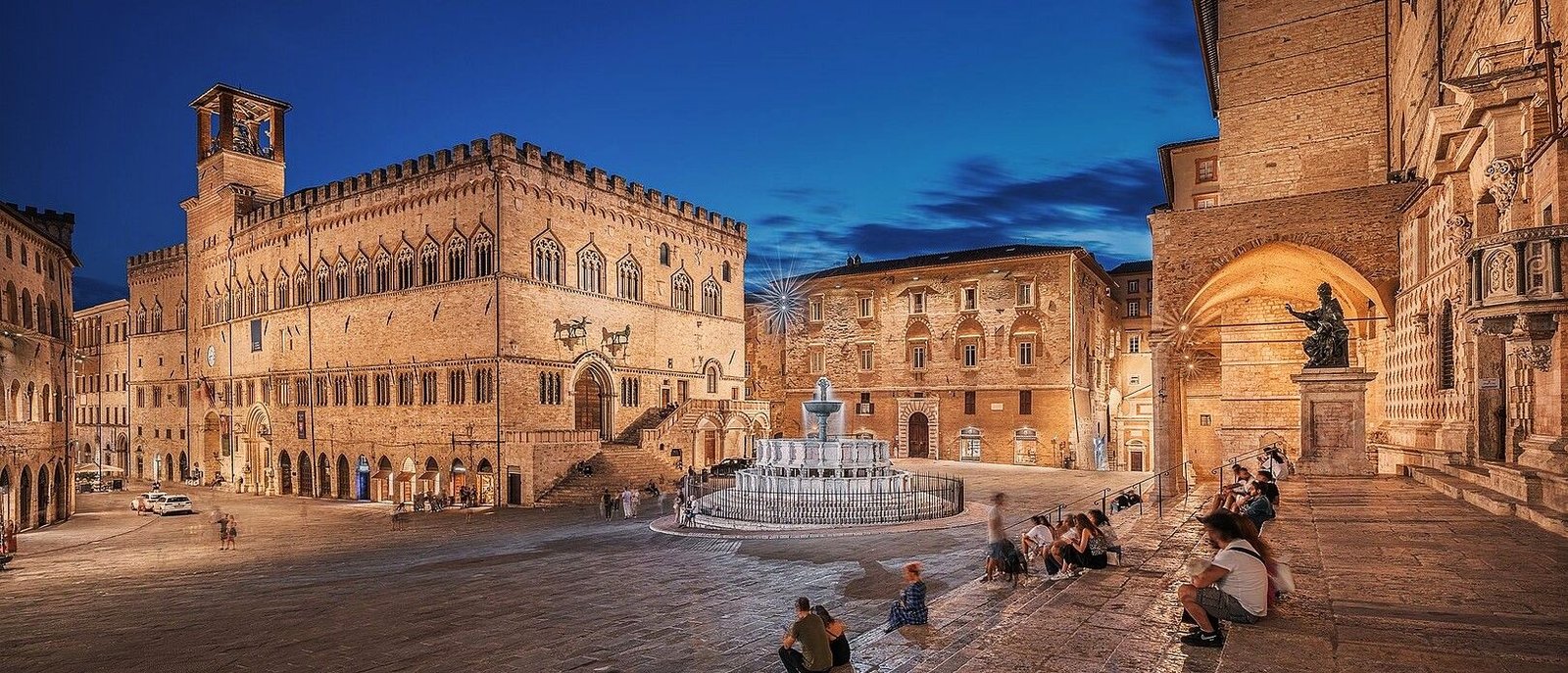
The beautiful image above, depicting Piazza IV Novembre at dusk 📱🔄️, introduces this itinerary that will guide you through the discovery of the iconic landmarks of Perugia.
See also:
Route Description
This itinerary has been designed to let you visit almost all of Perugia’s most important attractions in a single day, immersing yourself in its artistic heritage and its most charming corners.
The route is a 4.2 km circular walking itinerary, covering 10 main stops and 14 sub-stops, for an experience lasting approximately 10 hours, from morning until evening.
We will start at 8:30 a.m. from the Galleria Nazionale dell’Umbria, in the heart of the city, and finish the tour at 6:30 p.m. at the Chiesa del Gesù, ending the day with a traditional dinner at a carefully selected restaurant.
📌 The pace of the itinerary is quite demanding, so you may not have enough time to see everything. Besides the two main stops mentioned above, make sure not to miss the Complesso della Cattedrale di San Lorenzo, including a visit to Perugia Sotterranea, the Rocca Paolina, and the Museo Archeologico Nazionale dell’Umbria.
PERUGIA IN 1 DAY
- Open Route Map📍
- Distance: 4.2 km on foot
- Time: 1,03* min. on foot
- Visit duration: 10 hours
- Stops: 10 main (X → I)* + 14 secondary
- Palazzo dei Priori (X) → Cattedrale di San Lorenzo (A) → Pozzo Etrusco (B) → Arco Etrusco (C) → Cassero di Porta Sant’angelo – Museo (D) → Tempio Chiesa di San Michele Arcangelo (E) → Chiesa di San Filippo Neri (F) → Rocca Paolina (G) → Museo Archeologico Nazionale dell’Umbria (H) → Chiesa del Gesù (I)
- For days, times, prices and other info see Itinerary Table 📊
* These values may differ from those shown on Google Maps, as they are continuously recalculated in real time. See also Itinerary Info and Navigator + See here for Shared Stop 🧩
Steps Details
📌 All the stops summarized here are structured in the Itinerary Table 📊 with days, opening hours, prices, and Wikipedia 🌐 and Google Maps insights.
Morning
⬇️ starting point
X. Palazzo dei Priori
Our itinerary begins in the civic heart of Perugia, inside one of the city’s most important medieval buildings. Here is located the Galleria Nazionale dell’Umbria, which houses works by masters such as Pietro Perugino, Pinturicchio, Beato Angelico and Piero della Francesca. Within the complex you will also find highly valuable historic spaces such as:
- Collegio del Cambio, with precious frescoes by Perugino.
- Collegio della Mercanzia, featuring a finely preserved Gothic wooden hall.
✨ Visiting the Galleria Nazionale dell’Umbria means walking through one of the most powerful artistic cores of Umbria: masterpieces surround you from the very first rooms, with an almost “overwhelming” visual density.
❌ Long and very rich visit: if you exceed the 90 minutes estimated in Itinerary Table 📊, you risk completely delaying the first part of the itinerary.
⬇️
A. Cattedrale di San Lorenzo
Just a few steps away opens the city’s main religious and symbolic center, where history and urban life intertwine.
- Cattedrale di San Lorenzo, rich in artworks and medieval testimonies.
- Museo Capitolare di San Lorenzo, which preserves important sacred art artifacts.
- Perugia Sotteranea – Area Archeologica, which allows you to discover the Etruscan and Roman layers of the city.
- Fontana Maggiore, a Gothic masterpiece and symbol of the medieval city. One of the most photogenic spots of the entire itinerary, where every angle completely changes the perception of the square.
- Piazza IV Novembre, the urban and scenic heart of the city. Here you truly feel Perugia: a perfect balance between medieval power, urban space and everyday life.
✨ The interior of the Cattedrale di San Lorenzo is striking for its stratification: it is not just a church, but an architectural narrative of the city.
✨ Perugia Sotteranea is a literal dive beneath the city: you walk above two thousand years of history without even realizing it.
❌ A visit that may take longer than expected: be careful if you are following a tight schedule.
⬇️
B. Pozzo Etrusco
One of the most evocative testimonies of Etruscan Perugia, an ancient water collection system over 37 meters deep, perfectly preserved.
✨ Descending into the heart of Etruscan water is an almost physical experience: cold, silence and absolute vertical depth.
❌ A very interesting but optional stop if time is limited during the day.
⬇️
C. Arco Etrusco
Also known as Arco di Augusto, it is one of the best-preserved monumental gates of the ancient Etruscan walls and represents one of the historical entrances to the city.
✨ Walking underneath it means crossing the same entrance once used by the Etruscans: immediate and highly scenic impact.
⬇️
D. Cassero di Porta Sant’Angelo
One of the most imposing medieval fortifications in Perugia, today also a privileged panoramic viewpoint. Inside is the Museo delle Mura e delle Porte, dedicated to the city walls and their historical evolution.
❌ The uphill walk and museum visit may take longer than expected compared to a simple photo stop.
Afternoon
⬇️
E. Tempio Chiesa di San Michele Arcangelo
One of the oldest churches in Perugia, characterized by a circular plan of early medieval origin and by important artistic evidence linked to the early Christian phase of the city.
✨ Its circular layout creates a sense of primordial balance: you enter and immediately lose the classic perception of urban space.
⬇️
F. Chiesa di San Filippo Neri
A splendid example of Perugian Baroque style, with a sober façade that hides a richly decorated interior filled with gilded stuccoes, frescoes, and highly scenic architectural details.
❌ Visit strongly dependent on opening hours: if it is closed, you risk missing one of the most scenic stops of the route.
⬇️
G. Rocca Paolina e Museo della Rocca Paolina
One of the most evocative places in the city. The Rocca Paolina, commissioned by Pope Paul III in the 16th century, was a powerful fortress that absorbed part of the medieval urban fabric. Today, the underground path allows visitors to walk through ancient streets and original environments, also visiting the museum and the remaining defensive structures.
✨ The experience is immersive: dim lights, ancient stone, and silence transform the passage into something almost theatrical.
⬇️
H. Museo Archeologico Nazionale dell’Umbria
A complex of great historical and artistic value that tells the evolution of the city:
- Museo Archeologico Nazionale dell’Umbria, with one of the most important Etruscan and Roman collections in the region.
- Basilica di San Domenico, among the most imposing churches in the city, famous for its stained glass windows and artworks preserved inside.
- Chiostro del Museo Archeologico, a quiet and harmonious space, an example of monastic architecture.
✨ One of the densest collections in Umbria: here history is not observed, it is experienced layer by layer.
❌ Wide and complex visit: it may take longer than the 90 minutes estimated in the Itinerary Table 📊
“`html
📌 Based on our latest table update, the Museo Archeologico Nazionale dell’Umbria is currently closed to the public for renovation works. We recommend checking its current status on the clickable Google Maps listing linked in the table.
“`
⬇️
I. Chiesa del Gesù and historic Oratories
Final stop of the route, dedicated to Perugian Baroque style and the confraternity tradition of the city. The Chiesa del Gesù is one of the richest examples of Baroque decoration, while the surrounding oratories tell the social and religious life of the ancient confraternities:
- Oratorio della Congregazione dei Nobili, with elegant interior decorations.
- Oratorio della Congregazione degli Artisti, historically linked to the city’s cultural life.
- Oratorio dei Contadini o dei Coloni, testimony of popular devotion and ancient guilds.
✨ The interior of the Chiesa del Gesù creates an immediate scenic effect: every surface seems designed to guide the gaze upward.
❌ Historic oratories are interesting but optional if time is limited in the final part of the itinerary.
📌 Visits to the oratories are by reservation only. You can find the phone number in the clickable Google Maps listing linked in the table.
Dinner
After an eventful day immersed in art, history, and culture, the best way to end your itinerary is with dinner at one of Perugia’s traditional restaurants, where you can savor the authentic flavors of Umbrian cuisine. Some of the must-try dishes include:
- Umbricelli, a rustic Umbrian pasta, often served with rich and flavorful sauces;
- Minestra alla perugina, a traditional farmer’s soup made with vegetables and legumes;
- Torello alla perugina, a hearty local main course traditionally prepared for festive occasions;
- Torcolo di San Costanzo, a traditional Perugian cake scented with citrus fruits and anise.
To enjoy these specialties, stop at some of the city’s most renowned restaurants, such as Osteria a Priori, perfect for traditional cuisine with a contemporary touch, or Ristorante Enoteca Giò Arte e Vini, ideal for pairing local dishes with excellent Umbrian wines.
Among the wines to try, the Colli del Trasimeno DOC and the Vinosanto da uve affumicate dell’Alta Valle del Tevere stand out, both perfect companions to the flavors of Perugian cuisine.
For a complete guide on where and what to eat in Perugia, visit our dedicated guides: Where to eat in Perugia and What to eat in Perugia.
Sleeping
To make the most of your day in Perugia, the ideal place to stay is the historic center, the heart of the itinerary and the perfect starting point for exploring the city’s main attractions on foot.
By staying around Piazza IV Novembre and its surrounding area, you will be able to experience the city during its most charming hours, when the streets become quieter and the atmosphere feels more authentic and peaceful.

Alternatively, if you are looking for a quieter setting that is still well connected, the areas just outside the historic walls offer comfortable and often more affordable accommodation, ideal for reaching the city center in just a few minutes while enjoying greater convenience.
For more information on where to stay in the city, read our dedicated guide: Where to sleep in Perugia: Info and Tips.
📊 Itinerary Table
In the table below you will find all the attractions included in the itinerary, designed to help you make the most of and better orient your one-day visit to Perugia:
- Scroll the table down and to the right 📱🔄 Rotate your phone horizontally to get an overview of opening days, hours, prices of attractions, and for further details on Wikipedia 🌐 and Google Maps ➡️.
- ⚠️ Always check the opening days and hours of attractions through the Google Maps entries linked in the table. See also Itinerary Info.
- To see the explanation of each data column, click its title (e.g. Attractions Index, Ratings, Org, etc.) at the top of the table.
⏳ Caricamento tabella in corso…
📌 This table is updated every 6–12 months.
🛡️ The tables on Tourplan360.com are original content protected by copyright © and monitored through anti-plagiarism tracking systems.
FAQ
You can open the Route Map📍 directly here. Alternatively, you can check the dedicated section with all the details.
📌 See the Route Description
How much time does it take to visit Perugia in one day?
This itinerary allows you to visit the main attractions in about 10 hours.
Is this Perugia itinerary walkable?
Yes. The route is about 4.2 km long and is a circular walking itinerary in the historic center.
📌 See also Getting around Perugia
Is it necessary to book the main attractions in advance?
During peak tourist periods, it is recommended to book in advance or join guided tours to avoid queues and secure entry.
Is it possible to do this itinerary in half a day?
Yes. In half a day it is possible to visit only some of the main attractions. You can adjust the stops based on your interests.
Where can I find opening days, times, and prices of the attractions?
All updated information is available in the dedicated itinerary table, which also includes direct links to Google Maps ➡️ and Wikipedia 🌐 for each attraction.
📌 See the Itinerary Table 📊
See also
Other Destinations
🔐 Some images on this page are used under a Creative Commons license:
By PROPOLI87 – Florence, panorama from Piazzale Michelangelo – own work – CC BY-SA 4.0 – Wikimedia Commons
By © Anil Öztas – Rome, the Colosseum illuminated at night – own work – CC BY-SA 4.0 – Wikimedia Commons
By Maretta Angelini – Bologna, panoramic view of Piazza Maggiore – own work – CC BY-SA 4.0 – Wikimedia Commons
By Kristianpot – Perugia, Piazza IV Novembre, illuminated at night – own work – CC BY 4.0 – WikiCommons
,_Kolosseum_--_2024_--_0610.jpg)
