
Palermo Complete Tour – Part 1: Travel itinerary
What to see, opening hours, prices, map


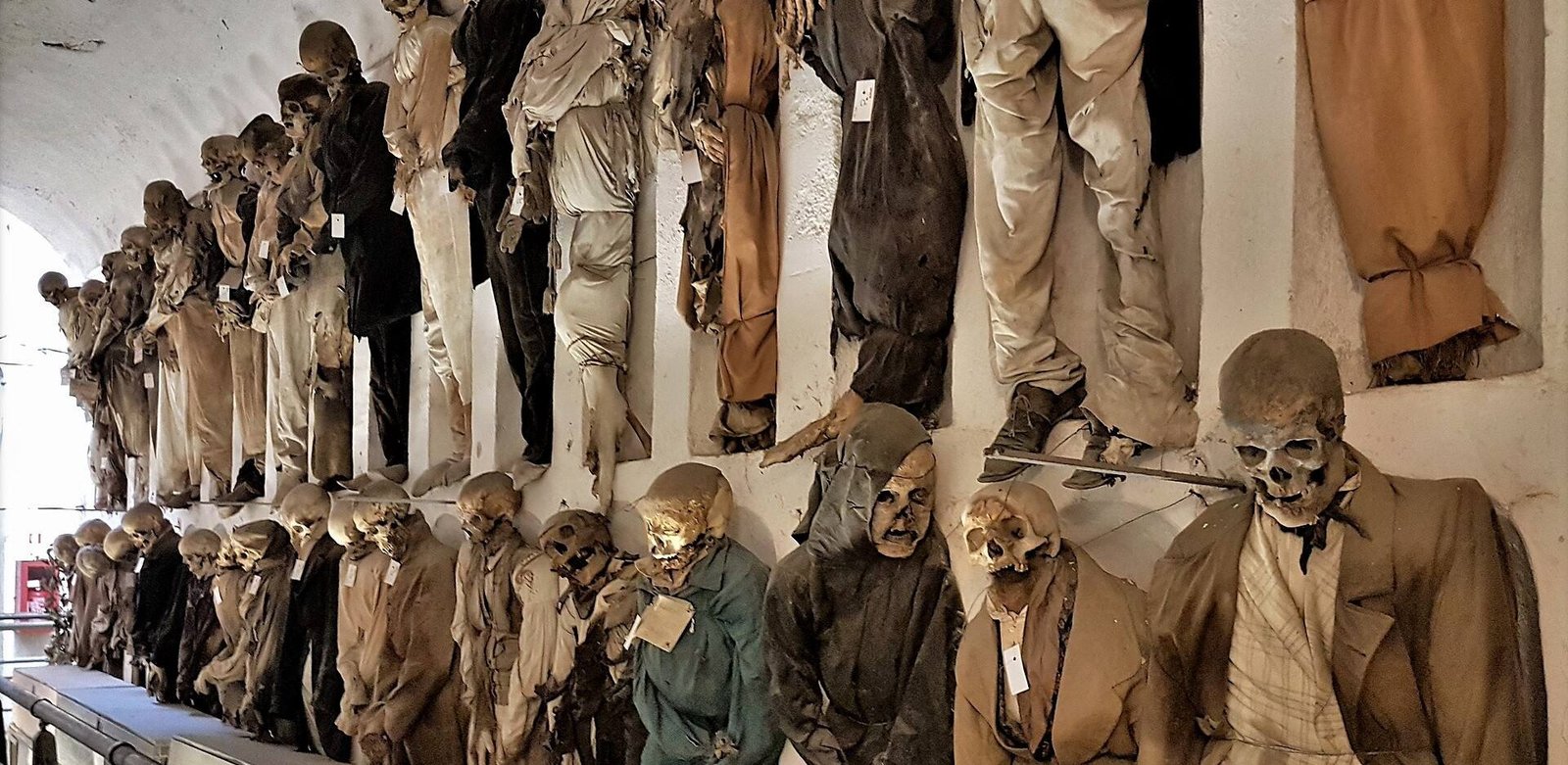
Palermo Complete Tour is an immersive journey into the city. In this first part you will see some of the most engaging attractions such as the evocative Catacombe dei Cappuccini 📱🔄️ shown above.
- 📍 Cattedrale, Normanni and Palatina
- 📍 Cappuccini and Zisa
- 📍 Teatro Massimo and Museo Salinas
- 📍 Monte Pellegrino and Santa Rosalia
- 📍 Real Casina and Mondello
See also:
- Complete Tour 2
- Guide to Palermo
- Itineraries: 1d, 3d, CT1
- See: Attractions
- Do: Experiences
- Eat: Where and What
- Getting Around, Stay
Overview
Palermo Complete Tour is designed for anyone who wants to immerse themselves in the culture of Sicily’s capital without leaving anything to chance.
The Tour, divided into Part 1 and Part 2, consists of 11 itineraries: Part 1 includes the West and North areas of the city, while Part 2 is entirely dedicated to the East area, where most of the attractions are concentrated.
The estimated total visiting time for all 11 itineraries combined is 55 hours. Let’s take a closer look:
WEST AREA
This section of the tour focuses on the western area of Palermo, featuring three linear itineraries to be completed on foot, with varying lengths never exceeding 5 km each, and average visiting times of around 5 to 6 hours per route.
In this section, you will find some of Palermo’s most important UNESCO landmarks, such as the Cattedrale di Palermo and the Palazzo dei Normanni e Cappella Palatina, as well as other major attractions such as the Catacombe dei Cappuccini, Palazzo della Zisa, Teatro Massimo and Museo Archeologico Salinas.
View maps, descriptions and detailed stops
NORTH AREA
This part of the tour includes attractions located in the northern outskirts of the city and therefore requires travelling by car or public transport. It features two linear itineraries covering a total distance of approximately 50 km, with a total visiting time of 13 hours.
Highlights across both routes include Teatro Politeama Garibaldi, the highly panoramic Monte Pellegrino and the important Santuario di Santa Rosalia. The experience ends with relaxation on the beaches of the Mondello district.
View map, description and detailed stops
📌 All routes within each area, West and North, are connected (shared stop 🧩), so you always have continuity if you want to skip one or more stops. See also Itinerary Info.
Routes: Maps, Descriptions, Details
CATTEDRALE, NORMANNI AND PALATINA
- Open Route Map📍
- Distance: 1,6* km on foot
- Time: 0,22* min. on foot
- Visit duration: 6 hours
- Stops: 10 main (X →I-X)* + 9 secondary
- Cattedrale di Palermo (X) → Palazzo Arcivescovile (A) → Palazzo Asmundo (B) → Villa Bonanno (C) → Porta Nuova (D) → Palazzo dei Normanni (E) → Museo della Specola (F) → Camera delle Meraviglie (G) → Chiesa di San Giovanni degli Eremiti (H) → Oratorio di San Mercurio (I-X)🧩
- For days, times, prices and other info see Itinerary Table 📊
* These values may differ from those shown on Google Maps, as they are continuously recalculated in real time. See also Itinerary Info and Navigator + See here for Shared Stop 🧩
Route Description
SUMMARY
This itinerary unfolds in the historic heart of the city, starting from the Cattedrale di Palermo, passing through the Archbishop’s Palace complex and the Palazzo dei Normanni, all the way to the evocative Church of San Giovanni degli Eremiti.
The walking route covers approximately 1.6 km, with 10 main stops and several sub-stops, for a total of around 6 hours of visiting time concentrated in a single compact urban itinerary.
Expand STEP DETAIL ⬇️
📌 All the stops summarized here are structured in the Itinerary Table 📊 with days, opening hours, prices, and Wikipedia 🌐 and Google Maps insights.
⬇️ starting point
X. Cattedrale di Palermo
The tour begins at the magnificent Cattedrale di Palermo (UNESCO World Heritage), one of the most important symbols of the city. This imposing building tells the story of Palermo through its architecture, which blends Arab, Norman, Gothic, and Baroque influences.
Inside, visitors can admire the Tesoro della Cattedrale di Palermo, which preserves precious sacred artifacts, including the famous crown of Constance of Aragon.
✨ Entering here means walking through centuries of layered history in a single glance: different styles coexist and merge into a monumental scene unique in the Mediterranean.
❌ During peak hours it can become very crowded, so a morning visit is recommended to enjoy the interiors in peace.
Book one of the recommended experiences here:
✅ Cathedral audio guide tour and rooftop entry ticket
✅ Walking tour of markets and historic monuments
✅ Private personalized tour with a local guide
⬇️
A. Palazzo Arcivescovile
Right next to the Cathedral stands the Palazzo Arcivescovile, seat of the Archdiocese of Palermo, which houses the Museo Diocesano di Palermo. Here are preserved extraordinary works of sacred art ranging from the Middle Ages to the Baroque period, including paintings, sculptures, and liturgical furnishings.
⬇️
B. Palazzo Asmundo
A short walk away is Palazzo Asmundo, an elegant 18th-century noble residence that now hosts a museum with collections of ancient ceramics, weapons, porcelain, and paintings. From the piano nobile, visitors enjoy a stunning view of the Cathedral.
✨ The view of the Cathedral from its historic windows offers a surprising, almost theatrical perspective, suspended between Baroque elegance and urban life.
📌 The Museo di Palazzo Asmundo can be visited by reservation. You can find the phone number in the Google Maps listing accessible from the table link.
⬇️
C. Villa Bonanno
Walking along Corso Vittorio Emanuele, you reach Villa Bonanno, a green oasis in the heart of the city, famous for its tall palm trees. Inside are the remains of the Case Romane di Villa Bonanno, a testimony to ancient imperial-era Palermo.
⬇️
D. Porta Nuova
Continuing along the route, you encounter Porta Nuova, one of the historic city gates, built to celebrate Charles V’s victory over the Ottomans. Its richly decorated façade represents one of the most striking monumental architectures in Palermo.
⬇️
E. Palazzo dei Normanni
The tour continues with a visit to the Palazzo dei Normanni (UNESCO World Heritage), the former royal residence of the Norman kings and today the seat of the Sicilian Regional Assembly.
Inside is the stunning Cappella Palatina (UNESCO World Heritage), a jewel of Byzantine art with priceless golden mosaics.
✨ The Cappella Palatina is one of those places that leaves you speechless: gold, mosaics, and light blend into a space that feels suspended in time.
❌ Access is regulated and queues are frequent, especially during peak tourist seasons; booking in advance or arriving early is recommended.
Book one of the recommended experiences:
✅ Tour of Palazzo dei Normanni and Cappella Palatina with tickets
✅ Cappella Palatina and Royal Palace tour: UNESCO heritage
⬇️
F. Museo della Specola
Inside the Astronomical Observatory of Palermo is the Museo della Specola, which tells the history of astronomy through historical scientific instruments, ancient telescopes, and celestial maps. A fascinating place for those passionate about science and history.
❌ Recommended only for visitors specifically interested in the history of astronomy, as it is less relevant in a short itinerary.
📌 The Museo della Specola can be visited upon request. You can find the phone number in the Google Maps listing accessible via the link in the table.
⬇️
G. Camera Delle Meraviglie
One of the most curious stops on the route is the Camera Delle Meraviglie, a secret room inside a historic building, completely decorated with Arabic inscriptions and blue-and-gold motifs. This mysterious and fascinating place is still the subject of studies to understand its true meaning.
✨ A hidden and hypnotic environment, where inscriptions and decorations create an almost enigmatic atmosphere, between mystery and continuous discovery.
📌 The Camera Delle Meraviglie can be visited upon request. You can find the phone number in the Google Maps listing accessible via the link in the table.
⬇️
H. Chiesa di San Giovanni degli Eremiti
The tour ends with a visit to the Chiesa di San Giovanni degli Eremiti (UNESCO World Heritage), a masterpiece of Arab-Norman architecture with its unmistakable red domes. Its cloister and surrounding garden create an atmosphere of peace and spirituality, perfect for concluding this first part of the itinerary.
⬇️
I/X. Oratorio di San Mercurio is a shared stop🧩 – See starting point of the next itinerary
CAPPUCCINI AND ZISA
- Open Route Map📍
- Distance: 5,5* km on foot
- Time: 1,16* min. on foot
- Visit duration: 6 hours
- Stops: 10 main (I-X →I-X)* + 1 secondary
- Oratorio di San Mercurio (I-X)🧩 → Parco d’Orléans (A) → Fontana dei Due Draghi (B) → Necropoli Punica di Palermo (C) → Castello della Cuba (D) → Catacombe dei Cappuccini (E) → Palazzo della Zisa (F) → Villino Florio (G) → Mercato del Capo (H) → Chiesa Immacolata Concezione al Capo (I-X)🧩
- For days, times, prices and other info see Itinerary Table 📊
* These values may differ from those shown on Google Maps, as they are continuously recalculated in real time. See also Itinerary Info and Navigator + See here for Shared Stop 🧩
Route Description
SUMMARY
This second itinerary unfolds in the western area of the city, starting from the Oratorio di San Mercurio, passing through Parco d’Orléans and Castello della Cuba, all the way to the famous Catacombe dei Cappuccini and Palazzo della Zisa.
The walking route covers approximately 5.5 km, with 10 main stops and one sub-stop, for a total of around 6 hours of visiting time spread across an itinerary rich in history, nature, and unique architecture.
Expand STEP DETAIL ⬇️
📌 All the stops summarized here are structured in the Itinerary Table 📊 with days, opening hours, prices, and Wikipedia 🌐 and Google Maps insights.
⬇️
I/X. Oratorio di San Mercurio
The itinerary begins with a visit to the Oratorio di San Mercurio, a small Baroque gem hidden among the streets of Palermo. This oratory, richly decorated with stuccoes by Giacomo Serpotta, is a perfect example of 18th-century Sicilian art and offers a highly atmospheric experience.
⬇️
A. Parco d’Orléans
After visiting the oratory, a walk through Parco d’Orléans allows you to immerse yourself in a green oasis within the city. The park, once a royal hunting reserve, is now a perfect place for a relaxing break before continuing the tour.
⬇️
B. Fontana dei due Draghi
Inside the park is the Fontana dei due Draghi, a scenic structure featuring two mythological figures intertwined in a striking water display. A little-known but very fascinating corner.
⬇️
C. Necropoli Punica di Palermo
Continuing the walk, you reach the Necropoli Punica di Palermo, one of the oldest testimonies of the city. Here you can observe rock-cut tombs dating back to the Carthaginian period, revealing Palermo’s millennia-old past as an important Phoenician center.
❌ A site that may appear quick to visit but is often underestimated in terms of logistics, access time, and walking distance.
⬇️
D. Castello della Cuba
The visit continues with the Castello della Cuba, one of the most fascinating Norman buildings in the city. Built in the 12th century as a royal leisure residence, the castle is a masterpiece of Islamic-Norman architecture and one of the most striking examples of Arab influence in Sicily.
⬇️
E. Catacombe dei Cappuccini
One of the most striking and unsettling stops on the route is the visit to the Catacombe dei Cappuccini, famous for the presence of hundreds of perfectly preserved mummified bodies. This unique place in the world offers an unusual insight into Sicilian funerary traditions between the 17th and 19th centuries.
✨ A unique and at the same time disturbing sight: memory becomes physical space, in an experience that remains deeply imprinted.
❌ During peak periods there may be waiting times at the entrance, but the visit is generally smooth and well managed.
Book here one of the recommended experiences:
✅ Private tour of the Capuchin Catacombs and Monreale Cathedral
✅ Beyond the Veil: Catacombs and Cemeteries of Palermo
⬇️
F. Palazzo della Zisa
The route continues with the Palazzo della Zisa (UNESCO World Heritage), a splendid example of Norman-Islamic architecture. Inside is the Museo d’Arte Islamica, housing artifacts that tell the story of Arab influence on Sicilian culture.
✨ An extraordinary example of Arab-Norman fusion: geometry, water, and light create a rare and fascinating architectural balance.
❌ Visits are scheduled in specific time slots, with possible queues during tourist periods.
⬇️
G. Villino Florio
After visiting the Zisa, you arrive at Villino Florio, a beautiful Art Nouveau residence belonging to the famous Florio family. The richly decorated building is one of the most important examples of modernist architecture in Sicily.
❌ An interesting stop for Liberty-style enthusiasts, but not essential in a high-priority itinerary.
⬇️
H. Mercato del Capo
The tour ends with a walk through the colors and scents of the Mercato del Capo, one of Palermo’s historic markets. Here you can immerse yourself in the lively atmosphere of the city, among stalls of local products, spices, fresh fruit, and Sicilian street food. A perfect place to taste local specialties and conclude the itinerary with an authentic experience.
✨ A full sensory immersion: colors, voices, and aromas create an authentic and vibrant urban experience.
❌ High crowd levels during lunch hours and weekends, with narrow passages that can slow down the visit.
⬇️
I/X. Chiesa Immacolata Concezione al Capo is a shared stop🧩 – See starting point of the next route
TEATRO MASSIMO AND MUSEO SALINAS
- Open Route Map📍
- Distance: 3,2* km on foot
- Time: 0,44* min. on foot
- Visit duration: 5 hours
- Stops: 9 main (I-X →H)* + 1 secondary
- Chiesa Immacolata Concezione al Capo (I-X)🧩 → Teatro Massimo Vittorio Emanuele (A) → Palazzo Francavilla (B) → Museo Archeologico “A. Salinas” (C) → Chiesa di Sant’Ignazio all’Olivella (D) → Palazzo Branciforte (E) → Chiesa di Sant’Agostino (F) → Catacombe di Porta d’Ossuna (G) → Chiesa di Santa Cristina la Vetere (H)
- For days, times, prices and other info see Itinerary Table 📊
* These values may differ from those shown on Google Maps, as they are continuously recalculated in real time. See also Itinerary Info and Navigator + See here for Shared Stop 🧩
Route Description
SUMMARY
Third itinerary in the western area of Palermo, set in the city’s monumental and cultural heart, starting from the Chiesa Immacolata Concezione al Capo, passing through the Teatro Massimo Vittorio Emanuele and the “A. Salinas” Archaeological Museum, all the way to the evocative Catacombe di Porta d’Ossuna.
The walking route covers approximately 3.2 km, with 9 main stops and one sub-stop, for a total of around 5 hours of visiting time spread across a compact itinerary combining art, history, and urban archaeology.
Expand STEP DETAIL ⬇️
📌 All the stops summarized here are structured in the Itinerary Table 📊 with days, opening hours, prices, and Wikipedia 🌐 and Google Maps insights.
⬇️
I/X. Chiesa Immacolata Concezione al Capo
The tour begins with a visit to the Chiesa Immacolata Concezione al Capo, an authentic Baroque gem located in the heart of the Capo market. The church, often overlooked by tourists, is an explosion of stuccoes, frescoes, and polychrome marble, creating a breathtaking scenic effect.
❌ During market hours, access may feel less immersive due to noise and continuous pedestrian traffic.
⬇️
A. Teatro Massimo Vittorio Emanuele
After visiting the church, continue to the Teatro Massimo Vittorio Emanuele, the largest opera house in Italy and one of the most imposing in Europe. This building, a symbol of 19th-century Palermo, boasts perfect acoustics and majestic architecture, with its unmistakable neoclassical colonnade overlooking Piazza Verdi.
✨ The monumentality of the hall and the scenic perfection of the interior spaces create a visual and acoustic impact that immediately conveys the absolute grandeur of 19th-century Palermo.
❌ Internal visits are available only at fixed times: without booking, you risk losing time compared to the rest of the itinerary.
✅Tour guided of Teatro Massimo
⬇️
B. Palazzo Francavilla
A few steps from Teatro Massimo stands Palazzo Francavilla, a splendid example of a Sicilian noble residence. This palace, with its refined decorations and Art Nouveau details, offers a glimpse into aristocratic Palermo at the end of the 19th century.
📌 Palazzo Francavilla can be visited upon request. You can find the phone number in the Google Maps listing accessible via the link in the table.
⬇️
C. Museo Archeologico “A. Salinas”
The itinerary continues with a cultural stop at the Museo Archeologico “A. Salinas”, one of the most important archaeological museums in Italy. Here you can admire an extraordinary collection of Phoenician, Greek, and Roman artifacts, including the metopes from the temples of Selinunte, true masterpieces of archaic Greek sculpture.
✨ The metopes of Selinunte and the classical artifacts create a powerful visual impact: here, the ancient history of Sicily takes on a tangible and monumental form.
⬇️
D. Chiesa di Sant’Ignazio all’Olivella
A few meters from the museum is the Chiesa di Sant’Ignazio all’Olivella, one of the most important Baroque churches in Palermo. Its sober façade contrasts with the richly decorated interior, which preserves valuable works of art and a spectacular frescoed ceiling.
⬇️
E. Palazzo Branciforte
The visit continues with Palazzo Branciforte, now home to the Fondazione Sicilia and its museum. This noble palace, beautifully restored by Gae Aulenti, houses a collection of ceramics, coins, and sculptures, as well as an extraordinary 18th-century wooden library.
✨ A signature restoration that transforms the palace into a total museum experience: architecture, collections, and vertical spaces create an elegant and surprising journey.
⬇️
F. Chiesa di Sant’Agostino
After Palazzo Branciforte, the route continues to Chiesa di Sant’Agostino, an example of Catalan-Gothic architecture. Inside, it preserves splendid frescoes and a magnificent portal decorated with bas-reliefs depicting biblical scenes.
❌ Interesting but not essential compared to other Baroque and monumental stops in the same itinerary.
⬇️
G. Catacombe di Porta d’Ossuna
One of the most fascinating and mysterious stops on the itinerary is the visit to the Catacombe di Porta d’Ossuna, a complex of early Christian burial sites dating back to the 4th century. This underground site offers a journey into Palermo’s late antique past, with rock-cut tunnels and evocative funerary inscriptions.
❌ Limited access and routes may extend visiting times beyond expectations.
⬇️
H. Chiesa di Santa Cristina la Vetere
The tour ends with a visit to the Chiesa di Santa Cristina la Vetere, one of the oldest churches in Palermo, linked to the city’s patron saint. This small medieval building, with its austere and intimate charm, represents a perfect final stop to conclude the itinerary with a moment of reflection on the city’s long history.
MONTE PELLEGRINO AND SANTA ROSALIA
- Open Route Map📍
- Distance: 42,9* km by car
- Time: 1,34* min. by car
- Visit duration: 6 hours
- Stops: 10 main (X →I-X)* + 2 secondary
- Villa Malfitano Whitaker (X) → Palazzo Ziino (A) → Teatro Politeama Garibaldi (B) → Pinacoteca di Villa Zito (C) → Arsenale Borbonico (D) → Casa Florio – Palazzina dei Quattro Pizzi (E) → Santuario di Santa Rosalia (F) → Belvedere di Monte Pellegrino (G) → Parco della Favorita (H) → Museo del Caffè Morettino (I-X)🧩
- For days, times, prices and other info see Itinerary Table 📊
* These values may differ from those shown on Google Maps, as they are continuously recalculated in real time. See also Itinerary Info and Navigator + See here for Shared Stop 🧩
Route Description
SUMMARY
This driving itinerary combines culture, scenery, and history, taking you from Villa Malfitano Whitaker to the famous Monte Pellegrino, with visits to the Santuario di Santa Rosalia, the Belvedere, and some of the most representative sites of nineteenth-century Palermo.
The route covers approximately 42.9 km, with 10 main stops and 2 sub-stops, for a total of around 6 hours of visiting time spread across a driving itinerary among historic villas, culture, nature, and sea panoramas.
Expand STEP DETAIL ⬇️
📌 All the stops summarized here are structured in the Itinerary Table 📊 with days, opening hours, prices, and Wikipedia 🌐 and Google Maps insights.
⬇️ starting point
X. Villa Malfitano Whitaker
The itinerary begins with a visit to Villa Malfitano Whitaker, a magnificent 19th-century residence surrounded by a lush exotic garden. The villa belonged to the Whitaker family, famous for producing Marsala wine. Inside, it preserves original furnishings, frescoes, and a rich collection of artworks from around the world.
✨ Walking through its rooms and exotic gardens gives the feeling of entering an elegant and cosmopolitan world, far from the rhythm of the modern city.
⬇️
A. Palazzo Ziino
Continuing the tour, you reach Palazzo Ziino, a refined neoclassical residence now used for exhibitions and cultural events. The Museo di Palazzo Ziino hosts interesting temporary exhibitions of contemporary art, offering a glimpse into Sicilian and international creativity.
❌ The value of the visit depends heavily on the temporary exhibitions on display, making it less of a priority compared to other stops on the itinerary.
⬇️
B. Teatro Politeama Garibaldi
The journey continues to one of Palermo’s symbols: Teatro Politeama Garibaldi. Built in the 19th century, the theatre is known for its elegant neoclassical architecture and the distinctive bronze horse quadriga on its façade. It is home to the Sicilian Symphony Orchestra and hosts prestigious musical events.
✨ The scenic quadriga dominating the façade offers one of the most iconic urban views of 19th-century Palermo.
⬇️
C. Pinacoteca di Villa Zito
The next stop is the Pinacoteca di Villa Zito, which houses an extraordinary collection of paintings from the 16th to the 20th century. Here you can admire works by Sicilian and Italian painters, as well as prints, historical photographs, and a section dedicated to contemporary art.
❌ Recommended mainly for art enthusiasts; on a tight schedule, it can easily be skipped.
⬇️
D. Arsenale Borbonico
The route continues towards the Museo del Mare, located inside the Arsenale Borbonico, an 18th-century historic building. The museum tells the maritime history of Palermo through ship models, navigation instruments, and archaeological finds linked to the sea.
⬇️
E. Casa Florio – Palazzina dei Quattro Pizzi
Casa Florio, also known as Palazzina dei Quattro Pizzi, is an unmissable stop. This elegant residence belonged to the famous Florio family, key figures of 19th-century Sicilian industry. Overlooking the sea, the building still preserves original furnishings and traces of the dynasty’s grandeur.
⬇️
F. Santuario di Santa Rosalia
Leaving the city, you ascend Monte Pellegrino to visit the Santuario di Santa Rosalia, Palermo’s patron saint. The sanctuary is carved into the rock and preserves the saint’s relics. It is a place of deep spirituality and devotion, as well as an unmissable destination for visitors.
✨ A unique place where nature, spirituality, and rock merge into an environment that conveys a truly special sense of contemplation.
❌ The ascent to Monte Pellegrino takes longer than often expected, especially during heavy traffic periods.
⬇️
G. Belvedere di Monte Pellegrino
Continuing the climb, you reach the Belvedere di Monte Pellegrino, which offers breathtaking views over all of Palermo and the sea. This panoramic viewpoint is perfect for taking spectacular photos and watching the sunset over the city.
✨ One of the most spectacular panoramas in Sicily: the city, the gulf, and the mountains unfold in a memorable single view.
❌ At sunset and on weekends, the viewpoint can be very crowded, with congested parking and viewing areas.
⬇️
H. Parco della Favorita
The itinerary ends at Parco della Favorita, Palermo’s green lung. This large park, created by the Bourbons in the 18th century, offers wide green areas, walking paths, and perfect spaces for relaxation.
⬇️
I/X. Museo del Caffè Morettino is a shared stop🧩 – See starting stop of the next itinerary
REAL CASINA AND MONDELLO
- Open Route Map📍
- Distance: 12,4* km by car
- Time: 0,27* min. by car
- Visit duration: 8 hours
- Stops: 6 main (I-X →E)*
- Museo del Caffè Morettino (I-X)🧩 → Villa Niscemi (A) → Museo Etnografico Siciliano “G. Pitrè” (B) → Real Casina Cinese (C) → Grotta dell’Addaura (D) → Mondello (E)
- For days, times, prices and other info see Itinerary Table 📊
* These values may differ from those shown on Google Maps, as they are continuously recalculated in real time. See also Itinerary Info and Navigator + See here for Shared Stop 🧩
Route Description
SUMMARY
This second and final itinerary in the northern area of Palermo focuses on unique and scenic experiences, starting from the Museo del Caffè Morettino, passing through Villa Niscemi and the Real Casina Cinese, all the way to the beautiful seaside area of Mondello.
The route covers approximately 12.4 km, with 6 main stops, for a total of around 8 hours of visiting time spread across an itinerary combining culture, Sicilian traditions, nature, and the sea.
Expand STEP DETAIL ⬇️
📌 All the stops summarized here are structured in the Itinerary Table 📊 with days, opening hours, prices, and Wikipedia 🌐 and Google Maps insights.
⬇️
I/X. Museo del Caffè Morettino
The itinerary begins with a visit to the Museo del Caffè Morettino, an unmissable experience for coffee lovers. Here you can trace the history of Sicilian roasting and discover vintage coffee machines, ancient processing tools, and a rich collection of coffee beans from around the world. A tasting experience is also included, allowing visitors to enjoy authentic Sicilian espresso.
✨ The aroma of coffee accompanies an unusual journey through culture, tradition, and tasting, turning a simple visit into a sensory experience.
📌 The Morettino Coffee Museum can be visited by reservation. You will find the phone number on the Google Maps listing accessible via the link in the table.
⬇️
A. Villa Niscemi
Continuing the tour, you arrive at Villa Niscemi, a splendid aristocratic residence surrounded by greenery. Today it serves as an official representative seat of the Municipality of Palermo, but the villa still preserves its sumptuous interiors with frescoes, period furniture, and a historic library. Its garden is an oasis of tranquility, ideal for a short walk among centuries-old trees and fountains.
✨ Between historic halls and quiet gardens, you can feel the elegant atmosphere of Palermo’s great aristocratic residences.
📌 Villa Niscemi can be visited by reservation. You will find the phone number on the Google Maps listing accessible via the link in the table.
⬇️
B. Museo Etnografico Siciliano “G. Pitrè”
A short distance from Villa Niscemi lies the Museo Etnografico Siciliano “Giuseppe Pitrè”, a unique place to discover the island’s popular traditions. The museum hosts a vast collection of objects related to Sicilian daily life, including traditional costumes, musical instruments, handcrafted items, and evidence of rural and maritime culture.
❌ The richness of the collection requires more visiting time than one might initially expect.
📌 The Sicilian Ethnographic Museum “G. Pitrè” can be visited by mandatory reservation. You will find the phone number on the Google Maps listing accessible via the link in the table.
⬇️
C. Real Casina Cinese
Continuing the tour, you reach the Real Casina Cinese, an architectural masterpiece in an exotic style. This royal Bourbon residence, located within the greenery of the Parco della Favorita, was commissioned by Ferdinand III of Bourbon as a retreat away from the city. The interior is a fascinating mix of Chinese, neo-Gothic, and neoclassical styles, with finely decorated rooms and original furnishings.
✨ One of the most unusual architectural sites in all of Sicily and one that often exceeds visitors’ expectations.
⬇️
D. Grotta dell’Addaura
After visiting the Casina Cinese, you reach one of Sicily’s most fascinating archaeological sites: the Grotta dell’Addaura. Located on Monte Pellegrino, this cave is famous for its Paleolithic rock engravings. The depictions of human and animal figures illustrate prehistoric life scenes, representing one of the most important examples of rock art in the Mediterranean.
✨ Standing in front of engravings made thousands of years ago creates a direct connection with one of the oldest chapters of human presence in the Mediterranean.
❌ Accessibility and visiting conditions may be subject to restrictions; it is advisable to check opening availability before planning the stop.
⬇️
E. Mondello
The itinerary ends in the beautiful seaside area of Mondello, one of Palermo’s most famous beaches. Here you can relax on white sand and swim in the crystal-clear waters of the Tyrrhenian Sea. Mondello is also known for its Art Nouveau architecture, with landmarks such as the iconic Charleston, one of the city’s most emblematic restaurants.
✨ The combination of white sand, turquoise sea, and Liberty-style villas creates a landscape reminiscent of some of the most famous seaside destinations in the Mediterranean.
❌ During summer months and weekends, parking and the beach can quickly reach maximum crowding; it is better to arrive early in the morning.
Eating
During the tour, breaks along the different itineraries become an opportunity to discover the most authentic flavors of Sicilian tradition.
Between one stop and the next, the city also tells its story through its cuisine, made of street food and iconic dishes that represent the true soul of Palermo:
- Arancini di riso, the ultimate symbol of Palermitan street food, perfect to enjoy along the route.
- Panelle and crocchè, stars of the historic markets and everyday street food of the city.
- Frittola, one of the oldest and most popular specialties of Palermitan tradition.
- Pasta con le sarde and pasta câ muddica, first courses that tell the deep connection between sea and land.
- Anelletti al forno, a typical dish of family tables and Sicilian convivial occasions.
- Caponata di melanzane, a symbol of the island’s sweet-and-sour cuisine, rich in history and flavor contrasts.
- Involtini alla palermitana and cotoletta alla palermitana, rich and flavorful main courses of the local tradition.
- Cannolo siciliano and cassata siciliana, the most iconic desserts of Sicilian pastry.
See also What to eat in Palermo
Some restaurants in the western and northern areas covered by the five itineraries are ideal for enjoying traditional dishes:
- Antica Focacceria San Francesco – a historic institution of Palermitan street food, just a short walk from the historic center and the main stops of the itinerary.
- Osteria dei Vespri – refined Sicilian cuisine in a central and strategic location near the main monuments of the route.
- Trattoria ai Cascinari – authentic and traditional cuisine in a simple and genuine setting.
- Ristorante Palazzo Branciforte – elegant gastronomic experience inside one of the most charming palaces in the city.
- Bye Bye Blues – high-end dining experience in Mondello, among the most refined interpretations of modern Sicilian cuisine.
- Charleston – historic seaside restaurant in Mondello, iconic for its location and atmosphere.
See also Where to eat in Palermo.
Sleeping
To make the most of the Complete Tour Part 1, the most strategic choice is to stay in the historic center, in the area between the Cattedrale, Quattro Canti, and Teatro Massimo.
From here, most of the urban itinerary stops can be reached on foot, including monuments, churches, museums, and historic markets, without the need for transportation.

For itineraries that include wider areas such as Monte Pellegrino, the Parco della Favorita, and the seaside area of Mondello, it can be useful to have a car or arrange dedicated transfers.
Alternatively, a second strategic base is the area between Politeama and Via Libertà, which is more modern and better connected to the main routes toward the coast and the outskirts of the city.
See also Where to sleep in Palermo: Info and Tips.
📊 Itinerary Table
The table below shows all the stops of the five routes of the Palermo Complete Tour Part 1, to help you optimize your visit as effectively as possible.
- Scroll the table down and to the right 📱🔄 Rotate your phone horizontally to get an overview of opening days, hours, prices of attractions, and for further details on Wikipedia 🌐 and Google Maps ➡️.
- ⚠️ Always check the opening days and hours of attractions through the Google Maps entries linked in the table. See also Itinerary Info.
- To see the explanation of each data column, click its title (e.g. Attractions Index, Ratings, Org, etc.) at the top of the table.
⏳ Caricamento tabella in corso…
📌 This table is updated every 6–12 months.
🛡️ The tables on Tourplan360.com are original content protected by copyright © and monitored through anti-plagiarism tracking systems.
FAQ
Palermo Complete Tour Part 1 is organized into 5 itineraries: the first three routes mainly develop in the historic center and can be done on foot, while the remaining two routes are dedicated to the outer areas of the city and require travel by car or public transport.
📌 See also Overview
Is it possible to skip stops or customize the itineraries?
Yes. In the five itineraries of Palermo Complete Tour Part 1 you can remove stops or change their order while always maintaining route continuity. This allows you to adapt the experience based on your interests and available time.
📌 See also Itinerary Info: How to Read, Understand, and Experience Each Route
Can these itineraries be done on foot?
Yes. The first three itineraries of Palermo Complete Tour Part 1 (western area and historic center) are designed to be explored on foot. The remaining two itineraries, covering the northern area and the outskirts, are designed to be done by car or public transport.
📌 See also Getting around Palermo: Info and Tips
Is it worth booking the main attractions in advance?
During peak tourist seasons, it is recommended to book in advance or join guided tours to avoid waiting times and ensure entry to the most popular attractions.
📌 See also Experiences in Palermo: Tours, Tickets and Useful Info
How long does it take to complete Palermo Complete Tour Part 1?
Palermo Complete Tour Part 1 includes approximately 30 hours of visiting time spread across the five itineraries.
Where can I find opening days, times, and prices of attractions?
All updated information is available in the Itinerary Table 📊, with direct links to Google Maps and Wikipedia for further details.
See also
- Complete Tour 2
- Palermo in 1 day
- Palermo in 3 days
- Guide to Palermo
- See: Attractions
- Do: Experiences
- Eat: Where and What
- Getting Around, Stay
Other Destinations
🔐 Some images on this page are used under a Creative Commons license:
By Stefano Marrocu – Cagliari, flamingos in the Molentargius area – Own work – CC BY-SA 3.0 – Wikimedia Commons
By Richard Nevell – Naples, panoramic view of the city and Mount Vesuvius – Own work – CC BY-SA 4.0 – Wikimedia Commons
By Ildivisore2 – Catanzaro, panoramic view of the city – Own work – CC BY 4.0 – Wikimedia Commons
By Rolf Dietrich Brecher from Germany – Palermo, Capuchin Catacombs – interior. – CC BY-SA 2.0 – Wikimedia Commons
.jpg)