
Palermo Complete Tour – Part 2: Travel itinerary
What to see, opening hours, prices, map


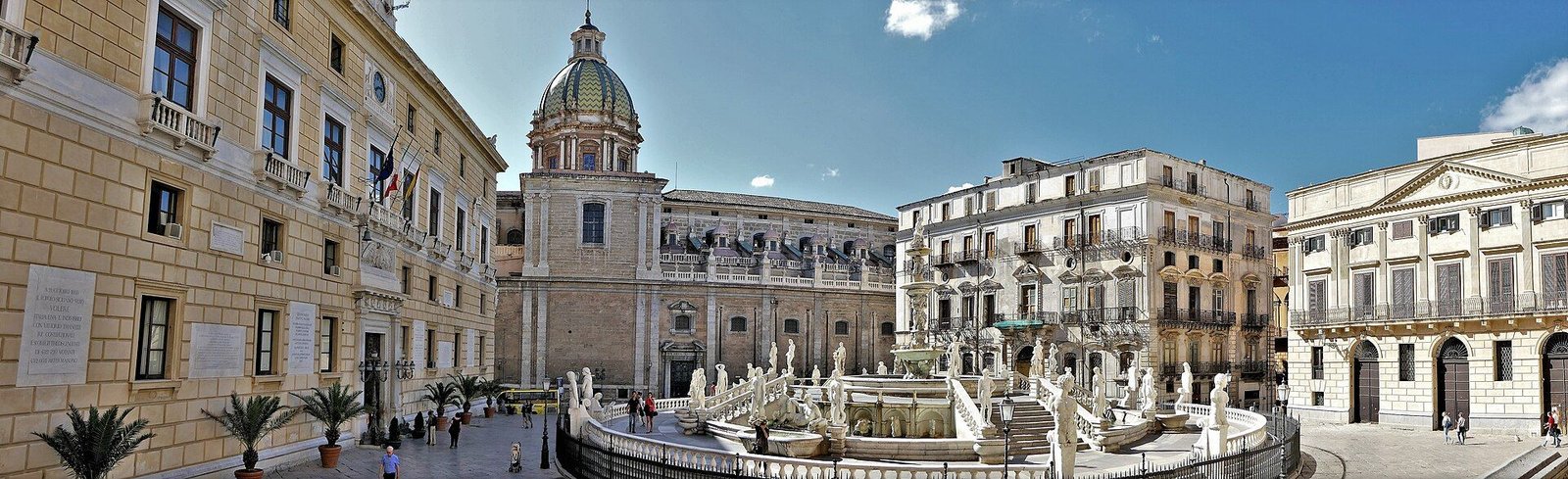
The splendid setting of the Fontana Pretoria introduces this Part 2 of the Complete Palermo Tour, which will lead you to discover other magnificent attractions and hidden gems.
- 📍 4 Canti and Fontana Pretoria
- 📍 Martorana and San Lorenzo
- 📍 Palazzo Mirto and Steri
- 📍 Palazzo Abatellis and Foro Italico
- 📍 Palazzo Gangi and Orto Botanico
- 📍 Ballarò and Casa Professa
See also:
- Complete Tour 1
- Guide to Palermo
- Itineraries: 1d, 3d, CT2
- See: Attractions
- Do: Experiences
- Eat: Where and What
- Getting Around, Stay
Overview
This second part of the Complete Palermo Tour unfolds in the eastern part of the city, where most of the monumental and museum attractions are concentrated.
To allow you to explore everything in a complete and relaxed way, we have designed 6 linear walking routes, all no longer than 3 km, with an average visiting time of no more than 6 hours each.
Along the routes you will find several notable highlights. Among the most important are: Piazza Pretoria and its Fontana, the Chiesa di San Cataldo and the Church of the Admiral, the Martorana (both UNESCO-listed sites), Palazzo Mirto and Steri, the Galleria Regionale della Sicilia in Palazzo Abatellis, the Chiesa di Santa Maria dello Spasimo and Santa Teresa alla Kalsa, the Orto Botanico di Palermo, and finally the Mercato di Ballarò and Casa Professa.
📌 All walking routes are connected (shared stop 🧩), so you always have continuity if you want to skip one or more stops. See also Itinerary Info.
Routes: Maps, Descriptions, Details
4 CANTI AND FONTANA PRETORIA
- Open Route Map📍
- Distance: 1* km on foot
- Time: 0,12* min. on foot
- Duration: 5 hours
- Stops: 10 main (X → I-X)* + 1 secondary
- Cattedrale di Palermo (X) → Chiesa del Santissimo Salvatore (A) → RISO Museo d’Arte Contemporanea (B) → Palazzo Alliata di Villafranca (C) → Chiesa di San Giuseppe dei Teatini (D) → Quattro Canti (E) → Piazza Pretoria (F) → Palazzo Bonocore (G) → Chiesa di Santa Caterina d’Alessandria (H) → Chiesa di San Cataldo (I-X)🧩
- For days, times, prices and other info see Itinerary Table 📊
* These values may differ from those shown on Google Maps, as they are continuously recalculated in real time. See also Itinerary Info and Navigator + See here for Shared Stop 🧩
Route Description
SUMMARY
First itinerary of Part 2 of the Complete Palermo Tour, a route in the heart of the historic center that leads through some of the city’s most iconic places, from the RISO Museo d’Arte Contemporanea della Sicilia to the famous Quattro Canti, passing by the monumental Fontana Pretoria and the elegant Piazza Pretoria.
The itinerary covers approximately 1 km on foot, includes 10 main stops and one sub-stop, for a total estimated duration of about 5 hours of visiting time.
Expand STEP DETAIL ⬇️
📌 All the stops summarized here are structured in the Itinerary Table 📊 with days, opening hours, prices, and Wikipedia 🌐 and Google Maps insights.
⬇️ starting point
X. Cattedrale di Palermo
The route starts from the Cattedrale di Palermo (UNESCO World Heritage), the city’s most imposing religious symbol, with its majestic façade that blends different architectural styles, from Norman to Baroque. In addition to the main building, the visit can include the cathedral treasury, which houses precious artifacts, and the rooftop walkways, offering a spectacular panoramic view over the city.
📌 Itinerary note: the Cathedral is the landmark of the historic center from which the route toward the eastern area of the city ideally begins. If you have already visited it in Part 1, you can skip directly to the next stop.
⬇️
A. Chiesa del Santissimo Salvatore
Just a few steps from the Cathedral lies the Chiesa del Santissimo Salvatore, a Baroque masterpiece characterized by an elliptical floor plan and a riot of golden decorations. This church, often less crowded than others, offers an immersive experience among frescoes and plays of light.
📌 The Chiesa del Santissimo Salvatore can be visited by request. You will find the phone number in the Google Maps listing accessible from the table link.
⬇️
B. RISO Museo d’Arte Contemporanea
After admiring the charm of Baroque art, the atmosphere changes with a stop at the RISO Museo d’Arte Contemporanea, housed inside a historic building. This museum represents one of Palermo’s most innovative cultural institutions, with temporary exhibitions by Italian and international artists interacting with the city’s historical context.
⬇️
C. Palazzo Alliata di Villafranca
Continuing along the route, you arrive at Palazzo Alliata di Villafranca, a noble residence of extraordinary charm. Inside, you can admire lavish decorations, original furnishings, and important paintings, including works by Van Dyck and Matthias Stomer.
⬇️
D. Chiesa di San Giuseppe dei Teatini
One of the most spectacular examples of Palermo Baroque is the Chiesa di San Giuseppe dei Teatini, located near the Quattro Canti. With its breathtaking frescoes, decorated dome, and polychrome marble inlays, this church is a true treasure chest of sacred art.
⬇️
E. Quattro Canti
Arriving in the heart of the city, you reach the Quattro Canti, the monumental crossroads that divides the historic center into four districts. This scenic square is surrounded by 17th-century buildings with allegorical statues and elaborate decorations.
A few steps away is the Fontana Pretoria, one of the most beautiful and controversial fountains in the city, with its marble nude statues that earned it the nickname “Fountain of Shame.”
✨ The Quattro Canti are a perfect urban theater: every corner frames Baroque palaces and statues that seem to mark the rhythm of the city, as if Palermo were an open stage.
❌ Always a very busy and crowded intersection: stops tend to be short and not very smooth during peak hours.
⬇️
F. Piazza Pretoria
Dominated by the majestic fountain, Piazza Pretoria is one of the most evocative urban spaces in Palermo. Surrounded by historic buildings, including the Town Hall, the square offers a perfect glimpse of the Renaissance and Baroque elegance of the city.
⬇️
G. Palazzo Bonocore
Among the buildings overlooking Piazza Pretoria stands Palazzo Bonocore, a refined noble palace recently restored and now used as an exhibition space. Here you can admire multimedia exhibitions and explore the city’s history through interactive installations.
⬇️
H. Chiesa di Santa Caterina d’Alessandria
The itinerary concludes with a visit to the Chiesa di Santa Caterina d’Alessandria, a masterpiece of Sicilian Baroque art. This church is famous for its spectacular frescoes, precious marble, and richly decorated interior. The adjacent convent is also worth visiting, where traditional sweets prepared according to ancient monastic recipes can be purchased.
✨ An explosion of Sicilian Baroque culminating in a unique experience: from the church to the convent, where monastic sweets end the visit with a surprising and authentic touch.
❌ The full visit (church + convent + sweets) takes more time than expected, which is why it is placed as the final stop of the route.
⬇️
I/X. Chiesa di San Cataldo is a shared stop🧩 – See starting stop of the next route
MARTORANA AND SAN LORENZO
- Open Route Map📍
- Distance: 1,3* km on foot
- Time: 0,18* min. on foot
- Duration: 4 hours
- Stops: 10 main (I-X → I-X)* + 1 secondary
- Chiesa di San Cataldo (I-X)🧩 → Chiesa dell’Ammiraglio della Martorana (A) → Chiesa di San Matteo al Cassaro (B) → Chiesa di Sant’Antonio Abate (C) → Mercato della Vucciria (D) → Chiesa di San Domenico (E) → Oratorio del Rosario di San Domenico (F) → Oratorio di San Lorenzo (G) → Oratorio dell’Immacolatella (H) → Chiesa di San Francesco d’Assisi (I-X)🧩
- For days, times, prices and other info see Itinerary Table 📊
* These values may differ from those shown on Google Maps, as they are continuously recalculated in real time. See also Itinerary Info and Navigator + See here for Shared Stop 🧩
Route Description
SUMMARY
This second itinerary highlights some UNESCO masterpieces such as the Chiesa di San Cataldo and the Martorana, as well as famous Baroque oratories like the one of San Lorenzo, all the way to the lively Mercato della Vucciria, in a blend of art, faith, and everyday local life.
The route covers approximately 1.3 km on foot, with 10 main stops and one sub-stop, for a total estimated duration of about 4 hours of visiting time.
Expand STEP DETAIL ⬇️
📌 All the stops summarized here are structured in the Itinerary Table 📊 with days, opening hours, prices, and Wikipedia 🌐 and Google Maps insights.
⬇️ starting point
I/X. Chiesa di San Cataldo
The itinerary begins with a visit to the evocative Chiesa di San Cataldo (UNESCO World Heritage), one of Palermo’s most recognizable symbols thanks to its three distinctive red domes. Built in the 12th century, this church is a perfect example of Norman architecture with Arab influences, characterized by a simple yet fascinating structure, sober interiors, and mosaic floors that recall the ancient artistic traditions of the city.
✨ The three red domes rising from the historic center create a unique visual impact: a fragment of the Middle Ages suspended in time, essential yet magnetic.
❌ Limited interior space: visits may slow down during peak tourist flow along the UNESCO circuit.
⬇️
A. Chiesa dell’Ammiraglio della Martorana
Just a few steps from Chiesa di San Cataldo lies the Chiesa dell’Ammiraglio della Martorana (UNESCO World Heritage), a masterpiece of Byzantine and Baroque art. Famous for its extraordinary golden mosaics, among the oldest and most precious in Sicily, the Martorana represents a meeting point between Eastern and Western influences that define Palermo’s history.
✨ The golden Byzantine mosaics envelop the viewer in an almost unreal glow: an interior that seems to shine with its own light, among the most spectacular in Sicily.
❌ Regulated entry and variable access times: possible waiting time during peak tourist periods.
⬇️
B. Chiesa di San Matteo al Cassaro
Continuing along the Cassaro, one of the oldest streets in the city, you encounter the Chiesa di San Matteo, a lesser-known but highly fascinating example of Sicilian Baroque. The interior is richly decorated with frescoes and stuccoes, reflecting the splendor of 18th-century Palermo style.
⬇️
C. Chiesa di Sant’Antonio Abate
Not far away lies the Chiesa di Sant’Antonio Abate, a small hidden gem located in a strategic position among the main streets of the historic center. Its simple façade hides a richly decorated interior and a history tied to the medieval traditions of the city.
⬇️
D. Mercato della Vucciria
After the religious stops, it is time to dive into the beating heart of Palermo: the Mercato della Vucciria. Once the most important market in the city, today it is a mix of tradition and modernity, with stalls of fish, meat, fruit, and spices alternating with street food spots where you can taste local specialties such as pane con la milza, panelle, and sfincione. An essential stop for anyone who wants to experience the authentic soul of Palermo.
✨ An explosion of life, colors, and voices: between intense aromas and authentic street food, you experience the rawest and most genuine soul of Palermo.
❌ Very chaotic area in the evening hours and on weekends: a less smooth experience for those seeking an orderly visit.
⬇️
E. Chiesa di San Domenico
After the market, the visit continues to the Chiesa di San Domenico, one of the largest and most imposing churches in the city. This place, known as the “Pantheon of Palermo,” hosts the tombs of several notable figures, including Giovanni Falcone. Next to the church is the Museo del Risorgimento “V. E. Orlando”, which collects historical documents and artifacts related to Italian unification.
⬇️
F. Oratorio del Rosario di San Domenico
Near the church is the Oratorio del Rosario di San Domenico, a true decorative masterpiece created by Palermo’s master stucco artists in the 18th century. The walls are covered with detailed stuccoes and frescoes, including works by the famous painter Vito D’Anna.
⬇️
G. Oratorio di San Lorenzo
One of the most atmospheric oratories in the city is the Oratorio di San Lorenzo, famous for the splendid stuccoes by Giacomo Serpotta, the greatest Sicilian Baroque sculptor. This place also once housed one of Caravaggio’s most famous works, “Nativity with Saints Lawrence and Francis of Assisi”, unfortunately stolen in 1969 and never recovered.
✨ Serpotta’s stuccoes transform the space into a three-dimensional Baroque theater: every detail seems to move in the light, creating an almost theatrical effect.
❌ Short visit but often slowed down by small organized groups: risk of delays during midday hours.
⬇️
H. Oratorio dell’Immacolatella
The itinerary concludes with a visit to the Oratorio dell’Immacolatella, another magnificent example of Giacomo Serpotta’s stucco school. Here, the decorations create an incredible scenic effect, with allegorical figures seemingly emerging from the walls and guiding visitors through a symbolic journey between faith and art.
⬇️
I/X. Chiesa di San Francesco d’Assisi is a shared stop🧩 – see starting point of the next route
PALAZZO MIRTO AND STERI
- Open Route Map📍
- Distance: 3,2* km on foot
- Time: 0,45* min. on foot
- Duration: 6 hours
- Stops: 10 main (I-X → I-X)* + 1 secondary
- Chiesa di San Francesco d’Assisi (I-X)🧩 → Palazzo Mirto (A) → Area Archeologica di Castello a Mare (B) → Fontana danzante musicale “Marina” (C) → Chiesa di San Giovanni dei Napoletani (D) → Chiesa di Santa Maria della Catena (E) → Porta Felice (F) → Museo Internazionale delle Marionette “Pasqualino” (G) → Palazzo Chiaramonte-Steri (H) → Chiesa di Santa Maria degli Angeli (I-X)🧩
- For days, times, prices and other info see Itinerary Table 📊
* These values may differ from those shown on Google Maps, as they are continuously recalculated in real time. See also Itinerary Info and Navigator + See here for Shared Stop 🧩
Route Description
SUMMARY
This third itinerary unfolds between the seafront and the historic center of the city, passing by iconic landmarks such as Palazzo Mirto, the Palazzo Chiaramonte-Steri, and the Museo Internazionale delle Marionette Antonio Pasqualino, as well as the views of Foro Italico and the historic architecture overlooking the harbor.
The route covers approximately 3.2 km on foot, with 9 main stops and one sub-stop, for a total estimated duration of about 6 hours of visiting time.
Expand STEP DETAIL ⬇️
📌 All the stops summarized here are structured in the Itinerary Table 📊 with days, opening hours, prices, and Wikipedia 🌐 and Google Maps insights.
⬇️
I/X. Chiesa di San Francesco d’Assisi
The itinerary begins with a visit to the Chiesa di San Francesco d’Assisi, one of the most important religious buildings in Palermo, characterized by a blend of architectural styles ranging from Gothic to Baroque. Located in the heart of the historic center, the church is famous for its finely decorated chapels and the artworks preserved inside, including sculptures by Gagini and frescoes by Pietro Novelli.
✨ The interior stands out for its layering of styles and artworks: an environment that naturally transitions from Gothic to Baroque, creating an atmosphere that feels almost suspended in time.
❌ At certain times, entry is regulated and the visit may be slowed down by organized groups.
⬇️
A. Palazzo Mirto
Just a short walk away is Palazzo Mirto, a perfectly preserved noble residence offering an authentic glimpse into Sicilian aristocratic life between the 17th and 19th centuries. Its sumptuous rooms, furnished with period furniture, tapestries, and porcelain, tell the story of the Filangeri family, one of the most influential families of Baroque Palermo.
✨ Walking through perfectly preserved halls feels like stepping into the real life of Sicilian aristocracy, as if the house were still inhabited.
❌ Visit often longer than the expected 90 minutes if all floors and collections are explored.
⬇️
B. Archaeological Area of Castello a Mare
Continuing toward the sea, you reach the Archaeological Area of Castello a Mare, an ancient Norman fortress that once protected the port of Palermo. Today, its remains testify to the strategic importance of this structure over the centuries, with towers and walls overlooking the sea and offering a striking view of the city.
✨ The ruins overlooking the sea create a powerful contrast between stone and horizon: a place where history meets the port of Palermo in a scenic way.
⬇️
C. Musical Dancing Fountain “Marina”
After exploring the archaeological site, a short walk leads to the modern Musical Dancing Fountain “Marina”, one of the most scenic attractions in the city. In the evening, this fountain offers light and music shows, creating a magical atmosphere along the Foro Italico.
✨ The combination of lights, water, and music transforms the Foro Italico into a dynamic and surprisingly modern evening spectacle.
❌ Experience limited to evening hours: outside scheduled shows, the attraction loses impact.
⬇️
D. Chiesa di San Giovanni dei Napoletani
Returning toward the historic center, the visit continues with the Chiesa di San Giovanni dei Napoletani, a small hidden gem tucked away in the streets of the old town. Dating back to the 17th century, this church is an example of Sicilian Baroque with a simple façade but a richly decorated interior.
⬇️
E. Chiesa di Santa Maria della Catena
One of the most fascinating religious buildings in Palermo is the Chiesa di Santa Maria della Catena, located in a panoramic position overlooking the port. Its name comes from a legend linked to the chain that once closed the entrance to the old harbor. The church features Catalan-Gothic architecture with Renaissance details and a striking interior.
✨ Its suspended position above the sea offers one of the most elegant panoramic viewpoints in the city, especially at sunset.
❌ Very exposed outdoor area with short stops: tends to be crowded at sunset.
⬇️
F. Porta Felice
Continuing along the Foro Italico, you reach Porta Felice, one of the monumental gateways to the old city. Built in the 16th century, this Baroque gate marks the beginning of Corso Vittorio Emanuele, one of Palermo’s main streets, and is a great spot for panoramic photos.
✨ A monumental entrance framing both the sea and the old town, perfect as a scenic photographic viewpoint along the waterfront.
⬇️
G. Museo Internazionale delle Marionette “Antonio Pasqualino”
Just a short walk from Porta Felice is the Antonio Pasqualino International Puppet Museum, a must-visit for lovers of history and folk traditions. The museum hosts a rich collection of Sicilian puppets, marionettes, and puppets from around the world, showcasing the long tradition of the Opera dei Pupi, recognized as UNESCO Intangible Cultural Heritage.
❌ The visit may take longer if you attend scheduled demonstrations or performances.
⬇️
H. Palazzo Chiaramonte-Steri
The itinerary concludes with a visit to Palazzo Chiaramonte-Steri, one of Palermo’s most important historic buildings. Built in the 14th century, the palace had a turbulent past, serving as the seat of the Spanish Inquisition tribunal between 1601 and 1782. Today, it houses the famous “Vucciria” painting by Renato Guttuso, as well as prison cells still bearing inscriptions carved by inmates.
Nearby, the Giardino Garibaldi, with its majestic Ficus magnolioides, is the perfect place to end the day with a relaxing walk before exploring nearby restaurants and trattorias.
✨ The Inquisition cells and original graffiti create a rare and powerful emotional impact: a place where history becomes physical and tangible.
❌ Entry is often regulated for groups: possible waiting times during peak tourist seasons.
⬇️
I/X. Chiesa di Santa Maria degli Angeli is a shared stop🧩 – see the starting point of the next route
PALAZZO ABATELLIS AND FORO ITALICO
- Open Route Map📍
- Distance: 2* km on foot
- Time: 0,28* min. on foot
- Duration: 4 hours
- Stops: 10 main (I-X → I-X)* + 1 secondary
- Chiesa di Santa Maria degli Angeli (I-X)🧩→ Galleria Regionale della Sicilia (A) → Oratorio dei Bianchi (B) → Chiesa di Santa Maria dello Spasimo (C) → Chiesa di Santa Teresa alla Kalsa (D) → Foro Italico Umberto I (E) → Porta dei greci (F) → Villa Giulia (G) → Fontana del Genio di Palermo (H) → Orto Botanico di Palermo (I-X)🧩
- For days, times, prices and other info see Itinerary Table 📊
* These values may differ from those shown on Google Maps, as they are continuously recalculated in real time. See also Itinerary Info and Navigator + See here for Shared Stop 🧩
Route Description
SUMMARY
The fourth itinerary of Part 2 of the Complete Palermo Tour unfolds between the heart of the Kalsa district and the seafront, crossing one of the most elegant and historically layered areas of the city, from the Galleria Regionale della Sicilia di Palazzo Abatellis, the Chiesa di Santa Maria dello Spasimo, the Chiesa di Santa Teresa alla Kalsa, and the Foro Italico, all the way to large green spaces and panoramic sea views.
The route covers approximately 2 km on foot, with 10 main stops and one sub-stop, for a total estimated duration of about 4 hours of visiting time.
Expand STEP DETAIL ⬇️
📌 All the stops summarized here are structured in the Itinerary Table 📊 with days, opening hours, prices, and Wikipedia 🌐 and Google Maps insights.
⬇️
I/X. Chiesa di Santa Maria degli Angeli
The tour begins at the evocative Chiesa di Santa Maria degli Angeli, located in the heart of the Kalsa. Built in the 16th century, the church stands out for its elegant Renaissance façade and its sober yet refined interiors. Once the seat of a Franciscan monastery, it now represents an important place of worship and of the city’s history.
❌ Visit generally brief but with possible delays during limited opening hours or religious services.
⬇️
A. Galleria Regionale della Sicilia
A short walk away lies Palazzo Abatellis, a wonderful example of Catalan-Gothic architecture, which hosts the Galleria Regionale della Sicilia. Here you can admire masterpieces of Sicilian art, including the famous “Annunciata” by Antonello da Messina and highly valuable medieval frescoes. An unmissable stop for art lovers.
✨ Encountering masterpieces such as Antonello da Messina’s “Annunciata” creates an immediate visual impact: one of the most intense artistic experiences in the city.
❌ Timed entry and possible high visitor flow in the main rooms during peak hours.
⬇️
B. Oratorio dei Bianchi
Continuing along the route, you reach the Oratorio dei Bianchi, a lesser-known but extraordinarily beautiful Baroque gem. This small oratory, richly decorated with Serpotta stuccoes, was the seat of an aristocratic confraternity and today preserves a deeply atmospheric ambiance.
⬇️
C. Chiesa di Santa Maria dello Spasimo
One of the most fascinating stops of the tour is the Chiesa di Santa Maria dello Spasimo, a 16th-century unfinished building that today serves as a striking open-air space. Its never-completed roof leaves the sky visible, creating a unique atmosphere. It is now often used for cultural events and concerts.
❌ Highly evocative stop but optional if the itinerary is focused on museums and indoor art sites.
⬇️
D. Chiesa di Santa Teresa alla Kalsa
A short distance away stands the Chiesa di Santa Teresa alla Kalsa, one of the most refined examples of Palermo Baroque. Built in the 17th century for the Discalced Carmelite nuns, the church stands out for its elegant façade and interiors decorated with polychrome marbles and frescoes.
⬇️
E. Foro Italico Umberto I
Leaving the heart of the Kalsa district, you head toward the Foro Italico, one of the most beautiful panoramic promenades in Palermo. This wide waterfront, enriched with gardens and green spaces, offers a spectacular view of the sea and is the ideal place for a relaxing break before continuing the visit.
✨ An open seaside walk that brings light and breath: one of the most relaxing and scenic spots in Palermo, perfect at sunset.
❌ Very busy in the evening hours and on weekends.
⬇️
F. Porta dei Greci
A short walk from the Foro Italico lies Porta dei Greci, one of the ancient city gates. Built in the 16th century, this gate marked the entrance to the Greek community area.
⬇️
G. Villa Giulia
The itinerary continues with a visit to Villa Giulia, one of the most elegant parks in Palermo. Designed in the 18th century, it features gardens, fountains, and sculptures.
⬇️
H. Fontana del Genio di Palermo
The tour ends at the Fontana del Genio di Palermo inside Villa Giulia, depicting the ancient symbol of the city.
⬇️
I/X. Orto Botanico di Palermo is a shared stop🧩 – see the starting point of the next route
PALAZZO GANGI AND ORTO BOTANICO
- Open Route Map📍
- Distance: 2,2* km on foot
- Time: 0,31* min. on foot
- Duration: 5 hours
- Stops: 10 main (I-X → I-X)* + 1 secondary
- Orto Botanico di Palermo (I-X)🧩 → Palazzo Zingone-Trabia (A) → Museo di Zoologia Pietro Doderlein (B) → Basilica La Magione (C) → Museo delle maioliche Stanze al genio (D) → Palazzo Ajutamicristo (E) → Galleria d’Arte Moderna Sant’Anna (F) → Palazzo Valguarnera-Gangi (G) → Cripta delle Repentite (H) → Chiesa dell’Assunta (I-X)🧩
- For days, times, prices and other info see Itinerary Table 📊
* These values may differ from those shown on Google Maps, as they are continuously recalculated in real time. See also Itinerary Info and Navigator + See here for Shared Stop 🧩
Route Description
SUMMARY
This fifth itinerary unfolds between the Orto Botanico di Palermo and the historic center, passing through remarkable sites such as the Museo delle Maioliche Stanze al Genio, the Galleria d’Arte Moderna Sant’Anna, and the grand Palazzo Valguarnera-Gangi, blending nature, art, and noble residences of extraordinary historical value.
The route covers approximately 2.2 km on foot, with 10 main stops and one sub-stop, for a total estimated duration of about 5 hours of visiting time.
Expand STEP DETAIL ⬇️
📌 All the stops summarized here are structured in the Itinerary Table 📊 with days, opening hours, prices, and Wikipedia 🌐 and Google Maps insights.
⬇️
I/X. Orto Botanico di Palermo
The itinerary begins at the magnificent Orto Botanico di Palermo, one of the oldest botanical gardens in Europe, founded in 1789. It hosts a vast collection of exotic and Mediterranean plants, with species from all over the world. Walking through its paths means immersing yourself in a fascinating atmosphere among historic greenhouses, fountains, and centuries-old trees. A true paradise for nature lovers.
✨ A natural labyrinth of historic greenhouses and exotic plants that creates a feeling of global travel without leaving the city: a green oasis of great variety and breath.
❌ A large area with limited shaded sections: during hot hours, the visit can feel more tiring than expected.
⬇️
A. Palazzo Zingone-Trabia
A short walk from the Botanical Garden lies Palazzo Zingone-Trabia, a historic building that preserves its original elegant architecture. The palace is a perfect example of a Sicilian aristocratic residence and reflects the history of Palermo’s noble families.
📌 Palazzo Zingone-Trabia can be visited on request. You can find the phone number in the Google Maps listing accessible via the table link.
⬇️
B. Museo di Zoologia Pietro Doderlein
Continuing the walk, you reach the Museo di Zoologia Pietro Doderlein, located within the University of Palermo complex. The museum preserves an important collection of Mediterranean fauna specimens, including whale skeletons, rare birds, and historical naturalistic collections of great scientific value.
⬇️
C. Basilica La Magione
One of the highlights of the itinerary is the Basilica La Magione, one of the oldest churches in Palermo, built by the Teutonic Knights in the 12th century. Its Romanesque style with Arab and Norman influences reflects the city’s cultural layering. The sober but fascinating interior preserves artworks and ancient burials.
⬇️
D. Museo delle Maioliche Stanze al Genio
A short distance away lies a small but incredible gem of Palermo: the Museo delle Maioliche Stanze al Genio. Located inside a historic building, this museum hosts one of the largest collections of Sicilian and Neapolitan majolica tiles, dating from the 16th to the 20th century. A fascinating place for lovers of decorative art.
✨ A hypnotic collection of majolica tiles that transforms simple ceramics into visual stories: each room is an explosion of detail and color.
❌ Entry is sometimes by reservation only with small-group visits: limited availability in time slots.
⬇️
E. Palazzo Ajutamicristo
The itinerary continues with a visit to Palazzo Ajutamicristo, a majestic 15th-century noble residence. With its sumptuous frescoed halls and remarkable Renaissance architecture, the palace tells the story of the aristocratic families that shaped Palermo over the centuries.
❌ Internal visit may take longer than expected if guided or with historical insights.
⬇️
F. Galleria d’Arte Moderna Sant’Anna
For art lovers, the next stop is the Galleria d’Arte Moderna Sant’Anna, located inside a former Baroque convent. Here you can admire works by major Italian artists, including Francesco Lojacono and Renato Guttuso, showcasing Sicilian art from the 19th and 20th centuries.
❌ Recommended mainly for art enthusiasts; less impactful in short itineraries.
⬇️
G. Palazzo Valguarnera-Gangi
Continuing the itinerary, you reach the famous Palazzo Valguarnera-Gangi, known for hosting scenes from Luchino Visconti’s film “The Leopard”. This 18th-century palace is a triumph of Baroque decoration, frescoes, and antique furnishings that bring Sicilian aristocratic splendor back to life.
✨ One of the most spectacular palaces in Palermo: stepping inside immediately reveals the aristocratic grandeur that inspired scenes from “The Leopard”.
📌 Palazzo Valguarnera-Gangi can be visited on request. You can find the phone number in the Google Maps listing accessible via the table link.
⬇️
H. Cripta delle Repentite
The tour ends with a visit to the evocative Cripta delle Repentite, a fascinating place that tells the story of women who, in the 18th century, chose to retreat into convent life after a dissolute past. Nearby is the Oratorio di Santa Maria della Grazia, richly decorated with Baroque frescoes and stuccoes.
✨ A hidden place full of memory, where Palermo’s social and religious history emerges in a powerful and almost theatrical way.
⬇️
I/X. Chiesa dell’Assunta is a shared stop 🧩 – see the starting point of the next itinerary.
BALLARO’ AND CASA PROFESSA
- Open Route Map📍
- Distance: 1,6* km on foot
- Time: 0,22* min. on foot
- Duration: 3 hours
- Stops: 7 main (X → I)* + 1 secondary
- Chiesa dell’Assunta (I-X)🧩 → Mercato Ballarò (A) → Oratorio del Carminello (B) → Chiesa del Gesù – Casa Professa (C) → Cappella delle Dame (D) → Torre di San Nicolò di Bari (E) → Palazzo Conte Federico (F)
- For days, times, prices and other info see Itinerary Table 📊
* These values may differ from those shown on Google Maps, as they are continuously recalculated in real time. See also Itinerary Info and Navigator + See here for Shared Stop 🧩
Route Description
SUMMARY
This sixth and final itinerary of the tour allows you to move in just a few steps from the most authentic and popular soul of the city, with the Mercato di Ballarò, to one of the finest examples of Palermo Baroque such as the Chiesa del Gesù – Casa Professa, also including the evocative Cappella delle Dame, and ending at the splendid historic residence of Palazzo Conte Federico.
The route covers approximately 1.6 km, with a total of 7 main stops, and is designed for a visit of about 3 hours.
Expand STEP DETAIL ⬇️
📌 All the stops summarized here are structured in the Itinerary Table 📊 with days, opening hours, prices, and Wikipedia 🌐 and Google Maps insights.
⬇️
I/X. Chiesa dell’Assunta
The itinerary begins at Chiesa dell’Assunta, a small hidden gem in the heart of Palermo. This religious building, less well known than the city’s great basilicas, features a simple façade but a richly decorated interior. It is the perfect place to start the day with a moment of peace and tranquillity.
⬇️
A. Mercato Ballarò
Continuing the walk, you will reach the famous Mercato Ballarò, one of the oldest and liveliest markets in the city. Here you can experience the authentic atmosphere of Palermo among stalls selling fruit, fresh fish, spices and local street food. It is the ideal place to sample traditional specialties such as panelle, sfincione and arancine.
✨ A true sensory explosion: voices, colours and aromas blend together in one of Palermo’s most authentic and vibrant markets.
❌ Very crowded during the busiest morning hours, with constant activity that may slow down your visit.
⬇️
B. Oratorio del Carminello
A short walk from the market stands the Oratorio del Carminello, a small treasure of Baroque art. This oratory is renowned for its decorative stuccoes and frescoes, depicting scenes of religious life and moments of popular devotion. It is a perfect example of the union between faith and art in 17th-century Palermo.
❌ Less impressive if you have already visited the main circuit of the Serpotta oratories.
⬇️
C. Chiesa del Gesù – Casa Professa
One of the most significant stops is Chiesa del Gesù, also known as Casa Professa. This masterpiece of Sicilian Baroque is famous for its polychrome marble inlays, breathtaking frescoes and extraordinary decorative richness. Attached to the church is the Museo di Casa Professa, which preserves sacred artworks and historical documents of great value.
✨ An absolute triumph of Sicilian Baroque: every surface bursts with marble and decoration, creating an immediate visual impact.
❌ Regulated entry and high visitor numbers during tourist seasons may result in waiting times.
⬇️
D. Cappella delle Dame
Continuing along the itinerary, you will reach Cappella delle Dame (National Monument), a little-known yet highly evocative place. This small oratory was intended for the noblewomen of Palermo who gathered here for prayer. Its refined interiors and intimate atmosphere make the visit a truly unique experience.
⬇️
E. Torre di San Nicolò di Bari
One of the most beautiful panoramic spots on the itinerary is Torre di San Nicolò di Bari, offering an incredible view over Palermo. Climbing the tower’s steps leads to the terrace, where visitors are rewarded with a spectacular perspective over the city’s rooftops, with Monte Pellegrino and the sea on the horizon.
❌ Access is managed in timed groups or according to visitor flow, with possible waiting times during peak periods.
⬇️
F. Palazzo Conte Federico
The itinerary ends with a visit to Palazzo Conte Federico, one of Palermo’s most fascinating noble residences. Still inhabited by the family’s descendants, this palace offers a journey into the past through 18th-century frescoes, period furnishings and a history spanning centuries.
❌ Visits are often available by reservation only and with limited opening hours due to the palace’s family management.
Eating
During the tour, the breaks along the different itineraries become an opportunity to discover the most authentic flavors of Sicilian tradition.
Between one stop and the next, the city also tells its story through its cuisine, made of street food and iconic dishes that represent the true soul of Palermo:
- Pane con la milza (pani câ meusa), one of the absolute symbols of Palermo street food, intense and deeply rooted in local identity.
- Sfincione palermitano, a thick, soft focaccia topped with tomato, onion, and anchovies.
- Pasta alla Norma “palermitana”, a tribute to Sicilian cuisine also found in city restaurants.
- Pasta câ muddica, a first course symbol of Palermo’s humble cuisine.
- Cotoletta alla palermitana, a rich and flavorful traditional main dish.
- Cassata siciliana, an iconic Sicilian dessert, rich and visually elaborate.
- Granita siciliana con brioche, the perfect typical break between visits.
See also What to eat in Palermo
Some restaurants in the eastern and Kalsa areas covered by the itineraries are ideal for tasting traditional dishes:
- Ristorante Castello a Mare – refined cuisine in a scenic harbor location, perfect along the Foro Italico route.
- Osteria Ballarò – authentic local cuisine in the heart of the historic market, ideal for a genuine experience between the center and Kalsa.
- Trattoria Il Maestro del Brodo – traditional Palermo dishes in a simple and authentic setting near the historic center.
- Gagini Social Restaurant – contemporary cuisine in the heart of the historic city, just a short distance from the Kalsa stops.
- Piccolo Napoli – street food and popular tradition in an informal version, perfect for a quick break during the urban route.
See also Where to eat in Palermo.
Sleeping
To optimize Complete Tour Part 2, the most strategic choice is to stay in the Kalsa district or in the area between Foro Italico and Porta Felice, in the heart of the most historic and sea-facing part of Palermo.
From here, it is possible to reach on foot most of the eastern itineraries, including museums, oratories, noble palaces, and seaside walks, experiencing the route in a continuous way without complex transfers.

For those who want direct access also to the more internal areas and historic markets, the Kalsa district represents the most balanced point between cultural experience and urban logistics.
Alternatively, a practical base is the area between Stazione Centrale and southern Via Roma, more convenient for transportation but still close to the main routes of the eastern itinerary.
See also Where to sleep in Palermo: Info and Tips.
📊 Itinerary Table
The table below shows all the stops of the six routes in the Palermo Complete Tour Part 2, to help you optimize your visit in the best possible way.
- Scroll the table down and to the right 📱🔄 Rotate your phone horizontally to get an overview of opening days, hours, prices of attractions, and for further details on Wikipedia 🌐 and Google Maps ➡️.
- ⚠️ Always check the opening days and hours of attractions through the Google Maps entries linked in the table. See also Itinerary Info.
- To see the explanation of each data column, click its title (e.g. Attractions Index, Ratings, Org, etc.) at the top of the table.
⏳ Caricamento tabella in corso…
📌 This table is updated every 6–12 months.
🛡️ The tables on Tourplan360.com are original content protected by copyright © and monitored through anti-plagiarism tracking systems.
FAQ
Palermo Complete Tour Part 2 is organized into 6 itineraries, all located within the historic center.
📌 See also Overview
Is it possible to skip stops or customize the itineraries?
Yes. In the six itineraries of Palermo Complete Tour Part 2, you can remove stops or change their order while always maintaining route continuity. This allows you to adapt the experience based on your interests and the time available.
📌 See also Itinerary Info: How to Read, Understand, and Experience Each Route
Can these itineraries be done on foot?
Yes. All six itineraries of Palermo Complete Tour Part 2 are concentrated in the eastern part of the city and can normally be explored on foot. They are all connected to one another.
📌 See also Getting around Palermo: Info and Tips
Is it worth booking the main attractions in advance?
During peak tourist seasons, it is recommended to book in advance or join guided tours to avoid waiting times and ensure entry to the most popular attractions.
📌 See also Experiences in Palermo: Tours, Tickets and Useful Info
How long does it take to complete Palermo Complete Tour Part 2?
Palermo Complete Tour Part 2 includes approximately 27 hours of visiting time spread across the six itineraries.
Where can I find opening days, times, and prices of attractions?
All updated information is available in the Itinerary Table 📊, with direct links to Google Maps and Wikipedia for further details.
See also
- Complete Tour 1
- Palermo in 1 day
- Palermo in 3 days
- Guide to Palermo
- See: Attractions
- Do: Experiences
- Eat: Where and What
- Getting Around, Stay
Other Destinations
🔐 Some images on this page are used under a Creative Commons license:
By Stefano Marrocu – Cagliari, flamingos in the Molentargius area – Own work – CC BY-SA 3.0 – Wikimedia Commons
By Richard Nevell – Naples, panoramic view of the city and Mount Vesuvius – Own work – CC BY-SA 4.0 – Wikimedia Commons
By Ildivisore2 – Catanzaro, panoramic view of the city – Own work – CC BY 4.0 – Wikimedia Commons
By Rolf Dietrich Brecher from Germany – Palermo, panoramic view of Piazza and Pretoria Fountain. – CC BY-SA 2.0 – Wikimedia Commons
.jpg)