
Venice Sestiere Dorsoduro and Giudecca: what to see and complete itinerary
Travel guide, opening hours, prices, map


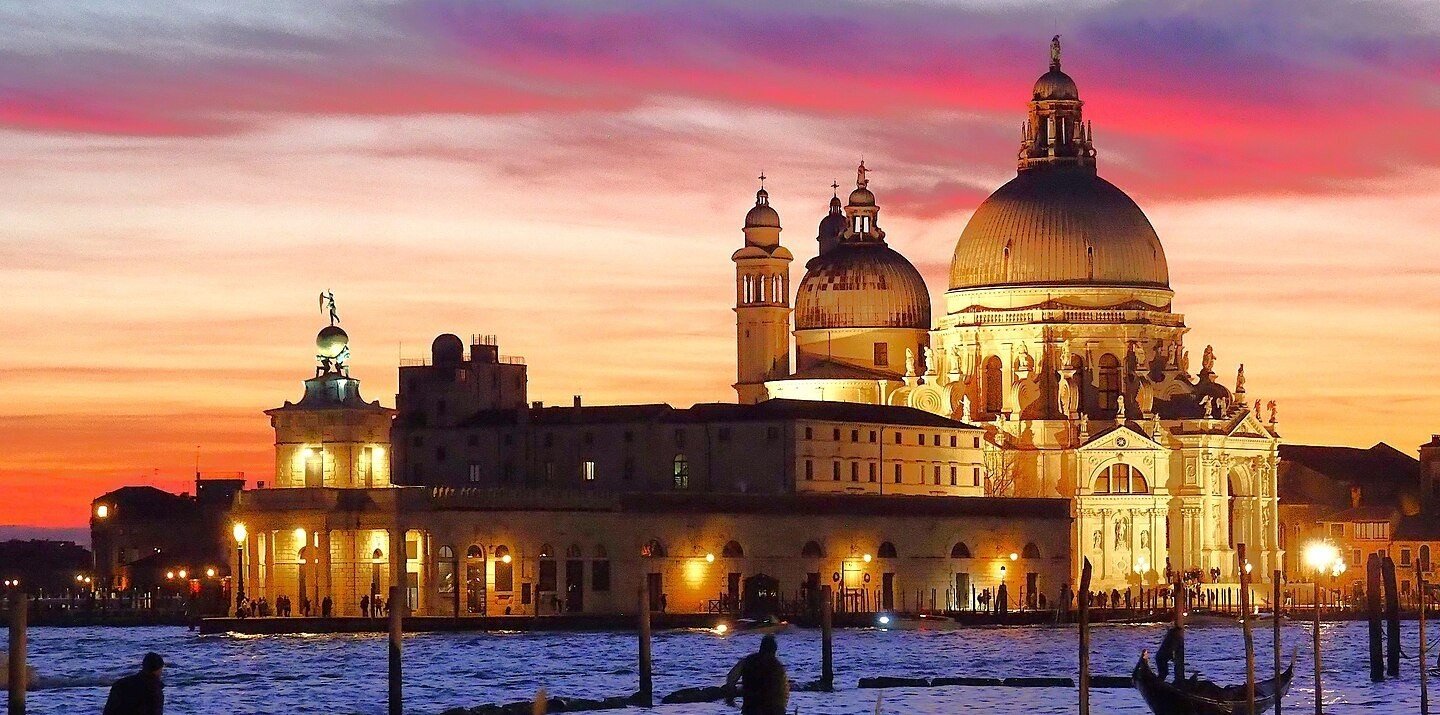
The evocative Basilica di Santa Maria della Salute shown here at sunset 📱🔄️ is one of the wonders of this itinerary dedicated to the Sestiere Dorsoduro and the island of Giudecca.
See also:
- Back to Complete Tour
- Guide to Venice
- Itineraries: 1d, 3d
- See: Attractions
- Do: Experiences
- Eat: Where and What
- Getting Around, Pass, Stay
Overview
To discover one of the most fascinating and authentic areas of the city, we have divided the visit between Dorsoduro and the Giudecca Island, two areas that offer different yet complementary perspectives on historic Venice.
Sestiere Dorsoduro
An itinerary that explores the more artistic and cultural side of Venice, among elegant fondamenta, historic buildings, and important museum institutions. The route unfolds in one of the city’s most refined sestieri, where art, history, and daily life coexist in perfect balance.
📍 See Route map and stage details.
Giudecca Island
An itinerary dedicated to one of the most evocative areas of the lagoon, characterized by wide views, a more relaxed pace, and a lesser-known yet equally fascinating Venice. The route allows you to discover unique viewpoints and a privileged perspective over the historic center and the Bacino di San Marco.
📍 See Route map and stage details.
Routes: Maps, Descriptions, Details
SESTIERE DORSODURO
- Open Route Map📍
- Distance: 3,4* km on foot
- Time: 0,47* min. on foot
- Visit duration: 7 hours
- Stops: 10 main (I-X → I)* + 6 secondary
- Gallerie della Fondazione Cini (I-X)🧩 → Collezione Peggy Guggenheim (A) → Basilica di Santa Maria della Salute (B) → Spazio Vedova (C) → Parrocchia di Santa Maria del Rosario (D) → Chiesa di San Sebastiano (E) → Scuola Grande dei Carmini (F) → Ca’ Rezzonico (G) → Cà Foscari (H) → Chiesa di San Pantalon (I)
- For days, times, prices and other info see Itinerary Table 📊
* These values may differ from those shown on Google Maps, as they are continuously recalculated in real time. See also Itinerary Info and Navigator + See here for Shared Stop 🧩
Route Description
SUMMARY
The Dorsoduro Tour is an itinerary through Venice’s artistic soul, unfolding between the Canal Grande and the inner calli of the district. The route passes through representative landmarks such as the Collezione Peggy Guggenheim, one of the most important modern art museums in Europe, the majestic Basilica di Santa Maria della Salute, the prestigious complex of Ca’ Rezzonico, and the Museo del Settecento Veneziano.
The linear itinerary of 3.4 km includes approximately 7 hours of sightseeing through the entire district up to the San Pantalon area, allowing visitors to experience Venice through modern art, Venetian Baroque architecture, and views over the Canal Grande.
Expand STEP DETAIL ⬇️
📌 All the stops summarized here are structured in the Itinerary Table 📊 with days, opening hours, prices, and Wikipedia 🌐 and Google Maps insights.
⬇️
I/X. Gallerie della Fondazione Cini is a shared stop🧩 – See final stop of the previous itinerary – San Marco district
⬇️
A. Collezione Peggy Guggenheim
The journey begins with one of the most important cultural institutions in the city, the Collezione Peggy Guggenheim. Located in the evocative Palazzo Venier dei Leoni, an elegant unfinished residence overlooking the Grand Canal, this collection represents a true temple of modern art.
Here you can admire works by great masters such as Picasso, Dalí, Kandinsky, Pollock and Mondrian, a testament to the passion of the famous American collector for 20th-century avant-garde art.
The museum also offers a charming walk through the sculpture garden, where artworks blend with nature, creating a unique atmosphere. Another highlight is the opportunity to visit Peggy Guggenheim’s private rooms, preserved exactly as she left them, offering a rare glimpse into her personal life.
✨ One of the most fascinating places for modern art lovers: absolute masterpieces overlooking the Grand Canal and the sculpture garden create an elegant, intimate and international experience in the heart of Venice.
❌ The richness of the collection often leads visitors to extend their stay beyond the planned time, especially for those who love 20th-century art.
⬇️
B. Basilica di Santa Maria della Salute
Continuing along the Grand Canal, you reach the majestic Basilica di Santa Maria della Salute, one of Venice’s most iconic landmarks. Built in the 17th century as a vow to the Virgin Mary for deliverance from the plague, its imposing dome dominates the city skyline and represents a masterpiece of Baroque architecture. Inside, the church preserves extraordinary works, including paintings by Tintoretto and Tiziano, enriching the solemn atmosphere of the place.
Just nearby, the Pinacoteca Manfrediniana houses a valuable collection of sacred art, while the Punta della Dogana, now an exhibition space of the Fondazione Pinault, hosts major contemporary art exhibitions, creating an interesting dialogue between past and present.
✨ The great dome offers one of the most iconic skylines in Italy; from Punta della Dogana opens one of the most spectacular views over the entire San Marco basin.
❌ Pinacoteca Manfrediniana and Punta della Dogana are recommended only if you have extra time in your itinerary.
⬇️
C. Spazio Vedova and Magazzini del Sale
A short walk away, the ancient Magazzini del Sale, once used to store this precious resource, have been transformed into a contemporary art center. Here you find Spazio Vedova, dedicated to the work of Emilio Vedova, one of Italy’s most important abstract artists. His works, displayed in a dynamic and engaging setup, convey the expressive power of his gestural painting.
❌ Recommended mainly for contemporary art enthusiasts; for many visitors the experience is less memorable compared to Venice’s major artistic icons.
⬇️
D. Chiesa di Santa Maria del Rosario
Continuing on, you reach the beautiful Chiesa di Santa Maria del Rosario, known as the Chiesa dei Gesuati. This 18th-century Baroque building is famous for the stunning frescoes by Giovanni Battista Tiepolo, which decorate the ceiling with scenes of light and movement, typical of his unmistakable style.
✨ Tiepolo’s ceilings seem to dissolve the architecture and open the space toward the sky, creating one of the most striking visual effects of Venetian Baroque.
⬇️
E. Chiesa di San Sebastiano
A short distance away lies another gem of the district, the Chiesa di San Sebastiano, a true temple dedicated to Paolo Veronese. The artist worked here for years, leaving an extraordinary cycle of frescoes that makes this church an unmissable stop for lovers of Venetian Renaissance art.
✨ A nearly hidden place where Veronese is the absolute protagonist: walls and ceilings narrate his genius in an immersive way, like a Renaissance gallery preserved intact through time.
⬇️
F. Scuola Grande dei Carmini
Continuing the route, you reach the Scuola Grande dei Carmini, a majestic building enriched with frescoes by Tiepolo, which give the interiors an aura of elegance and magnificence. Next to it, the Chiesa di Santa Maria dei Carmini preserves works by artists such as Cima da Conegliano, keeping alive the connection with Venice’s great pictorial tradition.
After the visit, you enter the lively atmosphere of Campo Santa Margherita, one of the most animated places in Venice. This wide square is the beating heart of student and local life, filled with historic cafés, markets, and bars frequented by students and residents.
✨ The contrast between the magnificence of decorated interiors and the everyday energy of Campo Santa Margherita allows you to experience two completely different souls of the city within the same stretch of itinerary.
⬇️
G. Ca’ Rezzonico
Reaching the banks of the Grand Canal, you find Ca’ Rezzonico, one of the most sumptuous palaces in the city, now home to the Museo del Settecento Veneziano. Walking through its richly decorated rooms, you can admire 18th-century Venice through frescoes by Giambattista Tiepolo, original furnishings, and paintings by Pietro Longhi and Canaletto, which portray the daily life and festivities of Venetian nobility.
⬇️
H. Ca’ Foscari
Continuing along the Grand Canal, you come across Ca’ Foscari, an elegant Gothic palace built in the 15th century for the Foscari family. Today it is the seat of the University of Venice, and the building still preserves the charm of its history, offering guided visits that reveal its interiors and breathtaking views over the city.
📌 Ca’ Foscari can be visited upon request. You will find the phone number in the Google Maps listing accessible via the table link.
⬇️
I. Chiesa di San Pantalon
The final stop of this itinerary leads to the Chiesa di San Pantalon, a place that hides a unique surprise. The ceiling hosts one of the largest canvases ever painted, created by Gian Antonio Fumiani. The scene, depicting the martyrdom of the saint, is a masterpiece of perspective illusion and creates a breathtaking effect, giving the impression of an infinite vault.
✨ Many visitors discover this wonder only at the very last moment, making it one of the most underrated surprises of the city.
GUIDECCA ISLAND
- Open Route Map📍
- Distance: 4,6* km on foot
- Time: 1* min. on foot
- Visit duration: 4 hours
- Stops: 10 main (X → I)*
- Palazzo Ducale di Venezia (X)⚠️ → Abbazia di San Giorgio Maggiore (A) → Le Stanze della Fotografia (B) → Labirinto Borges (C) → Fondazione Giorgio Cini (D) → Berggruen Institute Europe (E) → Villa Hériot (F) → Chiesa del Santissimo Redentore (G) → Chiesa di Sant’Eufemia (H) → Molino Stucky (I)
- For days, times, prices and other info see Itinerary Table 📊
* These values may differ from those shown on Google Maps, as they are continuously recalculated in real time. See also Itinerary Info and Navigator + See here for Shared Stop 🧩
Route Description
SUMMARY
The Giudecca Island tour is an itinerary dedicated to discovering Venice’s quieter and more panoramic side. The route leads from the monumental Abbazia di San Giorgio Maggiore to the prestigious Fondazione Giorgio Cini, continuing to the scenic Chiesa del Santissimo Redentore and the iconic Molino Stucky, offering a different and authentic perspective on the Venetian lagoon.
The route follows a linear itinerary of approximately 4.6 km, with an estimated visiting time of 4 hours, ideal for exploring everything at a relaxed pace, among masterpieces of Palladian architecture, important cultural institutions, and spectacular views over the lagoon.
⚠️ Important note – For technical reasons related to route visualization on Google Maps, the itinerary appears to start from Palazzo Ducale, which represents a major hub within Venice’s transportation network.
Expand STEP DETAIL ⬇️
📌 All the stops summarized here are structured in the Itinerary Table 📊 with days, opening hours, prices, and Wikipedia 🌐 and Google Maps insights.
⬇️ starting point
X. Palazzo Ducale di Venezia
See ⚠️ Important Note in the Route Description above.
⬇️
A. Abbey of San Giorgio Maggiore
The journey begins on San Giorgio Maggiore, the island located directly in front of Piazza San Marco. This peaceful and spiritual place hosts the magnificent Basilica di San Giorgio Maggiore, a masterpiece by Andrea Palladio. Its harmonious and monumental white façade welcomes visitors into a bright interior, where remarkable works can be found, including Tintoretto’s Last Supper, one of his most moving paintings.
✨ To enjoy an unforgettable view, simply climb the bell tower: from the top, a breathtaking panorama opens over Venice, with St. Mark’s Basilica and the lagoon stretching to the horizon. An experience absolutely worth it.
⬇️
B. Le Stanze della Fotografia
Continuing on the island, you reach Le Stanze della Fotografia, an institution dedicated to photographic art that hosts temporary exhibitions by international masters. Located in a fascinating setting, it offers a visual journey through powerful images capable of telling stories, eras, and different cultures. A perfect blend of contemporary art and historical memory.
❌ The value of the visit strongly depends on the temporary exhibition on display, making the experience less universal compared to other stops on the island.
⬇️
C. Borges Labyrinth
One of the most evocative and lesser-known corners of the island is the Borges Labyrinth, located inside the Fondazione Giorgio Cini. This extraordinary hedge maze is a tribute to the Argentine writer Jorge Luis Borges, inspired by his stories filled with symbolism and mystery.
✨ Walking through its intricate paths is an almost dreamlike experience, while from above the labyrinth reveals its perfect geometric design.
⬇️
D. Fondazione Giorgio Cini
The cultural heart of the island is undoubtedly the Fondazione Giorgio Cini, housed in an ancient Benedictine monastery. This prestigious research center is a reference point for the arts, literature, and music, and offers visitors the chance to explore its cloisters, library, and remarkable art collections.
✨ Guided tours allow visitors to discover not only the architecture of the complex, but also the intellectual vibrancy that still animates these spaces today.
⬇️
E. Berggruen Institute Europe
Inside the Fondazione Cini is also the European headquarters of the Berggruen Institute, a research center that hosts meetings and debates on philosophy, politics, and global culture. Here, world-renowned scholars and intellectuals gather to discuss the major issues of our time, making this place a crossroads of ideas and innovation.
❌ Primarily of academic and specialist interest, with limited impact for the average tourist visitor.
⬇️
F. Villa Hériot
Leaving the island of San Giorgio, the tour continues on the Giudecca, an island with an authentic character, less touristy than Venice’s historic center. The first stop is Villa Hériot, a historic building surrounded by gardens overlooking the lagoon. The villa hosts cultural events and artistic initiatives, offering a space for encounters for those who love art and creativity.
❌ Access is often limited to events or special openings, making it difficult to reliably plan a visit during the itinerary.
📌 Villa Hériot can be visited upon request. You will find the phone number in the Google Maps listing accessible via the table link.
⬇️
G. Chiesa del Santissimo Redentore
One of the most iconic landmarks of the Giudecca is the Chiesa del Santissimo Redentore, a Palladian masterpiece built to celebrate the end of the plague of 1576. The building stands out for its imposing architecture, characterized by harmonious lines and extraordinary brightness.
Every year, on the third Saturday of July, the church becomes the focal point of the famous Festa del Redentore, when a floating bridge connects the island to the rest of the city and spectacular fireworks illuminate the lagoon.
✨ The purity of Palladio’s design and its position overlooking the lagoon create one of the most elegant and harmonious views in all of Venice.
⬇️
H. Chiesa di Sant’Eufemia
Continuing along the Giudecca, you reach the Chiesa di Sant’Eufemia, one of the oldest churches on the island. This small hidden gem preserves an intimate and quiet atmosphere, far from the most crowded tourist routes. Inside, ancient frescoes and sculptures tell centuries of history and devotion.
❌ Pleasant for those seeking secluded and authentic places, but dispensable in a time-limited itinerary.
⬇️
I. Molino Stucky
The final stop of the tour is the majestic Molino Stucky, once an important industrial flour mill, now transformed into a luxury hotel.
This late 19th-century building is an icon of Venetian industrial architecture, with its imposing structure reflected in the waters of the lagoon. Today it hosts the prestigious Hilton Molino Stucky, which features one of the most spectacular panoramic terraces in Venice, offering breathtaking sunset views over the city.
✨ The monumental silhouette of the former industrial complex rising from the Giudecca reveals an unusual and surprising Venice.
❌ Access to the panoramic areas may be limited by events, availability, or hotel operations.
Eating
Between the district of Dorsoduro and Giudecca Island, Venetian cuisine blends with a more relaxed atmosphere, shaped by long walks along the Zattere, where flavors still follow local traditions.
- Seppie al nero, an iconic Venetian dish in which the rich flavor of cuttlefish is combined with its characteristic black ink sauce.
- Risotto di gò, a typical specialty of lagoon taverns, prepared with a traditional lagoon fish known for its delicate and authentic flavor.
- Risi e bisi, a historic dish of the Serenissima, also common in local trattorias thanks to its elegant seasonal tradition.
- Baccalà mantecato alla veneziana, a traditional Venetian fish cream, perfect served with crostini or polenta.
- Polenta e schie, a simple recipe from lagoon tradition, linked to the catch from Venetian waters.
- Frittòla veneziana, a traditional sweet associated with popular festivities, still found in the city’s most traditional venues.
Between the Sestiere and the island, visitors will find authentic taverns and restaurants overlooking the lagoon, perfect for a gastronomic break among art, museums, and canal sunsets.
- Osteria da Codroma – located in Dorsoduro, it is one of the area’s most authentic taverns, appreciated for its traditional Venetian cuisine and genuine atmosphere.
- La Calcina – in Dorsoduro (Zattere), a historic restaurant overlooking Giudecca, offering seasonal Venetian dishes and Mediterranean cuisine.
- Ristorante Altanella – located on Giudecca Island, it is one of the island’s most characteristic trattorias, renowned for its seafood cuisine and family atmosphere with lagoon views.
See also Where to eat in Venice and What to eat in Venice.
Sleeping
Among the most charming areas to stay in Venice, Dorsoduro and Giudecca Island offer a quieter and more authentic atmosphere, characterized by wide waterfront promenades, lagoon views, and important cultural institutions such as the Gallerie dell’Accademia and the Peggy Guggenheim Collection. This location allows easy access to the historic center while enjoying a more relaxed pace of life.

Alternatively, the areas of the Zattere and the waterfront along Giudecca Island are an ideal choice for those seeking scenic views, fewer crowds, and a more residential Venice, without giving up convenient connections to the city’s main attractions.
See also Where to sleep in Venice: Info and Tips.
📊 Itinerary Table
In the table below you will find all the attractions included in the itinerary, to enhance and best guide your visit in the Dorsoduro district and Giudecca Island:
- Scroll the table down and to the right 📱🔄 Rotate your phone horizontally to get an overview of opening days, hours, prices of attractions, and for further details on Wikipedia 🌐 and Google Maps ➡️.
- ⚠️ Always check the opening days and hours of attractions through the Google Maps entries linked in the table. See also Itinerary Info.
- To see the explanation of each data column, click its title (e.g. Attractions Index, Ratings, Org, etc.) at the top of the table.
⏳ Caricamento tabella in corso…
📌 This table is updated every 6–12 months.
🛡️ The tables on Tourplan360.com are original content protected by copyright © and monitored through anti-plagiarism tracking systems.
FAQ
You can open the Dorsoduro district and Giudecca Island route maps directly here:
📌 See also Route Description
How much time do I need to visit Dorsoduro and Giudecca?
The two itineraries together allow you to visit the main attractions in approximately 11 hours in total.
Can this Dorsoduro and Giudecca itinerary be done on foot?
Yes. The route is mainly explored on foot in Dorsoduro, while reaching Giudecca Island requires using the vaporetto (water bus). Distances between stops are short, and the itinerary winds through narrow streets, waterfront promenades, and scenic lagoon views.
📌 See also Getting around Venice: Info and Tips
Is it worth booking the main attractions in advance?
During peak tourist periods, it is advisable to book in advance or join guided tours to avoid queues and ensure entry.
📌 See also Experiences in Venice: Tours, Tickets and Useful Info
Where can I find opening days, times, and prices for the attractions?
All updated information is available in the dedicated itinerary table, which also includes direct links to Google Maps ➡️ and Wikipedia 🌐 for each attraction.
📌 See the Itinerary Table 📊
See also
- Back to Complete Tour
- Venice in 1 day
- Venice in 3 days
- Guide to Venice
- See: Attractions
- Do: Experiences
- Eat: Where and What
- Getting Around, Pass, Stay
Other Destinations
🔐 Some images on this page are used under Creative Commons licenses:
By Maretta Angelini – Bologna, panoramic view of Piazza Maggiore – Own work – CC BY-SA 4.0 – Wikimedia Commons
By Meri Valenti (TCI) – Trieste, Piazza Unità d’Italia at night – Own work – CC BY 4.0 – Wikimedia Commons
By Franco Visintainer – Trento, city panorama – Own work – CC BY-SA 3.0 – Wikimedia Commons
By Vittor Zoia – Venice, Dorsoduro, Basilica of Santa Maria della Salute – Own work, CC BY-SA 4.0 – Wikimedia Commons