
Genoa Complete Tour – Part 1: Travel itinerary
What to see, opening hours, prices, map


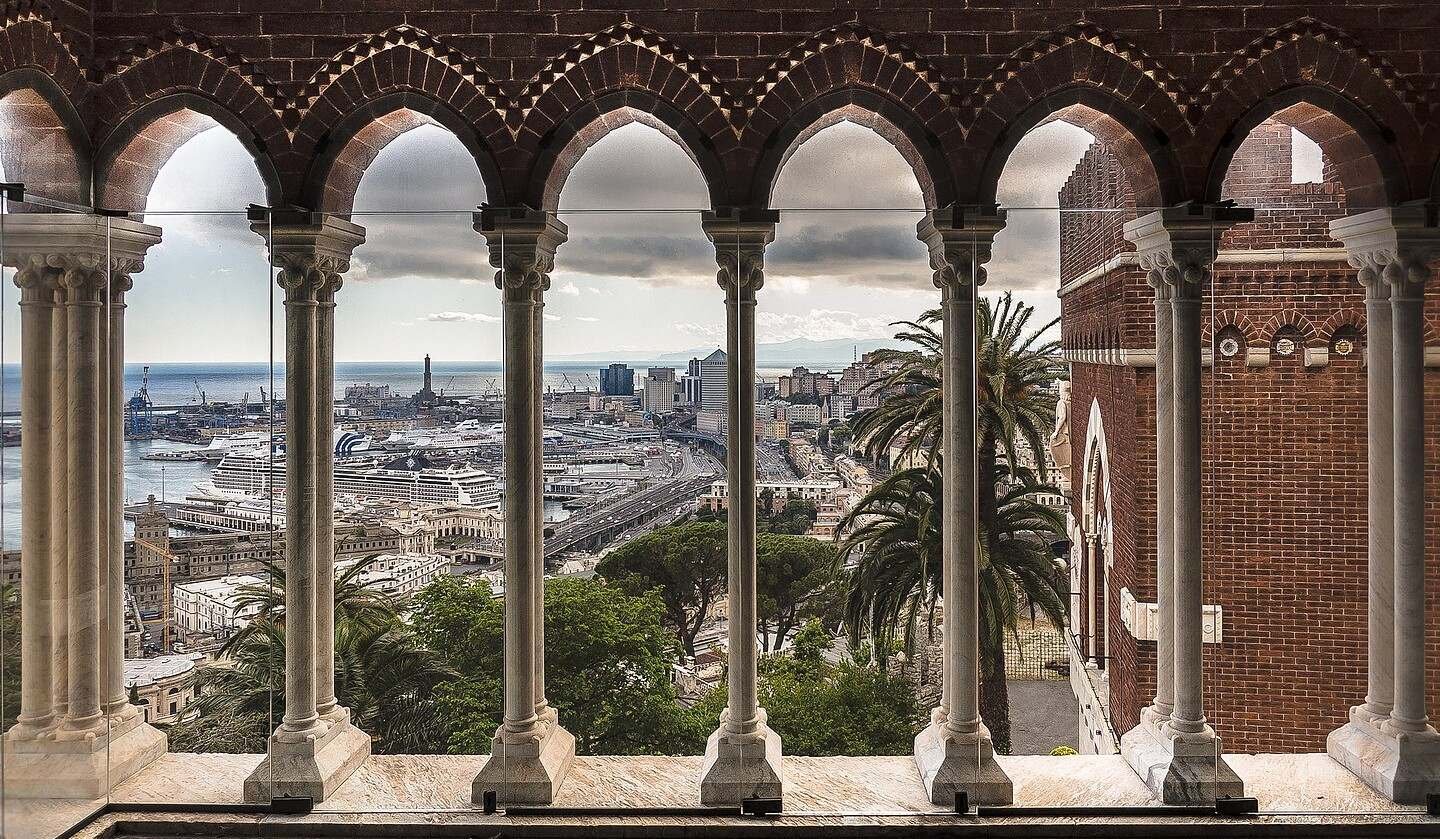
The stunning panoramic view over the port and the Lanterna, which can be admired from the Loggiato del Castello d’Albertis,📱🔄️ is one of the unmissable stops in this first part of the Genova Tour Completo.
- 📍 Porto Antico
- 📍 Historic Residences and Power
- 📍 Historic Center and Merchants
- 📍 Art and Spirituality
- 📍 Rolli and Panoramic Views
See also:
- Complete Tour 2
- Guide to Genoa
- Itineraries: 1d, 3d, CT1
- See: Attractions
- Do: Experiences
- Eat: Where and What
- Getting Around, Pass, Stay
Overview
To allow you to discover Genoa in its entirety, we have divided this Complete Tour into Part 1 and Part 2, with 10 distinct routes (5 for each part), each dedicated to a specific area of interest.
The complete itinerary requires at least one week, offering an in-depth travel experience that touches every corner of the city, from the most famous landmarks to the lesser-known, yet equally fascinating neighborhoods.
HOW IS THE TOUR STRUCTURED?
- 7 walking routes, to explore the most significant historical and cultural areas at a relaxed pace.
- 3 driving routes, to reach attractions located on the outskirts.
A complete journey, from the Porto Antico to the Historic Center, from the northern, central, eastern and southern areas of the city, extending towards the Genoese Levante and Ponente, along the coast and inland.
This complete tour is designed to allow visitors to immerse themselves in the authentic soul of Genoa, savoring every facet of it.
📌 the first 5 walking routes are connected through a Shared Stop 🧩, meaning the ending point of one is the starting point of the next, ensuring continuity of movement if you wish to skip one or more stops.
Routes: Maps, Descriptions, Details
PORTO ANTICO
- Open Route Map📍
- Distance: 3,4* km on foot
- Time: 0,46* min. on foot
- Visit duration: 7+4 hours: 7 hours for main stops + 4 for optional stops
- Stops: 10 main (X →I)* + 2 secondary
- Porto Antico (X) → Porta del Molo (A) → FantaCinema (B) → Ruota Panoramica / Arena Mare (C) → Museo Nazionale dell’Antartide F. Ippolito (D) → Bigo e ascensore panoramico (E) → Biosfera o Bolla di Renzo Piano (F) → Acquario di Genova (G) → Vascello Neptune (H) → Galata Museo del Mare (I-X)🧩
- For days, times, prices and other info see Itinerary Table 📊
* These values may differ from those shown on Google Maps, as they are continuously recalculated in real time. See also Itinerary Info and Navigator + See here for Shared Stop 🧩
Route Description
SUMMARY
The heart of this itinerary is the Porto Antico, redeveloped by architect Renzo Piano, which today hosts some of the city’s most iconic attractions, from the famous Acquario di Genova to the futuristic Bigo, up to the evocative Galata Museo del Mare.
The route, entirely on foot, extends for 3.4 km and includes 10 main stops plus 2 sub-stops, for a total of about 7 hours of visit, with the possibility of extending it up to 11 hours with optional attractions.
Optional Attractions: For those traveling with children or looking for a more interactive experience, some optional stops are included such as the FantaCinema, the Ruota Panoramica, the Museo Nazionale dell’Antartide, and the fun Città dei Bambini e dei Ragazzi.
Expand STEP DETAIL ⬇️
📌 All the stops summarized here are structured in the Itinerary Table 📊 with days, opening hours, prices, and Wikipedia 🌐 and Google Maps insights.
⬇️ starting point
X. Porto Antico
Our itinerary begins at Porto Antico, the beating heart of Genoa, blending history and innovation. Once the nerve center of maritime trade, today it is a lively area filled with museums, restaurants, cultural spaces, and unique attractions.
❌ Avoid the 1:00 PM–3:00 PM time slot: this is the peak tourist flow period and the area becomes very congested, especially with cruise ship arrivals or organized groups.
❌ Do not underestimate internal walking times: everything seems close from one stop to another, but breaks, photos, and pedestrian flow can easily extend the visit.
⬇️
A. Porta del Molo
The first stop is Porta del Molo, one of the historic entrances to the port and a witness to the city’s glorious past. From here you can enjoy a magnificent view of the sea and the modern harbor, with cruise ships and ferries connecting Genoa to the Mediterranean.
❌ Do not treat it as just a photo stop: it is one of the few places where you can truly perceive the transition between historic Genoa and the modern port.
⬇️
B. FantaCinema (Optional – for cinema lovers)
A unique museum dedicated to the history of fantasy cinema. Here you will find memorabilia from iconic sagas such as Star Wars, Harry Potter, and Marvel. A dive into the magic of the big screen!
⬇️
C. Ruota Panoramica / Arena Mare (Optional – for breathtaking views)
If you want to admire Genoa from above, the Ruota Panoramica is a must-see stop. Standing 45 meters tall, it offers spectacular views over the city and the sea. Nearby is the Arena Mare, which hosts concerts and events during the summer.
⬇️
D. Museo Nazionale dell’Antartide “F. Ippolito” (Optional – for science lovers)
This small but fascinating museum tells the story of Italian expeditions to Antarctica, featuring artifacts, models, and immersive videos. A journey into the most extreme continent on Earth.
❌ Skip it if you are short on time: it is an interesting but very niche stop that can easily be left out in a one-day itinerary.
⬇️
E. Bigo e Ascensore Panoramico
One of Genoa’s icons, the Bigo is a structure inspired by the ancient harbor cranes. Its panoramic lift rises up to 40 meters, offering an incredible view of the city and the sea.
✨ Rising suspended above the port with a 360° view over sea, historic alleys, and the city is one of the most scenic moments of the entire itinerary.
⬇️
F. Biosfera (Bolla di Renzo Piano)
Next to the Aquarium stands the futuristic Biosfera, a glass and steel sphere housing a tropical ecosystem with exotic plants, butterflies, and rare birds. A small corner of nature in the heart of the port.
⬇️
G. Acquario di Genova / La Città dei Bambini e dei Ragazzi (Optional – perfect for families)
The Acquario di Genova is the city’s main tourist attraction, the largest in Italy and one of the most important in Europe. Here you can admire dolphins, sharks, sea turtles, and many other species. If you are traveling with children, you can also visit the Città dei Bambini e dei Ragazzi, an interactive area with educational games and experiments.
✨ The Acquario di Genova is an immersive journey through giant tanks that feels like opening a direct window into the oceans.
❌ Allow more than 90 minutes in reality: it is an immersive visit that easily exceeds expectations, which is why we allocated 150 minutes in the itinerary table.
📌 The visit to the Città dei Bambini e dei Ragazzi requires advance booking. You will find the phone number in the Google Maps listing accessible from the itinerary table link.
⬇️
H. Vascello Neptune
Continuing along the harbor, we encounter the Neptune, a spectacular replica of a 17th-century galleon built for Roman Polanski’s film Pirates. Boarding it feels like traveling back in time among wooden decks, cannons, and sailors’ cabins.
⬇️
I. Galata Museo del Mare & Sommergibile Nazario Sauro
The final stop of the day, the Galata Museo del Mare is the largest maritime museum in the Mediterranean. Through interactive exhibits and reconstructions, it tells the story of Genoese navigation and great explorations. Outside, you can visit the Sommergibile Nazario Sauro, an authentic Navy submarine that can be explored inside for a unique experience.
HISTORIC RESIDENCES AND POWER
- Open Route Map📍
- Distance: 4.8 km on foot
- Time: 1 h 18 min on foot
- Duration of visit: 8 hours
- Stops: 10 main (I-X → I-X)* + 5 secondary
- Galata Museo del Mare (I-X)🧩 → Commenda di San Giovanni di Pré (A) → Villa del Principe – Palazzo di Andrea Doria (B) → Santuario di San Francesco da Paola (C) → Castello d’Albertis (D) → Albergo dei Poveri (E) → Orto Botanico dell’Università di Genova (F) → Chiesa dei Santi Vittore e Carlo (G) → Palazzo Reale di Genova (H) → Palazzo Durazzo-Pallavicini (I-X)🧩
- For days, times, prices and other info see Itinerary Table 📊
* These values may differ from those shown on Google Maps, as they are continuously recalculated in real time. See also Itinerary Info and Navigator + See here for Shared Stop 🧩
Route Description
SUMMARY
This linear itinerary of 4.8 km on foot unfolds in the northern area of Genoa, among spectacular views, historic villas and fortifications. The experience includes 10 main stops and 5 secondary ones, for a total visit duration of around 8 hours.
Among the must-see highlights are Villa del Principe, Castello d’Albertis and Palazzo Reale.
Expand STEP DETAIL ⬇️
📌 All the stops summarized here are structured in the Itinerary Table 📊 with days, opening hours, prices, and Wikipedia 🌐 and Google Maps insights.
I/X. Galata Museo del Mare is a shared stop🧩 – See final stop of the previous itinerary
⬇️
A. Commenda di San Giovanni di Pré
The itinerary begins from one of Genoa’s most fascinating medieval complexes: the Commenda di San Giovanni di Pré, built in the 12th century to host pilgrims and crusaders heading to the Holy Land. The structure still preserves the austere charm of Ligurian religious architecture, with layered spaces and a particularly evocative upper church.
Today the complex hosts:
- The Museo Nazionale dell’Emigrazione Italiana, an emotional journey that tells the stories, travels and hopes of millions of Italians who left for the Americas and other destinations.
- The Museoteatro della Commenda, an immersive experience that recreates daily life in the Middle Ages through sounds, lights and storytelling.
📌 The Museoteatro della Commenda is currently closed to the public.
⬇️
B. Villa del Principe – Palazzo di Andrea Doria
A short distance away is the Villa del Principe, one of the most important Renaissance residences in Genoa. It was commissioned by Andrea Doria, admiral and central figure in Genoese history, as a symbol of his power and prestige. The visit allows you to understand the political and cultural role of the Doria family in 16th-century Genoa.
✨ Here you breathe in the power of Renaissance Genoa: monumental frescoes and gardens that once extended all the way to the sea.
⬇️
C. Santuario di San Francesco da Paola
Continuing towards the hills, you reach the Santuario di San Francesco da Paola, a less touristy but very evocative place. The building, in Baroque style, is immersed in a quiet and panoramic setting.
✨ From here you enjoy a wide view over the harbor and the city, especially appreciated as a break away from the traffic and tourist flow of the center.
⬇️
D. Castello d’Albertis
The route continues with the Castello d’Albertis, built in the 19th century in neo-Gothic style and today home to two of the city’s most original museums.
- The Museo delle Culture del Mondo, with objects, artifacts and testimonies collected during the travels of Enrico Alberto d’Albertis.
- The Museo delle musiche dei popoli, dedicated to instruments and musical traditions from different cultures.
From its elevated position you can enjoy one of the most iconic views over Genoa, the same one that visually introduces this page.
✨ A castle suspended above Genoa where travel and panorama merge: it feels like looking at the city through the eyes of an explorer.
⬇️
E. Albergo dei Poveri
Descending towards the city center, you encounter the imposing Albergo dei Poveri, one of the largest welfare complexes built in Europe in the 17th century. Originally created to host and support the most vulnerable sections of the population, today it is a university site, but it still preserves its original monumental character, visible in the façade and the large inner courtyard.
⬇️
F. Orto Botanico dell’Università di Genova
Not far away is the Orto Botanico, a small green space often little known but very interesting, especially for those looking for a break in nature. Here you can observe rare plants, historical botanical collections and greenhouses, in a compact and peaceful environment in the heart of the city.
❌ A pleasant but secondary stop: in a short itinerary it can be skipped without missing the main attractions.
⬇️
G. Chiesa dei Santi Vittore e Carlo
This elegant Baroque church stands out for its richly decorated interiors, with stuccoes, frescoes and ornamental details typical of the period.
✨ It is a short but interesting stop, allowing you to discover another aspect of Genoa’s religious heritage.
⬇️
H. Palazzo Reale di Genova
Among the most important historic residences in the city, the Palazzo Reale represents one of the most complete examples of Genoese aristocratic dwellings. The rooms preserve frescoes, original furnishings, mirrors and chandeliers, while the terrace offers a striking view over the harbor.
✨ Entering here feels like stepping into the daily life of Genoese aristocracy, among spectacular halls and harbor views.
❌ During peak hours and weekends it can be very crowded: for this reason it is placed as the final stop of the itinerary, ideal in the late afternoon.
⬇️
I/X. Palazzo Durazzo-Pallavicini (UNESCO World Heritage)
The itinerary concludes with Palazzo Durazzo-Pallavicini, a testimony to the splendor of Genoa’s ancient noble families.
HISTORIC CENTER AND MERCHANTS
- Open Route Map📍
- Distance: 1.2 km on foot
- Time: 0.2 min on foot
- Duration of visit: 4 hours
- Stops: 10 main (I-X → I-X)* + 2 secondary
- Palazzo Durazzo-Pallavicini (I-X)🧩 → Palazzo Gio.Francesco Balbi (A) → Basilica SS. Annunziata del Vastato (B) → Palazzo Belimbau (C) → Museo del Risorgimento di Genova (D) → Via del Campo 29 Rosso (E) → Chiesa di San Pancrazio (F) → Sottoripa (G) → Palazzo delle Compere di San Giorgio (H) → Piazza Bianchi (I-X)🧩
- For days, times, prices and other info see Itinerary Table 📊
* These values may differ from those shown on Google Maps, as they are continuously recalculated in real time. See also Itinerary Info and Navigator + See here for Shared Stop 🧩
Route Description
SUMMARY
This linear itinerary of 1.2 km on foot unfolds in the central area of Genoa, among historic palaces, monumental churches and ancient commercial streets of the city. The experience includes 10 main stops and 2 secondary ones, for a total visit duration of around 4 hours.
Among the key highlights are the Basilica of the Santissima Annunziata del Vastato, the Museo del Risorgimento di Genova, Sottoripa and Palazzo San Giorgio.
Expand STEP DETAIL ⬇️
📌 All the stops summarized here are structured in the Itinerary Table 📊 with days, opening hours, prices, and Wikipedia 🌐 and Google Maps insights.
I/X. Palazzo Durazzo-Pallavicini is a shared stop🧩 – See final stop of the previous itinerary.
⬇️
A. Palazzo Gio. Francesco Balbi
The itinerary starts from Palazzo Gio. Francesco Balbi (UNESCO World Heritage), one of the elegant Palazzi dei Rolli. Built in the 17th century, it represents one of the finest examples of Genoese aristocratic architecture, with monumental façades and interiors designed to host distinguished guests during the period of the Republic of Genoa.
⬇️
B. Basilica della Santissima Annunziata del Vastato
Considered one of the most important churches in Genoa, it stands out for the contrast between its sober exterior and its richly decorated Baroque interior. The frescoes, gilded details and large naves testify to the church’s central role in the city’s religious and cultural life.
❌ During peak hours and weekends it can be very crowded: it is better to visit it early in the morning to enjoy the interiors in peace.
⬇️
C. Palazzo Belimbau (UNESCO World Heritage)
Located in a strategic position near Piazza della Nunziata, this 17th-century palace is part of the Palazzi dei Rolli system. Its structure reflects the prestige of Genoa’s merchant families and the city’s role as a major commercial hub in the Mediterranean.
⬇️
D. Museo del Risorgimento di Genova – Birthplace of Giuseppe Mazzini (National Monument)
Giuseppe Mazzini, a key figure of the Italian Risorgimento, was born in this building. The museum preserves documents, objects and testimonies linked to the unification process, offering historical insight into Genoa’s role in the patriotic movements of the 19th century.
⬇️
E. Via del Campo 29 Rosso
This exhibition space is dedicated to Fabrizio De André, one of Italy’s most important singer-songwriters. The route tells the story of his connection with the city through musical instruments, records, photographs and original materials.
✨ A place full of atmosphere where De André’s music still seems to linger within the walls.
❌ A short and very specific visit: if you are not interested in Fabrizio De André, you can skip it without losing value in the itinerary.
⬇️
F. Chiesa di San Pancrazio
A lesser-known Baroque church in the historic center, it preserves an elegant structure and rich artistic details. Damaged during World War II, it was restored while maintaining its original features.
⬇️
G. Sottoripa
The medieval arcades of Sottoripa represent one of the most authentic areas of the city. Once the commercial heart linked to the port, today they host historic shops, small eateries and traditional businesses that reflect the everyday life of popular Genoa.
✨ Here you truly feel authentic Genoa: among medieval arcades, smells and voices, it feels like stepping into another era.
❌ During peak hours and holidays it can be chaotic and less enjoyable: better to cross it during quieter times or outside lunch peaks.
⬇️
H. Palazzo delle Compere di San Giorgio (National Monument)
A symbol of the economic power of the Republic of Genoa, it hosted one of the earliest European financial institutions. Over the centuries it also served as an administrative and political center, reflecting the city’s central role in international trade.
📌 Visits to the Palazzo delle Compere di San Giorgio require mandatory booking. You can find the phone number in the Google Maps listing accessible from the table link.
⬇️
I/X. Piazza Bianchi
The itinerary ends in this historic square, where the Loggia della Mercanzia is located, an ancient space used for trade exchanges and a reference point for the economic activities of medieval Genoa.
ART AND SPIRITUALITY
- Open Route Map📍
- Distance: 3.6 km on foot
- Time: 0.57 min on foot
- Duration of visit: 5 hours
- Stops: 10 main (I-X → I-X)* + 7 secondary
- Piazza Bianchi (I-X)🧩 → Basilica di Santa Maria delle Vigne (A) → Chiesa di San Matteo (B) → Palazzo Negrone (C) → Sant’Anna Portello-Bertani Funicular (D) → Chiesa di Sant’Anna (E) → Museo d’Arte Orientale “E. Chiossone” (F) → Palazzo Doria-Spinola (G) → Chiesa di Santa Caterina – SS. Annunziata di Portoria (H) → Museo Ebraico di Genova (I-X)🧩
- For days, times, prices and other info see Itinerary Table 📊
* These values may differ from those shown on Google Maps, as they are continuously recalculated in real time. See also Itinerary Info and Navigator + See here for Shared Stop 🧩
Route Description
SUMMARY
This linear itinerary of 3.6 km on foot unfolds in the eastern area of Genoa, among historic churches, noble palaces, museums and scenic viewpoints over the city. The experience includes 10 main stops and 7 secondary ones, for a total visit duration of around 5 hours.
Among the most important stops are the Church of San Matteo, the Sant’Anna Funicular and especially the Galleria di Palazzo Spinola.
Expand STEP DETAIL ⬇️
📌 All the stops summarized here are structured in the Itinerary Table 📊 with days, opening hours, prices, and Wikipedia 🌐 and Google Maps insights.
I/X. Piazza Bianchi is a shared stop🧩 – See final stop of the previous itinerary.
⬇️
A. Basilica di Santa Maria delle Vigne
The visit begins at the Basilica di Santa Maria delle Vigne, an important place of worship dating back to the 13th century. The basilica is famous for its Gothic architecture and for the bell tower that stands out in the city skyline. This is a great starting point to immerse yourself in the historic atmosphere of Genoa. The site also has a cloister that is worth exploring.
✨ Entering here means stepping into one of the oldest churches in Genoa, where Gothic architecture and the verticality of the bell tower create a timeless atmosphere.
⬇️
B. Chiesa di San Matteo, Piazza di San Matteo
Continuing on, the next stop is the Chiesa di San Matteo, one of the most significant religious buildings in the city. Located in Piazza di San Matteo, this church was built in the 13th century and features a Gothic-style façade. The surrounding square is a charming corner of Genoa where medieval architecture can be admired. The church is also closely linked to the history of the Doria family, one of the most powerful families of the Republic of Genoa.
❌ The area is very small: it can become crowded on weekends and during tourist periods, so it is better to visit at quieter times.
⬇️
C. Palazzo Negrone
A short walk away is Palazzo Negrone (UNESCO World Heritage), a historic building that preserves the elegance of Genoese architecture. Today, the palace hosts exhibitions and cultural activities and is a fine example of the noble residences that characterize Genoa’s city center.
⬇️
D. Funicolare Sant’Anna Portello-Bertani
The visit continues with a more panoramic experience at the Funicolare Sant’Anna Portello-Bertani, offering an original way to discover the city. This funicular connects the city center to the Sant’Anna hill, providing a privileged view over Genoa and its districts. A short ride that prepares you for further historical highlights.
❌ The funicular ride lasts only 2 minutes, so if there are queues, walking up may actually be faster.
⬇️
E. Chiesa di Sant’Anna
Once you arrive, the Chiesa di Sant’Anna is an ideal place for a spiritual and historical pause. Although relatively small, the church holds great importance for the local community. Nearby you will also find the Antica Farmacia Sant’Anna, one of the oldest pharmacies in the city, still preserving its historic charm.
📌 The Antica Farmacia Sant’Anna can be visited upon request. You will find the phone number in the Google Maps listing accessible via the table link.
⬇️
F. Museo d’Arte Orientale “E. Chiossone”
Continuing towards the Museo d’Arte Orientale “E. Chiossone”, you enter a completely different world, featuring one of the richest collections of Oriental art in Italy. The museum is located inside the beautiful Parco di Villetta Di Negro, a green area that offers a perfect opportunity for a relaxing walk before continuing to other cultural stops.
❌ This attraction is secondary; keep it only if you have extra time available.
⬇️
G. Galleria Nazionale di Palazzo Spinola
The Galleria Nazionale di Palazzo Spinola (UNESCO World Heritage) is a key stop of the route. The palace hosts a vast collection of artworks ranging from the Renaissance to the Baroque period. The visit continues to Piazza Corvetto, an important city square, and concludes with the Monumento a Vittorio Emanuele II, a tribute to Italian unity and the king who led the country towards unification.
✨ Walking through the rooms of Palazzo Spinola means entering the noble Genoese world, among paintings, original furnishings, and windows overlooking the port.
❌ The visit can easily exceed the estimated 90 minutes in the itinerary: avoid slowing down too much if you want to keep up with the following stops.
⬇️
H. Chiesa di Santa Caterina – Chiesa SS. Annunziata di Portoria
Another important stop is the Chiesa SS. Annunziata di Portoria, more commonly known as the Chiesa di Santa Caterina, a place of great religious and historical value. Nearby is also the Museo dei Cappuccini di Genova, an interesting museum that tells the story of the Capuchin order and religious life in Genoa.
⬇️
I/X. Museo Ebraico di Genova
The itinerary ends at the Museo Ebraico di Genova, located in the heart of the historic district of the city. This museum is a testimony to the history of the Jewish community in Genoa, with exhibitions that illustrate its development and contribution to local culture.
It is a place that invites reflection and a deeper understanding of cultural diversity, making the route not only a historical walk but also an educational experience.
📌 The Museo Ebraico di Genova can be visited upon request. You will find the phone number in the Google Maps listing accessible via the table link.
ROLLI AND PANORAMIC VIEWS
- Open Route Map📍
- Distance: 1.6 km on foot
- Time: 0.26 min on foot
- Duration of visit: 7 hours
- Stops: 10 main (I-X → I)* + 7 secondary
- Museo Ebraico di Genova (I-X)🧩 → Palazzo Lercari-Parodi (A) → Palazzo Angelo Giovanni Spinola (B) → Palazzo Nicolosio Lomellino (C) → Palazzo Doria-Tursi (D) → Palazzo Rosso (E) → Palazzo Bianco (F) → Palazzo Gerolamo Grimaldi (G) → Basilica di San Siro (H) → Belvedere Castelletto (I)
- For days, times, prices and other info see Itinerary Table 📊
* These values may differ from those shown on Google Maps, as they are continuously recalculated in real time. See also Itinerary Info and Navigator + See here for Shared Stop 🧩
Route Description
SUMMARY
This linear itinerary of 1.6 km on foot unfolds in the north-eastern area of Genoa, among noble palaces, art museums, historic churches and scenic viewpoints over the city. The experience includes 10 main stops and 7 secondary ones, for a total visit duration of around 7 hours.
Key highlights include the Palazzi dei Rolli on Via Garibaldi (Lercari-Parodi, Spinola, Lomellino), Palazzo Doria-Tursi, Palazzo Rosso, Palazzo Bianco, the Basilica di San Siro and the Belvedere di Castelletto.
Expand STEP DETAIL ⬇️
📌 All the stops summarized here are structured in the Itinerary Table 📊 with days, opening hours, prices, and Wikipedia 🌐 and Google Maps insights.
I/X. Museo Ebraico di Genova is a shared stop🧩 – See final stop of the previous itinerary.
⬇️
A. Palazzo Lercari-Parodi
The itinerary begins at Palazzo Lercari-Parodi (UNESCO World Heritage), a magnificent example of a Genoese noble residence. Located in Via Lercari, this palace is known for its Baroque portal and for the splendid frescoes decorating some of its interior rooms.
The visit offers an insight into the importance of the Lercari family in historic Genoa, while also allowing visitors to admire the beauty of the city’s aristocratic architecture.
📌 Palazzo Lercari-Parodi can be visited during special occasions and Rolli Days.
⬇️
B. Palazzo Angelo Giovanni Spinola
Continuing along Via Giuseppe Garibaldi, one of the most famous streets in Genoa for its concentration of historic palaces, you reach Palazzo Angelo Giovanni Spinola (UNESCO World Heritage).
This palace stands out for its elegant façade and well-preserved inner courtyards, representing one of the symbols of the Spinola family’s power. Via Garibaldi itself is known as “Strada Nuova”, a place where palaces tell the rich history of the Republic of Genoa.
📌 Palazzo Angelo Giovanni Spinola can be visited during special occasions and Rolli Days.
⬇️
C. Palazzo Nicolosio Lomellino
The next stop is Palazzo Nicolosio Lomellino (UNESCO World Heritage), another example of a 17th-century Genoese noble residence. This palace is famous for its beautiful Italian-style garden and for the frescoes decorating its interior halls.
The visit highlights the integration between architecture and landscape, offering a glimpse into aristocratic life of the time.
✨ The hidden garden in the heart of the palace creates a striking contrast between stone and greenery, like a secret world inside the city.
📌 Palazzo Nicolosio Lomellino can be visited upon request. You will find the phone number in the Google Maps listing accessible via the table link.
⬇️
D. Palazzo Doria-Tursi
Palazzo Doria-Tursi (UNESCO World Heritage) is one of Genoa’s most iconic landmarks. Today it houses the Museo di Palazzo Doria-Tursi, and is famous for its frescoed halls and its art collection ranging from the Renaissance to the Baroque.
Among the masterpieces on display are works by Rubens and Van Dyck, along with a rich collection of furniture and historical objects. It also serves as Genoa’s City Hall, adding institutional importance to its cultural value.
✨ Here, the history of Genoa is felt in its most solemn form, among monumental halls and artworks that reflect the power of the Republic.
⬇️
E. Palazzo Rosso
Continuing the route, you reach Palazzo Rosso, another major example of Genoese noble architecture. In addition to visiting the Museo di Palazzo Rosso, which hosts a rich art collection (including works by Van Dyck and Veronese), you can also admire the impressive façade and courtyards.
Just a few steps away lies Palazzo Baldassarre Lomellini (UNESCO World Heritage), which, although simpler in appearance, is equally significant for its connection to Genoese nobility.
✨ The frescoed rooms and large canvases turn the visit to Palazzo Rosso into a continuous visual journey through light, color, and Genoese nobility.
❌ The visit to the Museo di Palazzo Rosso is already included in the 150 minutes planned for the itinerary, but it is easy to exceed the time if you spend too long inside the collections.
⬇️
F. Palazzo Bianco
The route continues with Palazzo Bianco (UNESCO World Heritage), home to the Museo di Palazzo Bianco. This palace, belonging to the Brignole-Sale family, is a masterpiece of Baroque art and offers an exceptional collection of paintings from the Renaissance to the Baroque period.
Among the highlights are works by Caravaggio and Bernardo Strozzi. The palace is also known for its elegance and richly decorated interiors, making the visit a complete cultural experience.
✨ One of the most important art collections in the city, where each room seems designed to stage a dialogue between painting and space.
❌ The visit is estimated at 90 minutes, but it is easy to exceed the time if you linger on the collections—keep an eye on timing to avoid reducing the following stops.
⬇️
G. Palazzo Gerolamo Grimaldi
A fascinating stop is Palazzo Gerolamo Grimaldi (UNESCO World Heritage), combining the grandeur of Genoese architecture with the history of one of the most powerful families of the Republic of Genoa.
The palace is known for its impressive façade and interiors that preserve the elegance and richness typical of Genoese noble residences. Here you can immerse yourself in the atmosphere of ancient Genoa, appreciating its decorations and monumental rooms.
❌ Optional stop within the Rolli system: it can be skipped if you want to focus on the main palaces of Via Garibaldi.
📌 Palazzo Gerolamo Grimaldi can be visited during special occasions and Rolli Days.
⬇️
H. Basilica di San Siro
The route continues with the Basilica di San Siro, one of the oldest and most important religious buildings in Genoa, dating back to medieval times. The interior is characterized by a sober elegance, with artworks reflecting the city’s religious history. The basilica represents an important spiritual and historical landmark.
⬇️
I. Ascensore Castelletto Ponente
The itinerary concludes with a breathtaking panoramic view from the Basilica di San Siro towards the Ascensore Castelletto Ponente, which leads to the Castelletto district—an elevated point offering one of the most spectacular views of Genoa.
From here, you can admire a wide panorama of the city, the port, and the sea—a perfect ending to a route that explores Genoa’s most historic and artistic side.
✨ It is placed as the final stop to enjoy the city from above at the best time of day, when light and atmosphere make the panorama even more striking.
Eating
During the Complete Tour of Genoa, Ligurian cuisine can accompany each stage of your journey, offering interesting insights to discover the authentic flavours of the territory:
- Appetizers: Genoese focaccia, chickpea farinata, fried or stuffed anchovies, torta pasqualina.
- First courses: trofie al pesto, trenette with pesto, potatoes and green beans, pansoti with walnut sauce, Genoese minestrone.
- Main courses: cima alla genovese, stewed stockfish, Ligurian-style cod, cappon magro.
- Desserts: Genoese pandolce, canestrelli.
To accompany meals, typical Ligurian wines such as Vermentino, Pigato and Sciacchetrà complete the gastronomic experience.
To learn more about Genoese food traditions see also What to eat in Genoa.
Where to eat in Genoa during the itinerary:
- Porto Antico and Molo: Antica Osteria di Vico Palla – historic seafood trattoria in the heart of the port, specialising in traditional Ligurian cuisine.
- Historic Centre: Trattoria da Maria – home-style cooking in the caruggi, with authentic Genoese dishes.
- Via Garibaldi and Rolli area: Le Rune – restaurant in the historic centre with refined Ligurian cuisine among the palaces.
- Portoria and San Vincenzo: Il Genovese – reference spot for mortar pesto and traditional Ligurian cuisine.
- Pré and old port area: Trattoria dell’Acciughetta – contemporary seafood cuisine inspired by Genoese tradition.
See also: Where to eat in Genoa
Sleeping
To make the most of the complete Genoa tour, choosing where to stay is essential to optimise travel between the different areas of the itinerary.
The most strategic solution is the Porto Antico and Molo area, ideal as a starting base for the route: here you will be close to the main maritime attractions such as the Aquarium, Galata Museo del Mare and Bigo, with numerous accommodation options including hotels, B&B and apartments perfect for exploring the harbour on foot.

For the second area of the itinerary, the Historic Centre and Carignano is the most immersive choice: staying in the caruggi allows you to experience the medieval atmosphere of the city up close and to easily reach the main Palazzi dei Rolli, Via Garibaldi and Piazza De Ferrari.
The third area, Portoria, San Vincenzo and Pré, is perfect for those who want a central but slightly quieter location compared to the more touristy caruggi, with excellent connections to all the museums and historical stops along the route.
For the panoramic part of the tour, Castelletto is one of the most scenic areas to stay in: located on a hillside, it offers spectacular views over the entire city and allows quick access to the centre via historic lifts and funiculars.
For further information see also Where to sleep in Genoa: Info and Tips.
📊 Itinerary Table
The table below shows all the stops of the five routes in Genoa Complete Tour Part 1, helping you to optimise your visit as effectively as possible.
- Scroll the table down and to the right 📱🔄 Rotate your phone horizontally to get an overview of opening days, hours, prices of attractions, and for further details on Wikipedia 🌐 and Google Maps ➡️.
- ⚠️ Always check the opening days and hours of attractions through the Google Maps entries linked in the table. See also Itinerary Info.
- To see the explanation of each data column, click its title (e.g. Attractions Index, Ratings, Org, etc.) at the top of the table.
⏳ Caricamento tabella in corso…
📌 This table is updated every 6–12 months.
🛡️ The tables on Tourplan360.com are original content protected by copyright © and monitored through anti-plagiarism tracking systems.
FAQ
Yes. The five itineraries of Genoa Complete Tour – Part 1 are interconnected, so you can remove stops or change their order while always maintaining route continuity. This allows you to adapt the journey based on your interests and available time.
📌 See also Info Itineraries
Can these itineraries be done on foot?
Yes, all five itineraries of Part 1 are designed to be walked, as they are focused on the Porto Antico and the historic centre of Genoa.
📌 See also Getting around Genoa
Is it worth booking the main attractions?
During peak tourist seasons, it is recommended to book in advance or join guided tours to avoid queues and secure entry.
📌 See also Experiences in Genoa
How much time is needed to complete Part 1 of the tour?
Part 1 of the Genoa Complete Tour requires approximately 20 hours of visiting time.
Where can I find opening days, hours and prices of the attractions?
All updated information is available in the Itinerary Table 📊, with direct links to Google Maps and Wikipedia for further details.
See also
- Complete Tour 2
- Genoa in 1 day
- Genoa in 3 days
- Guide to Genoa
- See: Attractions
- Do: Experiences
- Eat: Where and What
- Getting Around, Pass, Stay
Other Destinations
🔐 Some images on this page are used under Creative Commons licenses:
By https://www.pexels.com/u/ghostpresenter/ – Milan, Porta Nuova skyline – CC0 – Public Domain – Wikimedia Commons
By Hpnx9420 – Turin, view from Monte dei Cappuccini – Own work – CC BY 3.0 – Wikimedia Commons
By PROPOLI87 – Florence, panorama from Piazzale Michelangelo – Own work – CC BY-SA 4.0 – Wikimedia Commons
By Nedualismineregole-Roberto Bordieri – Genoa, Loggia of Castello d Albertis, view of the harbor – – CC BY 4.0, Wiki Commons
