
Milan Complete Tour – Part 1: Travel itinerary
What to see, opening hours, prices, map


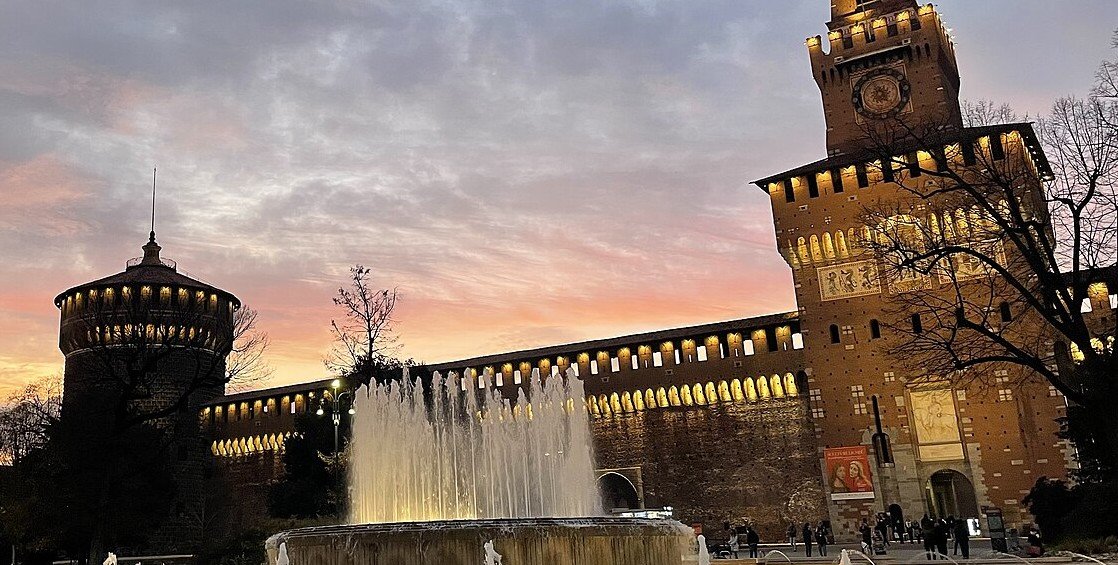
The magic of the Castello Sforzesco captured at sunset 📱🔄️ sets the backdrop for this first part of the Complete Milan Tour.
See also:
- Complete Tour 2
- Guide to Milan
- Itineraries: 1d, 3d, CT1
- See: Attractions
- Do: Experiences
- Eat: Where and What
- Getting Around, Pass, Stay
Overview
Complete Milan Tour is a 360-degree exploration of the city’s attractions, designed to satisfy these 3 fundamental aspects:
- Going beyond the mass tourism circuits
- Highlighting the many hidden gems
- Experiencing the very essence of the city
Complete Milan Tour is therefore designed both for those visiting the city for the first time and wishing to explore it in depth, and for anyone who has already been to Milan (or even for Milan residents themselves) who want to discover something new.
HOW THE TOUR IS STRUCTURED
The Complete Milan Tour is divided into 2 parts, each consisting of 4 itineraries. Completing the entire tour requires almost two weeks of travel, spread across six walking routes and two driving itineraries, for a total of 74 hours of exploration.
Walking Itineraries – The six walking itineraries focus on specific areas of the city, all easily reachable by metro. The itineraries are structured in a modular way: the final stop of each route is located a short distance from the starting point of the next one, creating a natural connection that allows you to skip or add stops with ease.
Driving Itineraries – To expand the experience beyond the heart of Milan, Part 2 also includes two connected driving itineraries dedicated to attractions located farther from the city center.
🅿️ Metro and Parking: If you arrive by car, in Table > Parking and Mobility we have selected what we believe are the most strategic solutions. Each parking area is located near the metro station indicated in the Itinerary Table 📊. From there, all you have to do is head towards the starting point of your chosen itinerary.
Routes: Maps, Descriptions, Details
DUOMO PART 1
- Open Route Map📍
- Distance: 1,3* km on foot
- Time: 0,19* min. on foot
- Visit duration: 12 hours spread over 2 days of approximately 6 hours each
- Stops: 8 main (X →G)* + 13 secondary
- Duomo di Milano (X) → Museo del Novecento (A) → Palazzo Reale – Museo della Reggia (B) → Chiesa di San Gottardo in Corte (C) → Chiesa di Santa Maria presso San Satiro (D) → Pinacoteca Ambrosiana (E) → Piazza Mercanti (F) → Galleria Vittorio Emanuele II (G)
- For days, times, prices and other info see Itinerary Table 📊
* These values may differ from those shown on Google Maps, as they are continuously recalculated in real time. See also Itinerary Info and Navigator + See here for Shared Stop 🧩
Route Description
SUMMARY
The heart of this itinerary is Milan’s historic centre, where testimonies of the medieval, Renaissance and Roman city intertwine in a compact route connecting iconic landmarks such as the Duomo di Milano, historic squares and the complex of the Pinacoteca Ambrosiana, all the way to the great basilicas and museums spread throughout the urban fabric.
The route, entirely walkable, covers 1.3 km and includes 8 main stops plus 13 secondary stops, for a total of about 12 hours of visiting time spread over 2 days.
Expand STEP DETAIL ⬇️
📌 All the stops summarized here are structured in the Itinerary Table 📊 with days, opening hours, prices, and Wikipedia 🌐 and Google Maps insights.
Day 1
⬇️ starting point
X. Duomo di Milano
The visit begins with the absolute symbol of Milan: the Duomo di Milano (National Monument), a Gothic masterpiece that amazes with its grandeur and rich sculptural decoration. After admiring the majesty of its façade, you enter inside to discover the evocative atmosphere of the Crypt, which houses the relics of Saint Charles Borromeo.
The experience continues with the ascent to the Terraces, a unique panoramic point offering an extraordinary view over the city.
✨ The Duomo Terraces are one of the most iconic viewpoints in Milan and deserve a thorough visit.
❌ Visiting the Duomo and especially the Terraces can involve very long queues, so it is better to book in advance.
Book one of the recommended experiences here:
✅ Entrance ticket for the Duomo and Terraces
✅ Fast-track guided tour of the Duomo and Terraces
✅ Duomo Rooftops and Cathedral Guided Tour with Tickets
The Museo del Duomo, located near the Cathedral, offers a journey through the history and artworks connected to the construction and evolution of this symbolic monument.
Just a few steps away, in Piazza del Duomo, stands the Statue of Vittorio Emanuele II, dedicated to the first King of Italy, dominating the square with its imposing presence.
⬇️
A. Museo del Novecento
After exploring the Duomo, head to the nearby Museo del Novecento, an unmissable place for lovers of modern and contemporary art. The museum hosts a vast collection of works by 20th-century Italian artists, including Boccioni, De Chirico, Morandi, and Fontana.
The exhibition route is designed to guide visitors through the main artistic movements of the last century, culminating in the famous room dedicated to Lucio Fontana’s Neon installation, which offers a pleasant view over the square and the Duomo.
Day 2
⬇️
B. Palazzo Reale – Royal Palace Museum
The itinerary continues with a visit to the Palazzo Reale, the former residence of Milan’s governors, now hosting prestigious temporary exhibitions. Its frescoed rooms, large exhibition spaces, and neoclassical elegance tell centuries of history and culture, offering an immersion into court life and the political dynamics of historical Milan.
✨ The Palazzo Reale is one of Milan’s most elegant cultural venues, where international exhibitions transform historic halls into immersive experiences.
❌ Exhibitions are temporary and change completely over time: always check the current show before visiting.
⬇️
C. Chiesa di San Gottardo in Corte
Continuing the walk, you reach the Chiesa di San Gottardo in Corte, a little-known gem of great artistic value. Built in the 14th century by order of Azzone Visconti, the church stands out for its octagonal bell tower and precious 14th-century frescoes preserved inside.
⬇️
D. Chiesa di Santa Maria presso San Satiro
A few minutes away is the extraordinary Chiesa di Santa Maria presso San Satiro, a true masterpiece of Renaissance architecture. Here, Bramante’s genius is expressed through the famous perspective illusion of the fake apse, creating a surprising optical effect that gives the impression of a much deeper space than reality.
⬇️
E. Pinacoteca Ambrosiana
The tour continues with a visit to the Pinacoteca Ambrosiana, one of the oldest art galleries in the city, housing invaluable works including Leonardo da Vinci’s Codex Atlanticus, as well as paintings by Caravaggio, Botticelli, and Raphael.
✨ The Codex Atlanticus is one of those rare moments where you are truly in direct contact with the mind of a genius, through his ideas, sketches, and visionary insights.
✅ Pinacoteca Ambrosiana and Codex Atlanticus exhibition
Adjacent to the Pinacoteca, the Chiesa di San Sepolcro and its evocative Crypt, one of the oldest places in Milan, will take you back in time to the medieval era, while the remains of the Roman Forum, still visible in this area, tell the story of imperial Milan.
Inside the complex is also the Biblioteca Ambrosiana, founded by Cardinal Federico Borromeo in 1607, which preserves ancient manuscripts and precious volumes, making it one of the most prestigious libraries in Europe.
⬇️
F. Piazza Mercanti
Not far away opens the scenic Piazza Mercanti, the beating heart of medieval Milan. Here you find historic buildings of great charm such as the Palazzo della Ragione, once the city’s courthouse, the Loggia degli Osii with its elegant Gothic balconies, and the Casa dei Panigarola, still preserving its 15th-century appearance.
✨ Piazza Mercanti is one of the best-preserved medieval corners of Milan, where you feel as if you are stepping into the original historic city.
⬇️
G. Galleria Vittorio Emanuele II
The day ends with a walk inside the majestic Galleria Vittorio Emanuele II, the “living room of Milan,” with its luxury shops, historic restaurants, and elegant cafés. This 19th-century architectural masterpiece, with its glass and iron dome, is a meeting point for both locals and tourists.
✨ According to tradition, spinning on the bull mosaic on the floor with your heel will bring good luck!
DUOMO PART 2
- Open Route Map📍
- Distance: 1,9* km on foot
- Time: 0,26* min. on foot
- Visit duration: 12 hours spread over 2 days of approximately 6 hours each
- Stops: 10 main (X →I)* + 8 secondary
- ISPI – Palazzo Clerici (X) → Leonardo3 Museum – Il mondo di Leonardo (A) → Chiesa di San Fedele (B) → Gallerie di Piazza Scala (C) → Teatro alla Scala (D) → Casa museo del Manzoni (E) → Museo Poldi Pezzoli (F) → Museo Bagatti Valsecchi (G) → Via Monte Napoleone (H) → Palazzo Morando Costume Moda Immagine (I)
- For days, times, prices and other info see Itinerary Table 📊
* These values may differ from those shown on Google Maps, as they are continuously recalculated in real time. See also Itinerary Info and Navigator + See here for Shared Stop 🧩
Route Description
SUMMARY
This second itinerary also develops entirely in the heart of Milan’s historic centre, among noble palaces, art museums and iconic cultural landmarks, all the way to the elegant atmosphere of luxury shopping streets.
Among the main stops stand out the Teatro alla Scala di Milano, a world symbol of opera and musical culture, the evocative Casa Museo del Manzoni and the elegant area of Via Monte Napoleone and the Quadrilatero della Moda, heart of Milan’s luxury shopping district and international icon of style and design.
The route, entirely walkable, covers 1.9 km and includes 10 main stops plus 8 secondary stops, for a total of about 12 hours of visiting time spread over 2 days.
Expand STEP DETAIL ⬇️
📌 All the stops summarized here are structured in the Itinerary Table 📊 with days, opening hours, prices, and Wikipedia 🌐 and Google Maps insights.
Day 1
⬇️ starting point
X. ISPI Palazzo Clerici
The tour begins with Palazzo Clerici, today home to the ISPI (Institute for International Political Studies). This elegant eighteenth-century palace preserves one of the city’s most surprising artistic treasures: the Galleria degli Arazzi, better known as the Galleria del Tiepolo. The frescoed ceiling painted by the famous Venetian artist is a masterpiece of perspective illusionism and Baroque dynamism, a true hidden gem in the heart of Milan.
📌 ISPI Palazzo Clerici and the Galleria degli Arazzi can be visited by appointment. You can find the phone number in the Google Maps listing accessible from the link in the table.
⬇️
A. Leonardo3 Museum
Continuing the journey, you reach an unmissable stop for science and innovation enthusiasts: the Leonardo3 Museum – The World of Leonardo. Located inside the central Galleria Vittorio Emanuele II, this interactive museum offers an extraordinary immersion into the universe of the Tuscan genius, featuring unprecedented reconstructions of his machines and multimedia insights into his studies and inventions. It is an excellent starting point to understand Leonardo da Vinci’s role in the history of Milan and science.
⬇️
B. Church of San Fedele
The visit continues with the discovery of the Chiesa di San Fedele, one of the most fascinating churches in Milan. This 16th-century Jesuit building features a sober façade but a richly decorated interior, including works by Lucio Fontana. Next to the church is the Museo San Fedele, which houses a collection of sacred and contemporary art.
Piazza San Fedele, with its intimate atmosphere, is dominated by the statue of the great writer Alessandro Manzoni, who lived in this very area. The bronze statue, created in 1883 by Francesco Barzaghi, pays tribute to the author of The Betrothed, who immortalised 17th-century Milan through his works.
⬇️
C. Gallerie di Piazza Scala
The Gallerie di Piazza Scala represent an important exhibition hub of Intesa Sanpaolo, located in the historic Palazzo Anguissola and Palazzo Brentani. This museum hosts a collection ranging from the 19th to the 21st century, with works by artists such as Canova, Boccioni, Modigliani, and De Chirico, offering an overview of modern and contemporary Italian art.
The visit allows you to admire not only pictorial masterpieces but also multimedia installations and sculptures, making the experience even more engaging.
✨ The Gallerie di Piazza Scala offer an elegant journey through modern and contemporary Italian art, in an architectural setting that blends history with museum innovation.
⬇️
D. Teatro alla Scala
A few steps away you will find the legendary Teatro alla Scala, one of the most famous opera houses in the world. For those who want to discover the secrets of the theatre, the Museo Teatrale alla Scala offers a journey through costumes, musical instruments, and memorabilia linked to the greatest composers and performers in history.
Piazza della Scala, elegant and majestic, is enriched by the famous Monument to Leonardo da Vinci, depicting the Renaissance genius surrounded by his disciples, a symbol of the deep connection between Leonardo and Milan.
✨ Teatro alla Scala is one of the world’s cultural landmarks, where the atmosphere of grand opera can be felt simply by stepping into Piazza della Scala.
📌 The Teatro alla Scala can be visited by reservation. You can find the phone number in the Google Maps listing accessible from the link in the table.
Book one of the recommended experiences:
✅ La Scala Museum and Theatre Tour
✅ La Scala Theatre and Museum Tour with Entry Tickets
Day 2
⬇️
E. Casa Museo del Manzoni
The second day begins with a visit to the Casa Museo del Manzoni (National Monument), where the great writer lived for over sixty years. The residence has remained almost unchanged and preserves manuscripts, original furnishings, and a rich library, allowing visitors to immerse themselves in the 19th-century atmosphere in which Manzoni wrote his masterpiece, The Betrothed.
⬇️
F. Museo Poldi Pezzoli
Continuing along the cultural route, you arrive at the Museo Poldi Pezzoli, one of the most prestigious house-museums in Europe. Here you can admire a collection of paintings, sculptures, armour, and decorative arts belonging to collector Gian Giacomo Poldi Pezzoli. Among the masterpieces on display are works by Botticelli, Mantegna, Piero della Francesca, and Tiepolo.
⬇️
G. Museo Bagatti Valsecchi
Another Milanese jewel is the Museo Bagatti Valsecchi, a historic residence that offers a perfect example of a 19th-century aristocratic home. The Bagatti Valsecchi brothers passionately collected Renaissance furniture, artworks, and decorative objects, creating a unique and fascinating atmosphere that can still be felt in its rooms today.
⬇️
H. Via Monte Napoleone
Leaving the museums behind, the tour moves into the heart of luxury shopping: Via Monte Napoleone and the Fashion Quadrilateral. This area, bordered by Via della Spiga, Via Manzoni, and Corso Venezia, is world-famous for its haute couture boutiques, exclusive jewellery stores, and ateliers of the greatest designers. Even those not interested in shopping will enjoy strolling among elegant shop windows and historic palaces.
⬇️
I. Palazzo Morando Costume Moda Immagine
The final stop of the tour is Palazzo Morando Costume Moda Immagine, a museum that tells the story of Milanese fashion through collections of historical clothing, fabrics, and accessories. Located in an elegant eighteenth-century palace, the museum is a true gem for costume history enthusiasts and for those who want to discover the evolution of style and elegance in Italy’s fashion capital.
BRERA and CASTELLO
- Open Route Map📍
- Distance: 4,7* km on foot
- Time: 1,03* min. on foot
- Visit duration: 12 hours spread over 2 days of 6 hours each
- Stops: 10 main (X →I)* + 24 secondary
- Pinacoteca di Brera (X) → Orto Botanico di Brera (A) → Chiesa di San Marco (B) → Basilica di San Simpliciano (C) → Castello Sforzesco (D) → Parco Sempione (E) → Acquario civico di Milano (F) → Palazzina Appiani (G) → Arco della Pace (H) → Triennale Design Museum (I)
- For days, times, prices and other info see Itinerary Table 📊
* These values may differ from those shown on Google Maps, as they are continuously recalculated in real time. See also Itinerary Info and Navigator + See here for Shared Stop 🧩
Route Description
SUMMARY
The focus of this itinerary develops between the Brera district and Piazza Castello, with a route that crosses some of the most representative places of the city through art, science and architecture, moving from one of the most important cultural hubs such as the Pinacoteca di Brera to the great monumental complex of the Castello Sforzesco.
The route, entirely walkable, covers 4.7 km and includes 10 main stops plus 24 secondary stops, for a total of about 12 hours of visiting time spread over 2 days.
Expand STEP DETAIL ⬇️
📌 All the stops summarized here are structured in the Itinerary Table 📊 with days, opening hours, prices, and Wikipedia 🌐 and Google Maps insights.
Day 1
⬇️ starting point
X. Pinacoteca di Brera
The tour begins from one of Milan’s main cultural hubs: the Palazzo di Brera, a magnificent Baroque building that hosts some of the city’s most important cultural institutions:
- Pinacoteca di Brera: one of Italy’s most prestigious art museums, featuring an extraordinary collection of works by masters such as Raphael, Caravaggio, Piero della Francesca and Hayez.
- Cortile d’onore del Palazzo di Brera: here you can find the famous statue of Napoleon Bonaparte, sculpted by Antonio Canova.
- Biblioteca Nazionale Braidense di Brera: one of the oldest and most important Italian libraries, founded in 1770, with a collection of over one and a half million volumes.
- Quartiere Brera: walking through its cobbled streets, you can feel a bohemian atmosphere with art galleries, historic cafés and artisan shops.
- Osservatorio Astronomico di Brera: founded in the 18th century, it is one of the most important research centers in Italy.
- Galleria Strumenti: exhibition of historical astronomical instruments.
- Cupola Schiaparelli: where astronomer Giovanni Schiaparelli observed the famous “canals of Mars”.
❌ In the main rooms of Pinacoteca di Brera, delays are common during peak hours, especially in front of the most famous masterpieces.
✅ Guided tour of Pinacoteca di Brera and the Brera district
⬇️
A. Orto Botanico di Brera
A green oasis in the heart of the city, the Orto Botanico di Brera is a small hidden gem located behind the Pinacoteca building. Founded in 1774, it hosts centuries-old plants, historic greenhouses and a collection of medicinal herbs, offering a relaxing break before continuing the tour.
⬇️
B. Chiesa di San Marco
The next stop is the Chiesa di San Marco, a Gothic building dating back to the 13th century. The church is famous for having hosted Mozart during his stay in Milan and for the large fresco by Giovanni Paolo Lomazzo in the presbytery vault.
Inside is the Cappella Foppa, a precious Renaissance testimony with frescoes attributed to Leonardo da Vinci’s school.
⬇️
C. Basilica di San Simpliciano
The last stop of the day is the Basilica di San Simpliciano, one of the four basilicas founded by Saint Ambrose in the 4th century. This Romanesque building is known for its medieval frescoes and for the majestic Coro ligneo, a Renaissance inlay masterpiece.
Next to the basilica is the charming Chiostro Grande di San Simpliciano, a peaceful corner with harmonious columns and arches, perfect to end the day with a relaxing walk.
Day 2
⬇️
D. Castello Sforzesco
The tour starts from the monumental Castello Sforzesco, one of the most impressive Renaissance fortresses in Europe. Built in the 15th century by Francesco Sforza, it is now a major cultural hub full of museums and art collections.
- Torre del Filarete: the main entrance, with its imposing red-brick structure, is the symbol of the castle.
- Biblioteca Trivulziana: one of the most prestigious historic libraries, home to the famous Codice Trivulziano by Leonardo da Vinci.
- Pinacoteca del Castello Sforzesco: hosts works by masters such as Mantegna, Canaletto and Tiepolo.
- Museo d’Arte Antica di Milano: preserves medieval and Renaissance sculptures, including the famous Equestrian Monument of Bernabò Visconti.
- Museo Egizio di Milano: a small but precious collection of Ancient Egyptian artifacts.
- Sala delle Asse: frescoed by Leonardo da Vinci, with an intricate network of branches and leaves creating a striking three-dimensional effect.
- Museo Pietà Rondanini: houses Michelangelo’s final unfinished masterpiece, a moving representation of the Virgin holding the body of Christ.
- Museo degli Strumenti Musicali di Milano: a journey through music history with rare instruments from the Renaissance to the 20th century.
- Museo dei Mobili e delle Sculture Lignee: a collection of historical furnishings and wooden decorations.
- Museo delle Arti Decorative: textiles, ceramics, jewelry and art objects telling the story of Italian design.
- Museo di Preistoria e Protostoria: artifacts reconstructing the life of ancient populations in Lombardy.
❌ The Castello Sforzesco complex is very large: without a focused selection of rooms, you risk wasting time and diluting the experience.
Book here one of the recommended experiences:
✅ Castello Sforzesco: entry ticket with digital audio guide
✅ Castello Sforzesco and Pietà Rondanini: guided tour
⬇️
E. Parco Sempione
After visiting the castle, a walk in Parco Sempione allows you to relax among tree-lined paths and small lakes. The park, designed in the late 19th century, is one of the most loved by Milanese residents.
Inside it stands the Statua Equestre di Napoleone III, an imposing sculpture dedicated to the French emperor who played a key role in Italian unification.
⬇️
F. Acquario Civico di Milano
Continuing through the park, you reach the Acquario Civico di Milano, one of the oldest aquariums in Europe. Located in an elegant Liberty-style building, it hosts a wide range of marine and freshwater species, with tanks recreating the ecosystems of the Mediterranean, the Po River and coral reefs.
⬇️
G. Palazzina Appiani
Next you encounter the Palazzina Appiani, a refined neoclassical building designed by Luigi Canonica as an honorary tribune for Napoleon and his court. Today it hosts events and exhibitions while preserving its original decorations.
⬇️
H. Arco della Pace
The next stop is another symbol of Milan: the Arco della Pace. This neoclassical monument, built in the 19th century, celebrates Napoleon’s victories and marks the entrance to the city from the northwest side. From here begins Corso Sempione, an elegant boulevard known for trendy bars and restaurants, perfect for relaxing after a day of sightseeing.
⬇️
I. Triennale Design Museum
The tour ends at the Triennale Design Museum, the first Italian museum dedicated to design and graphics, with temporary exhibitions exploring contemporary art and architecture trends.
Next to the museum rises the Torre Branca, an elegant steel structure designed by Gio Ponti, 108 meters high. Taking the panoramic elevator to the top offers a spectacular view over Milan.
Nearby is the Arena Civica Gianni Brera, an ancient stadium built in the 19th century by order of Napoleon Bonaparte. It is still used today for sports and cultural events.
✨ The Triennale Design Museum is Milan’s creative heart, where design, architecture and innovation tell the story of the city’s aesthetic evolution.
❌ The experience is strongly linked to temporary exhibitions: always check the schedule to avoid less relevant displays.
SAN VITTORE
- Open Route Map📍
- Distance: 3,5* km on foot
- Time: 0,43* min. on foot
- Visit duration: 8 hours
- Stops: 8 main (X →G)* + 4 secondary
- Museo Sensibile del Teatro Romano (X) → Palazzo Mezzanotte (A) → Museo Archeologico di Milano (B) → Chiesa San Maurizio Monastero Maggiore (C) → Basilica di Sant’Ambrogio (D) → Basilica di San Vincenzo in Prato (E) → Museo Nazionale Scienza e Tecnologia (F) → Chiesa di Santa Maria delle Grazie (G)
- Per giorni, orari, prezzi e altre info, vedi Tabella Itinerario 📊
* Questi valori, possono differire da quelli della Mappa Google Maps perché sempre ricalcolata in tempo reale. Vedi anche Info Itinerari e Navigatore + Vedi qui per Tappa Condivisa 🧩
Descrizione Percorso
SINTESI
The area of interest of this itinerary is historic Milan, between Roman archaeology, basilicas and Leonardesque masterpieces, a route that crosses some of the most fascinating attractions in the city, from the evocative Museo Sensibile del Teatro Romano to the monumental Basilica di Sant’Ambrogio, up to the famous Ultima Cena preserved in the Museo del Cenacolo Vinciano.
The route, entirely walkable, covers 3.5 km and includes 7 main stops plus 4 secondary stops, for a total of about 8 hours of visiting time.
Espandi DETTAGLIO TAPPE ⬇️
📌 All the stops summarized here are structured in the Itinerary Table 📊 with days, opening hours, prices, and Wikipedia 🌐 and Google Maps insights.
⬇️ starting point
X. Museo Sensibile del Teatro Romano
The tour begins with a stop in ancient Roman Milan, visiting the Museo Sensibile del Teatro Romano, an archaeological site that preserves the remains of the theatre of Mediolanum, dating back to the 1st century AD. Here it is possible to immerse yourself in the history of the city through a multimedia experience that reconstructs the ancient structure and the atmosphere of the imperial era.
📌 The visit to the Museo Sensibile del Teatro Romano is by mandatory reservation. You can find the phone number in the Google Maps listing accessible from the link in the table.
⬇️
A. Palazzo Mezzanotte
Continuing towards Piazza degli Affari, the financial heart of Milan, you will find Palazzo Mezzanotte, home of the Milan Stock Exchange since 1932. The building, designed in a rationalist style, is an important symbol of the Italian economy.
At the center of the square stands the controversial sculpture L.O.V.E. – Freedom, Hate, Revenge, Eternity by Maurizio Cattelan, known simply as “The Finger”. The work, with its provocative representation of a hand showing the middle finger, is an ironic critique of the financial world and its influence on society.
⬇️
B. Museo Archeologico di Milano
The next stop is the Museo Archeologico di Milano, housed in the former Monastero Maggiore of San Maurizio. The museum preserves a vast collection of artefacts from different eras, with sections dedicated to Roman Milan, the Etruscans, the Greeks, and the Lombards. Of particular interest are the remains of the ancient Roman walls, visible in the courtyard, and original sculptures from the imperial period.
⬇️
C. Chiesa di San Maurizio al Monastero Maggiore
A few steps away is the Chiesa di San Maurizio al Monastero Maggiore, often defined as the “Sistine Chapel of Milan”. This Renaissance jewel is famous for its magnificent frescoes painted by Bernardino Luini and his school.
The interior is a triumph of colors and details, with biblical scenes and decorations covering the walls and vaults entirely. The church was part of an ancient Benedictine convent, whose choir is still perfectly preserved.
⬇️
D. Basilica di Sant’Ambrogio
One of the most significant stops of the tour is the Basilica di Sant’Ambrogio, one of the oldest and most important churches in Milan, founded by the city’s patron saint in the 4th century.
- The Lombard Romanesque architecture of the basilica, with its rounded arches and majestic quadriportico, is an extraordinary example of medieval style.
- Inside you will find the famous Cripta di Sant’Ambrogio, where the saint’s remains rest, and the impressive Golden Altar, a masterpiece of Carolingian goldsmithing.
- The Museo della Basilica di Sant’Ambrogio preserves artefacts and artworks linked to the history of the church and the saint.
⬇️
E. Basilica di San Vincenzo in Prato
The visit continues to the Basilica di San Vincenzo in Prato, one of the few churches in Milan that has remained almost intact from the early Christian period. Characterised by a simple basilica plan and an austere atmosphere, this church offers an extraordinary example of 8th-century religious architecture. The interior is decorated with stone columns and reused Roman capitals, creating a striking contrast between different eras.
⬇️
F. Museo Nazionale Scienza e Tecnologia
The journey continues with a visit to the Museo Nazionale della Scienza e della Tecnologia “Leonardo da Vinci”, the largest scientific museum in Italy.
- Here you can admire a vast collection of Leonardo-inspired models, reconstructed based on the original drawings of the Tuscan genius.
- The museum also hosts submarines, historic trains, airplanes, and interactive sections, perfect for those passionate about innovation and technology.
- Of particular interest is the submarine Enrico Toti, which can be visited with a guided tour.
⬇️
G. Chiesa di Santa Maria delle Grazie
The final stop is one of the most emotional: the Chiesa di Santa Maria delle Grazie (UNESCO World Heritage Site) and the Museo del Cenacolo Vinciano, home to one of the most famous masterpieces in art history: L’The Last Supper of Leonardo da Vinci.
- The church, built in the 15th century, is a magnificent example of Renaissance architecture, featuring Bramante’s famous Tribune (Tiburio), considered one of his greatest achievements.
- The Cenacolo Vinciano, painted between 1494 and 1498, is a revolutionary work for its perspective and the expressiveness of the figures, making it one of the most studied and admired paintings in the world.
❌ Tickets for the Cenacolo Vinciano often sell out days or weeks in advance: do not include this stop in your itinerary without booking.
Book one of the recommended experiences:
✅ Walking historical tour and Last Supper ticket
✅ Guided visit to the Cenacolo Vinciano
✅ Leonardo’s Last Supper: tour and entrance ticket
Eating
During the itineraries of this first part of Complete Milan Tour, the best moments to enjoy the local cuisine are the breaks between one neighborhood and another or the dinners after the main visits, when the city changes atmosphere and comes alive among historic venues, trattorias, and contemporary restaurants.
- Duomo and Galleria Vittorio Emanuele II: Cracco in Galleria – Michelin-starred restaurant in the heart of Milan, perfect for an elegant gastronomic experience between contemporary cuisine and Italian tradition.
- Piazza Duomo: Ristorante Savini Milano 1867 – historic Milanese restaurant overlooking the Galleria, renowned for its refined atmosphere and traditional cuisine.
- Duomo and historic center: Luini – a true institution of Milanese street food, especially famous for its iconic panzerotti.
- Brera district: Nabucco – historic restaurant in the heart of Brera, known for its elegant atmosphere and typical Milanese dishes.
- Historic center and Via Montenapoleone: Marchesi 1824 – historic Milanese pastry shop ideal for breakfasts, afternoon breaks, and tastings of traditional desserts.
- Porta Vittoria and eastern Milan area: Trattoria La Pesa dal 1902 – historic Milanese trattoria famous for authentic Lombard cuisine and traditional dishes such as cotoletta and ossobuco.
See also Where to eat in Milan.
Milanese cuisine thus becomes part of the daily journey, with strategic lunch breaks and dinners between visits, to enjoy typical dishes such as:
- Lombard cheeses such as Gorgonzola, Taleggio and Quartirolo Lombardo.
- Cotoletta alla milanese, one of the most iconic dishes of the local cuisine, crispy on the outside and tender on the inside.
- Cassœula, a historic winter dish of Milanese and Lombard cuisine, rich and deeply rooted in popular tradition.
- Mondeghili, typical Milanese meatballs born from “recovery cuisine” and now one of the city’s gastronomic symbols.
- Trippa alla milanese, also known as “busecca”, one of the oldest and most authentic recipes of the local tradition.
See also What to eat in Milan
Sleeping
To make the most of the Complete Milan Tour, choosing the right area to stay in is essential to optimise travel between the different parts of the city.
The historic centre and Duomo area are the ideal base for the first days of the trip: here you are in the heart of the city, just steps away from attractions such as the Duomo di Milano, the Galleria Vittorio Emanuele II and the Teatro alla Scala, with a wide range of hotels, boutique hotels and apartments perfect for getting around entirely on foot.

For the second part of the itinerary, when the journey expands towards Brera, Castello Sforzesco and the cultural districts, Brera and the Sempione area also become a strategic solution—quieter but still central, ideal for experiencing the city at a more relaxed pace.
If instead you prefer a more modern and well-connected Milan, Porta Nuova and Isola offer contemporary hotels, an urban skyline and excellent connections by metro and train, perfect for comfortably managing longer and more complex itineraries.
For further updated advice on areas and accommodations, you can consult the complete guide on Where to sleep in Milan: Info and Tips.
📊 Itinerary Table
The table below shows all the stops of the four routes of Complete Milan Tour Part 1, to help you optimise your visit as much as possible.
- Scroll the table down and to the right 📱🔄 Rotate your phone horizontally to get an overview of opening days, hours, prices of attractions, and for further details on Wikipedia 🌐 and Google Maps ➡️.
- ⚠️ Always check the opening days and hours of attractions through the Google Maps entries linked in the table. See also Itinerary Info.
- To see the explanation of each data column, click its title (e.g. Attractions Index, Ratings, Org, etc.) at the top of the table.
⏳ Caricamento tabella in corso…
📌 This table is updated every 6–12 months.
🛡️ The tables on Tourplan360.com are original content protected by copyright © and monitored through anti-plagiarism tracking systems.
FAQ
Yes. In the four itineraries of Complete Milan Tour – Part 1 you can remove stops or change their order while still maintaining a logical flow. This allows you to adapt the route based on your interests and available time.
📌 See also Itinerary Info
Can these itineraries be done on foot?
Yes, all four itineraries of Part 1 are designed to be walked, as they are entirely focused on Milan’s historic centre.
📌 See also Getting around Milan: Info and Tips
Is it worth booking the main attractions in advance?
During peak tourist seasons, it is highly recommended to book in advance or join guided tours to avoid queues and secure entry.
- Milan Cathedral
- Ambrosian Art Gallery
- Brera Art Gallery
- Sforza Castle
- La Scala Theatre
- The Last Supper by Leonardo da Vinci
📌 See also Experiences in Milan
How long does it take to complete Part 1 of the tour?
Part 1 of the Complete Milan Tour includes approximately 44 hours of visits spread over 7 days.
Where can I find opening days, times and prices of attractions?
All updated information is available in the Itinerary Table 📊, with direct links to Google Maps and Wikipedia for further details.
See also
- Complete Tour 2
- Milan in 1 day
- Milan in 3 days
- Guide to Milan
- See: Attractions
- Do: Experiences
- Eat: Where and What
- Getting Around, Pass, Stay
Other Destinations
🔐 Some images on this page are used under Creative Commons licenses:
By Maurizio Beatrici – Genoa, port and Lanterna from Castello d’Albertis – Own work – CC BY-SA 4.0 – Wikimedia Commons
By Hpnx9420 – Turin, view from Monte dei Cappuccini – Own work – CC BY 3.0 – Wikimedia Commons
By Alexis Courthoud – Aosta, panoramic view of the Ancient Roman Theatre – Own work – CC BY-SA 4.0 – Wikimedia Commons
By Marilena Mastino – Milan, Sforza Castle at sunset – Own work – CC BY 4.0 – WikiCommons
