
Cagliari in 3 days: Travel itinerary
What to see, opening hours, prices, map


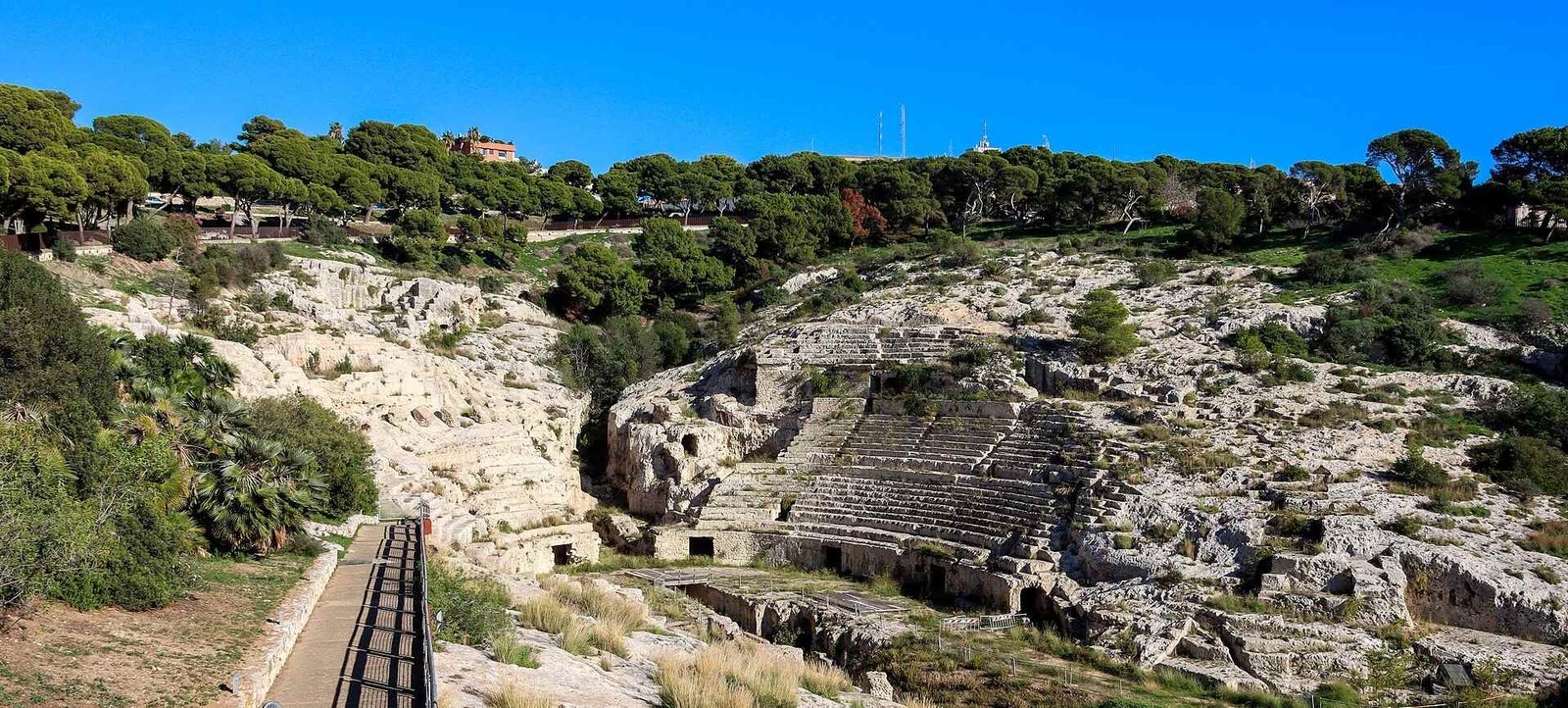
With this 3-day itinerary you will discover the authentic charm of Cagliari, among historic districts, sea views and landmark places such as the impressive Anfiteatro Romano, one of the city’s most fascinating archaeological treasures.
- 📍 Jour 1 et 2
- 📍 Jour 3
See also:
- Cagliari in 1 Day
- Guide to Cagliari
- Itineraries: 3d, CT
- See: Attractions
- Do: Experiences
- Eat: Where and What
- Getting Around, Stay
Route Description
Summary: If you have three days available, you can explore Cagliari in a complete and stress-free way thanks to an optimized itinerary that will take you through the city’s historical, artistic and natural wonders.
The itinerary is divided into a walking route in the heart of the historic center (during the first two days) and a third day dedicated to attractions outside the city, easily reachable by car or public transport.
Total duration:
- First two days: about 15 hours of sightseeing (7.5 hours per day), exploring the historic center (see map and stop details).
- Third day: dedicated to nature and landscapes, with excursions to Parco Naturale Molentargius Saline and Saline Conti Vecchi (see map and stop details).
A complete and varied experience, perfect to discover the authentic essence of Cagliari!
Maps and Details
CAGLIARI IN 3 DAYS > DAY 1 and 2
- Open Route Map📍
- Distance: 4.3* km on foot
- Time: 1 h 07* min. on foot
- Visit duration: 15 hours divided over 2 days
- Stops: 10 main (X →I)* + 9 secondary
- Cattedrale di Cagliari (X) → Torre dell’Elefante (A) → Bastione di Saint Remy (B) → Nuragica Museo Mostra (C) → Chiesa di San Michele (D) → Orto Botanico di Cagliari (E) → Anfiteatro romano di Cagliari (F) → Galleria Comunale d’Arte di Cagliari (G) → Museo Archeologico Nazionale di Cagliari (H) → Palazzo Regio (I)
- For days, times, prices and other info see Itinerary Table 📊
* These values may differ from those shown on Google Maps, as they are continuously recalculated in real time. See also Itinerary Info and Navigator + See here for Shared Stop 🧩
Day 1
⬇️ starting point
X. Cattedrale di Cagliari
The itinerary begins with the majestic Cattedrale di Cagliari (National Monument), one of the most representative symbols of the city. Its interior preserves masterpieces of sacred art and the evocative Cripta dei Martiri, where ancient relics are kept.
✨ Entering the Cripta dei Martiri feels like descending into a world suspended in time, between sacred silence and ancient stone that tells centuries of history.
❌ During peak hours the crypt has very narrow spaces and visitors proceed in small groups: the visit may slow down and feel less smooth than expected.
For a breathtaking view over the city, climb the Torre Campanaria. Next to the cathedral, the Museo Diocesano displays precious religious artworks, while the Antico Palazzo di Città, once the municipal seat, now hosts temporary exhibitions and cultural events.
📌 the Museo Diocesano del Duomo di Cagliari is currently closed to the public.
⬇️
A. Torre dell’Elefante
Continuing the visit, you will reach the Torre dell’Elefante, one of the city’s ancient medieval towers. Built in the 14th century by the Pisans, it represents an important vantage point over the city and the sea. Its name comes from the small marble elephant sculpture placed on its façade.
❌ The staircase is narrow and may cause slowdowns in visitor flow, especially on weekends.
⬇️
B. Bastione di Saint Remy
The Bastione di Saint Remy is one of the most scenic landmarks in Cagliari. This panoramic terrace, built between the 19th and 20th centuries, is the perfect place to admire the city from above and take breathtaking photos.
✨ Sunset from the Bastione di Saint Remy turns Cagliari into a golden mosaic suspended between sky and sea.
❌ At sunset hours, the terrace fills up quickly: finding a free spot to take photos without people in the foreground may require waiting or continuous repositioning.
⬇️
C. Nuragica Museo Mostra
To better understand the Nuragic civilization, visit the Nuragica Museo Mostra, an interactive exhibition that tells the story of one of the oldest peoples of the Mediterranean. Here you can virtually immerse yourself in the past and discover the heritage of prehistoric Sardinia.
❌ The experience is more effective if you visit without rushing: during busy hours it loses part of its immersive impact.
⬇️
D. Chiesa di San Michele
The Chiesa di San Michele is a masterpiece of Sardinian Baroque. Its interior amazes with rich decorations and spectacular frescoes, making it one of the most fascinating churches in Cagliari.
✨ The Baroque interior bursts with golden details that surprise at every step, almost theatrical in its visual intensity.
❌ Short visit: it may feel secondary compared to other more iconic stops along the itinerary.
⬇️
E. Orto Botanico di Cagliari
A green break in the heart of the city: the Orto Botanico di Cagliari hosts an incredible variety of exotic and Mediterranean plants, as well as Roman archaeological remains embedded within the garden.
❌ Midday hours reduce the quality of the visit due to heat and intense light.
⬇️
F. Anfiteatro romano di Cagliari
The final stop of the day is the Anfiteatro romano di Cagliari, one of the oldest monuments in the city. Built between the 1st and 2nd century AD, it could host up to 10,000 spectators for shows and gladiator fights.
Day 2
⬇️
G. Galleria Comunale d’Arte di Cagliari
The route continues from the Galleria Comunale d’Arte, where the modern art collection unfolds in elegant and quiet rooms that guide the visit without distractions.
❌ During certain periods, the exhibition rooms may feel less fluid due to small guided groups, with mandatory stops in narrower areas.
Next to the Galleria Comunale, the Museo delle Cere Anatomiche offers a surprising leap into 18th-century science, with models that combine anatomical precision and strong visual impact.
❌ It is not a mass tourism stop: its impact depends greatly on personal interest, so it may feel secondary within the rhythm of the itinerary.
At the end of the route, the Giardini Pubblici di Cagliari become a natural resting point: a green and relaxed setting, ideal for slowing down before continuing to the next stops.
❌ During midday hours it becomes a very busy crossing point for families and groups, making it less suitable for a quiet break.
⬇️
H. Museo Archeologico Nazionale di Cagliari
An entire museum-focused stop, where Cagliari expresses its historical and cultural identity through very different collections. The Museo Archeologico Nazionale is the heart of the visit, with Nuragic, Punic, and Roman artefacts that give concrete form to Sardinia’s ancient history.
❌ Complex internal layout: during peak days some rooms may cause slowdowns in visitor flow.
The Pinacoteca Nazionale offers a more artistic and local perspective, with works that showcase the pictorial evolution of the region.
❌ Shorter visit compared to the main museum: it may feel less of a priority if time is limited.
An unexpected and fascinating highlight is the stop at the Museo d’Arte Siamese, which presents a unique Eastern collection in Europe, creating a striking contrast with the rest of the itinerary.
❌ Small space and slow flow: best visited only if you have a specific interest in Eastern art.
Finally, the Museo Etnografico Regionale closes the visit with an immersion into Sardinian traditions, featuring objects, tools, and testimonies of past daily life.
❌ Very niche experience: it may feel less engaging for those seeking more scenic attractions.
⬇️
I. Palazzo Regio
The final stop of the second day is Palazzo Regio, once the residence of Spanish viceroys. Today it hosts frescoed rooms and historic furnishings that tell the aristocratic past of Cagliari.
❌ Access is often tied to limited hours or non-continuous openings: always check availability before visiting.
CAGLIARI IN 3 DAYS > DAY 3
- Open Route Map📍
- Distance: 24* km by car
- Time: 0,35* min. by car
- Visit duration: 6 hours
- Stops: 3 main (X →B)* + 2 secondary
- Parco Naturale Molentargius Saline (X) → Santuario di Nostra Signora di Bonaria (A) → Saline Conti Vecchi (B)
- Per giorni, orari, prezzi e altre info, vedi Tabella Itinerario 📊
* Questi valori, possono differire da quelli della Mappa Google Maps perché sempre ricalcolata in tempo reale. Vedi anche Info Itinerari e Navigatore + Vedi qui per Tappa Condivisa 🧩
Day 3
⬇️
X. Parco Naturale Molentargius Saline
The day begins with a visit to the Parco Naturale Molentargius Saline, a protected area stretching between Cagliari and Quartu Sant’Elena. This park is famous for its extraordinary biodiversity and is one of the best birdwatching spots in Sardinia. Here you can admire pink flamingos, which nest in the salt pans, along with many other bird species.
The area offers nature trails ideal for walking, cycling excursions, or simply enjoying the breathtaking landscape. The estimated visiting time is about 2 hours and 30 minutes, but if you are passionate about nature and trekking you may want to spend even more time exploring.
✨ Seeing pink flamingos moving between water mirrors and salt flats creates one of the most iconic and unexpected natural landscapes of urban Sardinia.
✨ If you love birdwatching, bring a binoculars and a camera to capture the wildlife.
❌ During peak hours, the main viewing areas can become crowded.
❌ The park is very large: without a bike or car, you may only cover a limited portion of it.
Book one of the recommended experiences:
✅ 2-hour bike tour in the flamingo oasis
✅ Segway tour of Molentargius Natural Park with coffee
⬇️
A. Santuario di Nostra Signora di Bonaria
After the immersion in nature, the route returns toward the city center to visit one of its most important landmarks: the Santuario di Nostra Signora di Bonaria. This religious site is connected to an ancient legend according to which, in 1370, a statue of the Virgin Mary arrived on the Cagliari coast inside a chest miraculously carried by the waves.
The monumental complex includes:
- The Basilica di Nostra Signora di Bonaria, one of the main places of worship in Sardinia, with its majestic architecture and the statue of the Virgin preserved inside.
- The Museo di Nostra Signora di Bonaria, which collects maritime ex-votos, relics, and historical artefacts linked to devotion to Our Lady of Bonaria, protector of sailors.
✨ The complex stands out for its strong connection between faith and the sea, with a spirituality that is immediately felt upon entering the basilica.
❌ During religious services or Marian events, access to indoor areas may be limited or less fluid.
⬇️
B. Saline Conti Vecchi
The final stop of the day takes us to the Saline Conti Vecchi, a unique place where nature, history, and industrial archaeology meet. This former saltworks, active since the 1930s, is now an open-air museum managed by FAI (Fondo Ambiente Italiano).
Here you can explore:
- The salt evaporation ponds, which create breathtaking landscapes with pink and blue shades that change depending on the season.
- The original industrial structures, including offices, laboratories, and archives perfectly preserved, telling the daily life of the saltworks workers.
- The chance to observe flamingos and other waterbird species that inhabit the area.
The visit includes an interactive route that tells the story of the saltworks and their economic and social impact on Sardinia.
Estimated visiting time: about 2 hours and 30 minutes.
✨ A landscape suspended between pink and white where industrial archaeology and nature create one of the most photogenic scenes in all of Cagliari. If you love photography, sunset over the salt pans offers incredible scenery!
📌 Although booking for the Saline Conti Vecchi is not strictly required, due to high visitor numbers in certain seasons, it is still recommended to contact the facility before visiting. You can find the phone number on the Google Maps listing via the table link.
Book one of the recommended experiences:
✅ Salt flats museum and train tour of Conti Vecchi
Eating
During a Cagliari in 3 days itinerary, discovering the city also means enjoying lunch breaks and dinners, which become an essential part of the travel experience.
Between the historic center and the port area, Sardinian cuisine accompanies each day with intense and authentic flavors.
Among the typical dishes and products not to miss along the way:
- Pane carasau, crispy and light, perfect as an accompaniment or snack during visits.
- Malloreddus alla campidanese, the iconic Sardinian pasta with a rich and flavorful meat sauce.
- Fregola, often served with clams, representing the direct link between cuisine and the sea.
- Culurgionis d’Ogliastra, traditional stuffed ravioli with an intense filling and a characteristic braided closure.
- Porcetto da latte, one of Sardinia’s most iconic dishes, with a bold and authentic flavor.
- Burrida alla cagliaritana, a historic fish-based dish marinated according to Cagliari’s maritime tradition.
To accompany lunches and dinners, Sardinian wines enhance every dish with balance and character:
- Cannonau di Sardegna DOC, structured and intense, ideal with meats and rich dishes.
- Vermentino di Sardegna DOC, fresh and aromatic, perfect with seafood dishes.
- Moscato di Sardegna DOC, ideal for ending the meal with sweet and aromatic notes.
See also What to eat in Cagliari
Along the itinerary, Cagliari offers a selection of traditional restaurants and local spots where you can best enjoy the city’s typical dishes:
- Sa Domu Sarda, traditional cuisine in the heart of the historic center.
- Sa Piola Restaurant, authentic atmosphere and traditional Cagliari dishes.
- Da Marino al St. Remy, panoramic views and seafood cuisine.
- La Stella Marina di Montecristo, seafood specialties rooted in local tradition.
- Ristorante Luigi Pomata, a benchmark for contemporary seafood cuisine in Cagliari.
See also Where to eat in Cagliari.
Sleeping
For a Cagliari in 3 days itinerary, choosing where to stay becomes strategic in order to reduce travel time and experience the city smoothly between the historic center, the sea and natural areas.
The Castello district and the entire historic center remain the most effective solution to optimize the first two days of the itinerary: by staying here you will be just a few steps away from the Cattedrale, Bastione di Saint Remy, museums and main cultural attractions, with the possibility of moving almost entirely on foot between the stops in the center.

If you want a balance between comfort and evening liveliness, the Marina district and the port area are an excellent alternative: restaurants, bars and quick connections to the train station make this area perfect to follow the rhythm of Day 1 and Day 2 without logistical constraints.
For Day 3, dedicated to nature and more peripheral areas such as Parco Molentargius and Saline Conti Vecchi, it may also be convenient to consider accommodation in the Poetto / seafront area, thus reducing travel time towards natural sites and enjoying direct access to the sea.
Alternatively, those traveling by car can stay in the city center and easily reach all stops thanks to the fast road network connecting the center, the coast and protected areas.
See also Where to sleep in Cagliari: Info and Tips.
📊 Itinerary Table
In the table below you will find all the attractions included in the itinerary, to enhance and best guide your 3-day visit to Cagliari:
- Scroll the table down and to the right 📱🔄 Rotate your phone horizontally to get an overview of opening days, hours, prices of attractions, and for further details on Wikipedia 🌐 and Google Maps ➡️.
- ⚠️ Always check the opening days and hours of attractions through the Google Maps entries linked in the table. See also Itinerary Info.
- To see the explanation of each data column, click its title (e.g. Attractions Index, Ratings, Org, etc.) at the top of the table.
⏳ Caricamento tabella in corso…
📌 This table is updated every 6–12 months.
🛡️ The tables on Tourplan360.com are original content protected by copyright © and monitored through anti-plagiarism tracking systems.
FAQ
You can open the Map Day 1 & 2 📍 or the Map Day 3 📍 directly from here.
📌 All detailed explanations are available in the Route Description Day 1 & 2 and Day 3
How much time do I need to visit Cagliari in 3 days?
The itinerary is structured over 3 full days, with visits divided between historic districts, museums, panoramic terraces, and natural areas, for an average of about 6–7 hours per day.
Can this Cagliari itinerary be done on foot?
Yes. Most of Cagliari’s historic center can easily be explored on foot, especially the Castello, Marina, and Stampace districts. Some Day 3 stops may require short trips by car or public transport.
📌 See also Getting around Cagliari: Info and Tips
Is it worth booking the main attractions in advance?
During peak tourist seasons, it is advisable to book in advance or join guided tours to avoid queues and ensure entry.
📌 See also Experiences in Cagliari
Is it possible to do this itinerary in less time?
Yes. In 1 or 2 days you can visit only some of the main attractions. You can adjust the stops depending on your interests.
Where can I find opening days, times, and prices for the attractions?
All updated information is available in the dedicated itinerary table, which also includes direct links to Google Maps ➡️ and Wikipedia 🌐 for each attraction.
📌 See the Itinerary Table 📊
See also
- Cagliari in 1 Day
- Complete Tour
- Guide to Cagliari
- See: Attractions
- Do: Experiences
- Eat: Where and What
- Getting Around, Stay
Other Destinations
🔐 Some images on this page are used under a Creative Commons license:
By Andrea Calcagno – Palermo, Gulf of Mondello – Own work – CC BY-SA 2.0 – Wikimedia Commons
By Anne Offermanns– Panoramic view of Rome from St. Peter’s Basilica – Own work – CC BY-SA 3.0 – Wikimedia Commons
By Richard Nevell – Naples, panoramic view of the city and Mount Vesuvius – Own work – CC BY-SA 4.0 – Wikimedia Commons
By Mike Peel – Cagliari, Roman amphitheatre – Own work – CC BY-SA 4.0 – Wikimedia Commons
