
Imperial Fora: what to see and complete itinerary
Travel guide, opening hours, prices, map


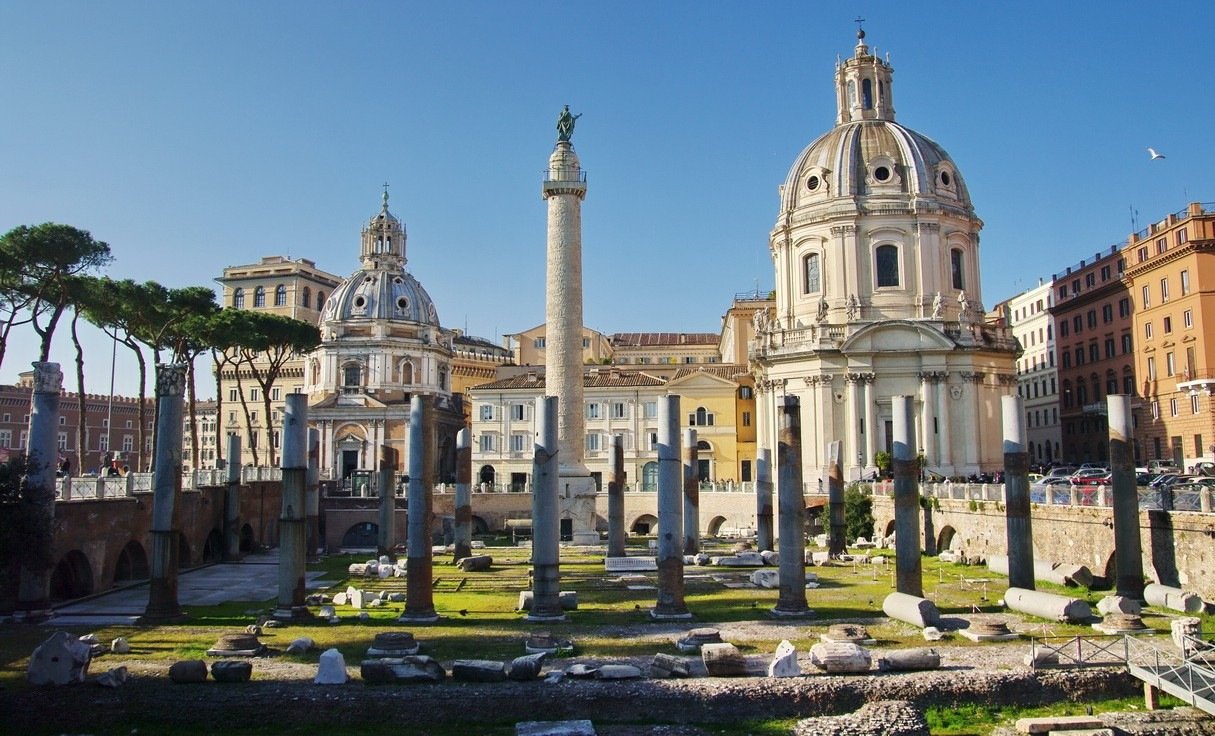
The Foro di Traiano shown above is fully included in this itinerary dedicated to discovering the Imperial Forum, allowing you to experience the archaeological heart of Rome, Caput Mundi.
See also:
- Colosseum in 1 day
- Guide to Rome
- Itineraries: 1d, 3d, CT1, CT2
- See: Attractions
- Do: Experiences
- Eat: Where and What
- Getting Around, Pass, Stay
Route Description
Welcome to the Fori Imperiali, one of Rome’s most famous archaeological complexes, showcasing the magnificence of Imperial Rome (rather than Republican Rome, represented by the Foro Romano).
Built between 46 BC and AD 113, the Fori Imperiali feature monuments commissioned by emperors to celebrate the power and greatness of Rome.
Our circular route, approximately 2.5 km long, allows you to discover the art, architecture, and thousands of years of history of these extraordinary sites in about 4 hours of sightseeing, following 9 main stops.
📌 The Fori Imperiali route is outside the Parco Archeologico del Colosseo admission circuit. A separate ticket is therefore required, which you can purchase directly at the entrance near the Colonna Traiana or online using the link below.
Book one of our recommended experiences here:
✅ Imperial Forum Tickets
✅ Trajan’s Markets experience with multimedia video
IMPERIAL FORUMS ITINERARY
- Open Route Map📍
- Distance: 2.5* km on foot
- Walking time: 35* min.
- Visit duration: 4 hours
- Stops: 9 main (X → H)* + 1 secondary
- Colonna Traiana (X) → Tempio di Venere Genitrice (A) → Tempio della Pace (Foro della Pace) (B) → Foro di Nerva (C) → Foro di Traiano (D) → Foro di Augusto (E) → Mercati di Traiano (F) → Foro di Cesare – Ingresso Fori Imperiali (G) → Le Domus romane di Palazzo Valentini (H)
- For days, times, prices and other info see Itinerary Table 📊
* These values may differ from those shown on Google Maps, as they are continuously recalculated in real time. See also Itinerary Info and Navigator + See here for Shared Stop 🧩
Steps Details
📌 All the stops summarized here are structured in the Itinerary Table 📊 with days, opening hours, prices, and Wikipedia 🌐 and Google Maps insights.
Imperial Forums
⬇️ starting point
X. Colonna Traiana
The Colonna Traiana, the starting point of the route, is one of the most iconic works, standing approximately 30 metres high and decorated with reliefs celebrating Emperor Traiano’s victories in the Dacian Wars. This monument is famous for the precision of its carved scenes and introduces visitors to the historical richness of this area.
✨ Approaching the Colonna Traiana means reading, scene after scene, one of the greatest “visual narratives” of antiquity.
⬇️
A. Tempio di Venere Genitrice
Continuing the route, you reach the Tempio di Venere Genitrice, dedicated by Giulio Cesare to the goddess Venus. This imposing temple, part of the Foro di Cesare, stands out for its columns and for the historical importance of the cult of Venus as the ancestor of the gens Julia, the family of Cesare.
⬇️
B. Tempio della Pace (Foro della Pace)
The Foro della Pace, built by Emperor Vespasiano, is an oasis of tranquillity and ancient art. Here, Vespasiano placed treasures and artistic objects obtained from military campaigns. Although heavily damaged, it still preserves traces of the grandeur of its original structure.
⬇️
C. Foro di Nerva
The Foro di Nerva, also known as Foro Transitorio, served as a connection between the existing forums. The temple, characterised by unique columns and sculptures, was dedicated to the goddess Minerva, protector of arts and wisdom, celebrating Nerva’s role as a mediator between past and present.
⬇️
D. Foro di Traiano
The largest and most majestic of the Imperial Forums, the Foro di Traiano included a market and a basilica. Famous for its colonnade and the Basilica Ulpia, it represents the supremacy of Roman architecture. Here visitors could admire statues, libraries and fountains celebrating the achievements of the emperor.
✨ Walking among the ruins of the Foro di Traiano offers one of the most powerful sensations of the archaeological area: standing before the grandeur of Imperial Rome, still perceptible today.
⬇️
E. Foro di Augusto
The Foro di Augusto was the centre of political and military life. Dominated by the Tempio di Marte Ultore, built to celebrate the revenge against Cesare’s assassins, it is one of the most significant examples of Roman emperors’ devotion and loyalty to the gods.
✨ At sunset or during the evening hours, the Foro di Augusto takes on a fascinating atmosphere, where lights and ruins transform Roman history into a spectacular experience.
⬇️
F. Mercati di Traiano e Museo dei Fori Imperiali
Considered the first shopping centre in history, the Mercati di Traiano offer a unique view of commercial life in ancient Rome. They house the Museo dei Fori Imperiali, where you can admire statues, architectural fragments and artefacts illustrating the opulence and complexity of Roman daily and political life.
✨ Entering the Mercati di Traiano allows you to explore ancient spaces that are still understandable today and imagine the daily life of a commercial and monumental Rome.
❌ The visit requires more time than a simple external walk through the Forums: consider entering the museum if you have a very concentrated itinerary.
⬇️
G. Foro di Cesare
The Foro di Cesare, the first of the Imperial Forums, was the centre of Giulio Cesare’s political activities. With its temple and square, Cesare redefined the concept of power in Rome, continuing to fascinate visitors today.
✨ Leaving this place feels like closing a symbolic circle in Roman history.
⬇️
H. Le Domus romane di Palazzo Valentini
To conclude the itinerary, the Domus Romane di Palazzo Valentini offer a multisensory experience. These ancient Roman aristocratic residences, brought back to light, reveal mosaic floors, decorations and remains that evoke the life of Roman nobles.
📌 The Domus Romane di Palazzo Valentini are not included in the official Imperial Forums route and require a specific ticket. We wanted to include them because, in our opinion, they are an integral part of the area.
Dinner
After exploring the grandeur of the Fori Imperiali, the best way to end your itinerary is with dinner at a traditional Roman trattoria, where you can rediscover the authentic flavors of Roman cuisine. Some of the specialties you shouldn’t miss include:
- Fried cod fillets, one of the great classics of Roman tradition, perfect as an appetizer;
- Spaghetti alla gricia, the famous Roman pasta dish made with guanciale, pecorino cheese, and black pepper;
- Abbacchio alla romana, the iconic lamb dish of Lazio, prepared according to the traditional recipe;
- Maritozzo, Rome’s signature dessert, the perfect way to end the day.
To enjoy these specialties, consider dining at some of Rome’s most renowned historic restaurants, such as Armando al Pantheon, famous for its traditional Roman cuisine in the heart of the historic center, L’Arcangelo, a benchmark for refined Roman cooking, or Antica Pesa, a historic Roman restaurant ideal for a more elegant dinner.
For a complete guide on where and what to eat in Rome, visit our dedicated guides: Where and What to eat in Rome.
Sleeping
To fully enjoy your visit to the Fori Imperiali, the best areas to stay are Monti, the Historic Center, and Piazza Venezia. These neighborhoods are ideal for easily reaching the archaeological area and the main monuments of ancient Rome on foot.
Staying in this part of the city allows you to experience the atmosphere of Imperial Rome even during the evening and early morning, when Via dei Fori Imperiali, the historic squares, and the illuminated monuments create a particularly enchanting setting.
Alternatively, the Colosseo, Celio, and Aventino districts are excellent choices for visitors who wish to stay close to the archaeological route while enjoying a quieter atmosphere and convenient connections to the rest of the city.
For more information about the best areas to stay in the city, read our dedicated guide: Where to sleep in Rome: Info and Tips.

📊 Itinerary Table
In the table below, you will find all the attractions included in this itinerary, helping you make the most of your visit and navigate it with ease:
- Scroll the table down and to the right 📱🔄 Rotate your phone horizontally to get an overview of opening days, hours, prices of attractions, and for further details on Wikipedia 🌐 and Google Maps ➡️.
- ⚠️ Always check the opening days and hours of attractions through the Google Maps entries linked in the table. See also Itinerary Info.
- To see the explanation of each data column, click its title (e.g. Attractions Index, Ratings, Org, etc.) at the top of the table.
⏳ Caricamento tabella in corso…
📌 This table is updated every 6–12 months.
🛡️ The tables on Tourplan360.com are original content protected by copyright © and monitored through anti-plagiarism tracking systems.
FAQ
You can open the Route Map📍 here as well. Alternatively, you can consult the dedicated section with all the details.
📌 Check the Route Description
How much time is needed to visit the Imperial Fora?
The complete Imperial Fora itinerary, including the main archaeological areas and Trajan’s Markets with the Museum of the Imperial Fora, requires about 3 hours. By adding the Domus Romane at Palazzo Valentini, the total experience takes around 4 hours.
Can this Imperial Fora itinerary be done on foot?
Yes. The route is entirely pedestrian and covers approximately 2.5 km among the main archaeological remains of ancient Rome, starting from the Colosseum area and ending near Caesar’s Forum.
📌 See also Getting around Rome
Is it worth booking admission or guided tours?
Yes. To visit the Imperial Fora and Trajan’s Markets, it is recommended to arrange admission in advance or choose a guided tour, especially during busy periods, to optimize your time and discover the history of one of Rome’s most important archaeological complexes.
📌 See also Recommended experiences
Where can I find opening days, hours and prices of the attractions?
All updated information is available in the itinerary table, which also includes direct links to Google Maps ➡️ and Wikipedia 🌐 for each attraction.
📌 Check the Itinerary Table 📊
See also
- Rome in 1 day
- Rome in 3 days
- Colosseum in 1 day
- Complete Tour: P1 + P2
- Guide to Rome
- See: Attractions
- Do: Experiences
- Eat: Where and What
- Getting Around, Pass, Stay
Other Destinations
🔐 Some images on this page are used under Creative Commons licenses:
By Richard Nevell – Naples, panoramic view of the city and Mount Vesuvius – Own work – CC BY-SA 4.0 – Wikimedia Commons
By PROPOLI87 – Florence, panorama from Piazzale Michelangelo – Own work – CC BY-SA 4.0 – Wikimedia Commons
By Luca Aless – Venice, panoramic view of Doge’s Palace and St. Mark’s Campanile – Own work – CC BY-SA 4.0 – Wikimedia Commons
Di Bgabel – Roma – Panoramica del Foro di Traiano – Fori Imperiali – Opera propria – CC BY-SA 3.0 – Wikimedia Commons

