
Rome, Rioni Parione and Regola: what to see and complete itinerary
Travel guide, opening hours, prices, map


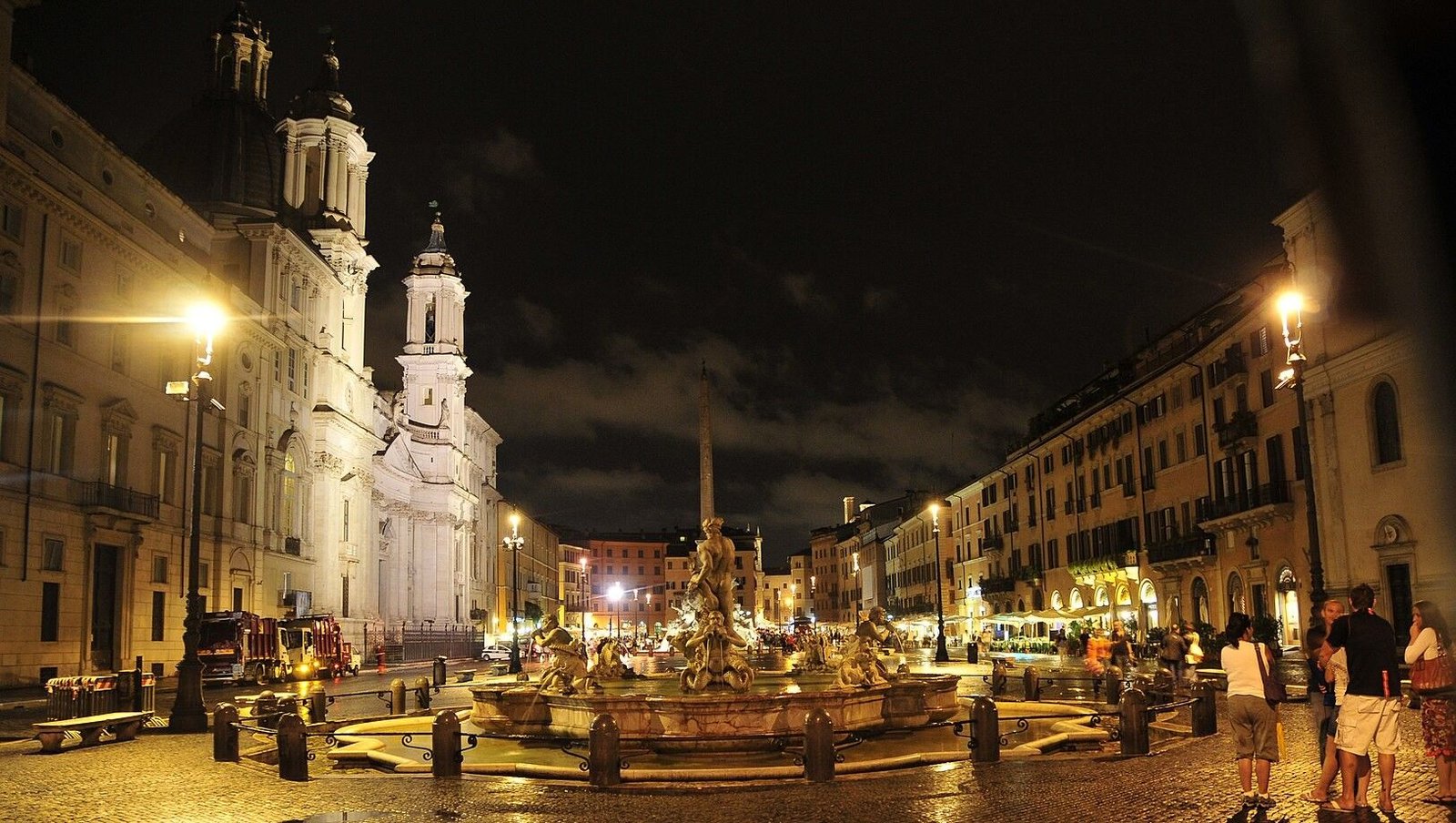
The magic that surrounds Piazza Navona in the evening 📱🔄️ sets the scene for this itinerary, which will guide you through the Rioni Parione and Regola, among monumental squares, noble palaces and picturesque views along the Tiber River.
See also:
- Back to Complete Tour 1
- Guide to Rome
- Itineraries: 1d, 3d, CT2
- See: Attractions
- Do: Experiences
- Eat: Where and What
- Getting Around, Pass, Stay
Route Description
This 2.7 km walking itinerary, with an estimated visiting time of 8 hours, will take you through the Rioni Parione and Regola, two of the most fascinating areas of Rome’s historic centre, where art, history and tradition come together among elegant squares and historic palaces.
The itinerary passes through some of the most iconic places in this area, from the famous Piazza Navona with the spectacular Fontana dei Quattro Fiumi, to the lively Campo de’ Fiori, the imposing Palazzo Farnese, and the fascinating Stadio di Domiziano, one of the most important underground archaeological sites in the Eternal City.
RIONI PARIONE and REGOLA
- Open Route Map📍
- Distance: 2.7* km on foot
- Time: 0.37* min. on foot
- Visit duration: 8 hours
- Stops: 10 main ones (X → I)* + 13 secondary ones
- Piazza Navona (X) → Chiesa di Sant’Agnese in Agone (A) → Museo di Scultura Antica “G. Barracco” (B) → Palazzo della Cancelleria (C) → Campo de’ Fiori (D) → Galleria Spada / Palazzo Capodiferro (E) → Palazzo Farnese (F) → Chiesa di Santa Maria in Vallicella (G) → Basilica S. Giovanni Battista dei Fiorentini (H) → Stadio di Domiziano (I)
- For days, times, prices and other info see Itinerary Table 📊
* These values may differ from those shown on Google Maps, as they are continuously recalculated in real time. See also Itinerary Info and Navigator + See here for Shared Stop 🧩
Steps Details
📌 All the stops summarized here are structured in the Itinerary Table 📊 with days, opening hours, prices, and Wikipedia 🌐 and Google Maps insights.
Morning
⬇️ starting point
X. Piazza Navona
The itinerary begins from Piazza Navona, one of the most iconic squares in Rome, built on the foundations of the Stadium of Domitian. Admire the three famous fountains, especially the Fontana dei Quattro Fiumi, a masterpiece by Gian Lorenzo Bernini, representing the four main rivers of the world (the Nile, the Ganges, the Danube and the Rio de la Plata).
In the centre stands the Obelisco Agonale, an ancient Egyptian obelisk that adds an exotic touch to the square. Do not forget to also admire the Fontana del Moro and the Fontana del Nettuno.
✨ The square changes its appearance between day and evening: when the lights illuminate the fountains, the atmosphere becomes truly unforgettable.
❌ The central hours of the day are often the busiest: if you want to enjoy the square in greater tranquillity, arrive early in the morning or in the evening.
⬇️
A. Chiesa di Sant’Agnese in Agone
The magnificent Chiesa di Sant’Agnese in Agone, located right on Piazza Navona, is a perfect example of Baroque architecture, with a façade designed by Borromini and a richly decorated interior.
⬇️
B. Museo di Scultura Antica “G. Barracco”
Continue with a visit to the Museo di Scultura Antica Barracco, which houses a collection of ancient sculptures from civilisations such as the Egyptian, Assyrian, Greek and Roman ones. This small free museum is a hidden gem for archaeology lovers.
⬇️
C. Palazzo della Cancelleria
The fourth stop is Palazzo della Cancelleria, an elegant Renaissance building that houses the Museo Leonardo da Vinci, dedicated to the inventions and works of the Tuscan genius. The museum is perfect for exploring Leonardo’s drawings and projects, with interactive models that allow visitors to better understand his brilliant mind.
📌 Palazzo della Cancelleria can be visited upon request. You can find the phone number in the Google Maps profile accessible through the link in the table.
⬇️
D. Piazza Campo de’ Fiori
Continue towards Piazza Campo de’ Fiori, famous for its lively daily market, where you can immerse yourself in the local atmosphere among stalls selling fruit, vegetables, flowers and handmade products. In the centre of the square stands the monument to Giordano Bruno, the philosopher sentenced to the stake in 1600 for his revolutionary ideas. Campo de’ Fiori is a place full of history, culture and everyday life.
✨ The market, outdoor venues and the constant movement of people make this one of the most authentic and lively squares in Rome.
❌ We have included Campo de’ Fiori in the late morning to show you the market while it is still active and allow you to take a break or have a snack before the closure of the stalls, generally scheduled by 2:00 PM.
⬇️
E. Galleria Spada / Palazzo Capodiferro
The morning ends with a visit to the Galleria Spada, located inside Palazzo Capodiferro. In addition to a collection of 17th-century paintings, here you can admire the famous illusory perspective designed by Borromini in the courtyard, a masterpiece of Baroque architecture that deceives the eye with a false perception of depth.
❌ If you are short on time, consider that the complete visit of the Galleria requires more time than it might seem at first glance.
📌 The visit to Galleria Spada is by reservation. You can find the phone number in the Google Maps profile accessible through the link in the table.
Afternoon
⬇️
F. Palazzo Farnese
Just a few steps away is Palazzo Farnese, one of the largest and most majestic Renaissance residences in Rome, today the seat of the French Embassy. Piazza Farnese is decorated with two monumental fountains, each made from enormous granite basins taken from the ancient Roman baths.
📌 Visiting Palazzo Farnese requires mandatory reservation. You can find the phone number in the Google Maps profile accessible through the link in the table.
❌ If you wish to visit the interiors, book well in advance: access is limited.
⬇️
G. Chiesa di Santa Maria in Vallicella
Head towards the Chiesa di Santa Maria in Vallicella, also known as Chiesa Nuova, built in the 16th century. Inside, you will find artworks by Rubens and Pietro da Cortona.
Near the church are the Oratorio dei Filippini and the magnificent Biblioteca Vallicelliana, designed by Borromini. Do not miss the unique Fontana della Terrina, with its distinctive shape resembling a soup tureen.
✨ Among artworks, Baroque architecture and places designed by Borromini, this is one of the most fascinating and lesser-known corners of the historic centre.
📌 The Oratorio dei Filippini can be visited upon request, as well as the Borrominian Hall of the Biblioteca Vallicelliana, which can only be visited by reservation. You can find the phone numbers in the Google Maps profiles accessible through the respective links in the table.
❌ If you also want to visit the Oratorio dei Filippini and the Biblioteca Vallicelliana, plan ahead: access is not always available without reservation.
⬇️
H. Basilica di San Giovanni Battista dei Fiorentini
The Basilica di San Giovanni Battista dei Fiorentini is another architectural gem, dedicated to the patron saint of Florence. Inside, you will find Renaissance and Baroque artworks, while the Museo San Giovanni de’ Fiorentini preserves historical artefacts connected to the Florentine community in Rome.
⬇️
I. Stadio di Domiziano
The itinerary ends in the northern part of Piazza Navona, where the remains of the Stadio di Domiziano are located, the ancient structure on which the modern square was built. A visit to this archaeological site allows you to explore the hidden history beneath the city.
✨ Going down beneath Piazza Navona and finding yourself among the remains of the ancient Roman stadium is an experience that completely changes your perspective of the square.
📌 Visiting the Stadio di Domiziano is by reservation. You can find the phone number in the Google Maps profile accessible through the link in the table.
❌ If your itinerary is very tight, consider this visit only if you are interested in archaeology: it requires additional time compared to a simple walk on the surface.
Dinner
After exploring the charming Rioni Parione and Regola, the best way to end the day is with dinner at one of the historic trattorias in central Rome, where you can enjoy some of the most authentic dishes of the Capitoline culinary tradition. Among the specialties not to be missed are:
- Carciofi alla giudia, one of the signature appetizers of Roman cuisine;
- Fettuccine alla papalina, a rich Roman pasta dish prepared with cooked ham, eggs and Parmesan cheese;
- Trippa alla romana, one of the great classics of Roman cuisine, cooked with tomato, Pecorino Romano cheese and mint;
- Pangiallo, an ancient Roman dessert made with dried fruit, honey and spices.
To enjoy these specialties, you can stop at some of the area’s most appreciated restaurants, such as Pierluigi, overlooking the square of the same name just a few steps from Campo de’ Fiori, Casa Coppelle, in the heart of the Rione Parione, or Glass Hostaria, an elegant restaurant located in the nearby Rione Regola.
For a complete overview of where and what to eat in Rome, visit our dedicated guides: Where to eat in Rome and What to eat in Rome.
Sleeping
For this itinerary discovering the Rioni Parione and Regola, the best area to stay is the Historic Centre, especially the area between Piazza Navona, Campo de’ Fiori, Piazza Farnese and the Pantheon. This location allows you to easily reach the main stops of the route on foot, while experiencing the atmosphere of Rome’s historic squares even in the evening hours.
An excellent alternative is the nearby Trastevere district, ideal for those who want to stay in a characteristic area full of charming streets, local venues and traditional restaurants, while still being able to reach the historic centre with a short walk.
For those who prefer a quieter yet central location, the area between Prati and Castel Sant’Angelo can also be a good choice, offering convenient connections to the Vatican and the other main areas of the city.
For more information on where to stay in the city, you can consult our dedicated guide: Where to sleep in Rome: Info and Tips.

📊 Itinerary Table
In the table below you will find all the attractions included in the itinerary, designed to help you better plan and make the most of your visit:
- Scroll the table down and to the right 📱🔄 Rotate your phone horizontally to get an overview of opening days, hours, prices of attractions, and for further details on Wikipedia 🌐 and Google Maps ➡️.
- ⚠️ Always check the opening days and hours of attractions through the Google Maps entries linked in the table. See also Itinerary Info.
- To see the explanation of each data column, click its title (e.g. Attractions Index, Ratings, Org, etc.) at the top of the table.
⏳ Caricamento tabella in corso…
📌 This table is updated every 6–12 months.
🛡️ The tables on Tourplan360.com are original content protected by copyright © and monitored through anti-plagiarism tracking systems.
FAQ
You can open the Route Map📍 also from here. Alternatively, you can consult the dedicated section with all the details.
📌 See the Route Description
How long does it take to visit the Parione and Regola Districts?
The complete itinerary takes approximately 8 hours, including the main attractions, breaks, and enough time to fully enjoy the squares, churches, historic palaces and museums along the route.
Can this Parione and Regola itinerary be done on foot?
Yes. The entire route is pedestrian and covers approximately 2.7 km through the heart of Rome’s historic centre, passing Piazza Navona, Campo de’ Fiori, Piazza Farnese and the other highlights of the itinerary.
📌 See also Getting around Rome
Is it worth booking the main attractions in advance?
Yes. Some attractions along the route may require advance booking or have regulated access. Always check the visiting conditions before planning your itinerary.
📌 See also Experiences in Rome
Is it possible to do this itinerary in half a day?
Yes. In half a day, you can focus on the main highlights such as Piazza Navona, Campo de’ Fiori and Palazzo Farnese, adapting the route according to the time available and your interests.
Where can I find opening days, times and ticket prices for the attractions?
All updated information is available in the dedicated itinerary table, which also includes direct links to Google Maps ➡️ and Wikipedia 🌐 for each attraction.
📌 See the Itinerary Table 📊
See also
- Back to Complete Tour 1
- Complete Tour 2
- Rome in 1 day
- Rome in 3 days
- Guide to Rome
- See: Attractions
- Do: Experiences
- Eat: Where and What
- Getting Around, Pass, Stay
Other Destinations
🔐 Some images on this page are used under Creative Commons licenses:
By Richard Nevell – Naples, panoramic view of the city and Mount Vesuvius – Own work – CC BY-SA 4.0 – Wikimedia Commons
By PROPOLI87 – Florence, panorama from Piazzale Michelangelo – Own work – CC BY-SA 4.0 – Wikimedia Commons
By Luca Aless – Venice, panoramic view of Doge’s Palace and St. Mark’s Campanile – Own work – CC BY-SA 4.0 – Wikimedia Commons
By Hanc1 – Piazza Navona di notte – Opera propria – CC BY-SA 3.0 – Wikimedia Commons

