
Rome, Rioni Sant’Angelo and Trastevere: what to see and complete itinerary
Travel guide, opening hours, prices, map


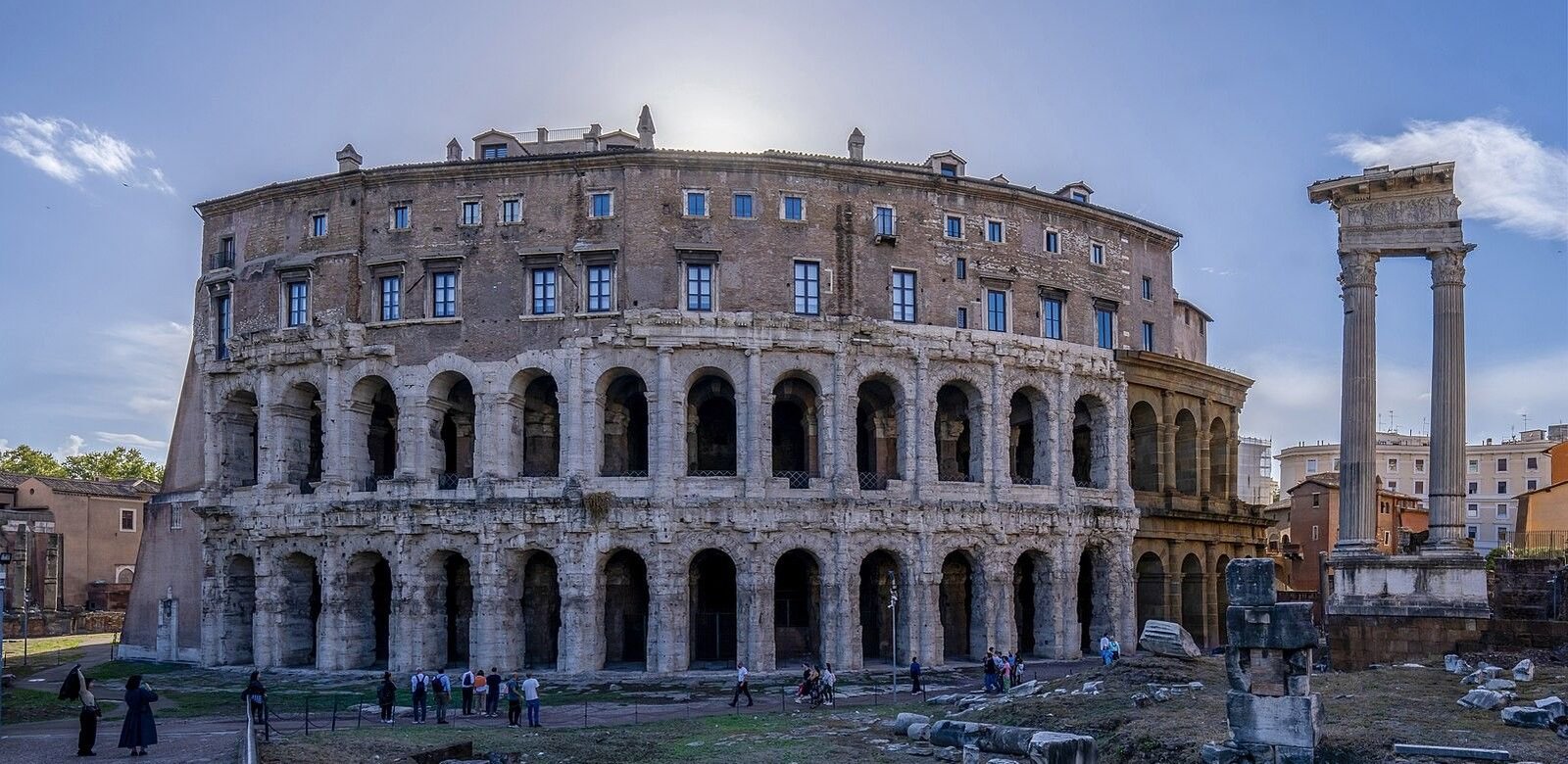
The magnificent photo above highlights the evocative monumentality of the Teatro di Marcello 📱🔄️, providing the perfect introduction to this itinerary dedicated to the Rioni Sant’Angelo and Trastevere.
See also:
- Back to Complete Tour 1
- Guide to Rome
- Itineraries: 1d, 3d, CT2
- See: Attractions
- Do: Experiences
- Eat: Where and What
- Getting Around, Pass, Stay
Route Description
This 3.2 km walking itinerary, spread over 2 days, will take you through two of Rome’s historic districts. The first day, dedicated to the Rione Sant’Angelo, begins with a visit to the Teatro Marcello, before continuing to Isola Tiberina and the Ghetto Ebraico, landmarks that bear witness to the city’s thousand-year history.
The second day focuses on Trastevere, with unmissable stops such as the National Galleries of Ancient Art at Palazzo Barberini, the Basilica di Santa Maria in Trastevere, the vibrant heart of the district, and concludes with the Basilica di Santa Cecilia in Trastevere and its fascinating underground excavations.
RIONI SANT’ANGELO and TRASTEVERE
- Open Route Map📍
- Distance: 3.2* km on foot
- Walking time: 45* min.
- Visit duration: 13 hours spread over 2 days
- Stops: 10 main (X → I)* + 15 secondary
- Teatro Marcello (X) → Basilica di San Bartolomeo all’Isola (A) → Tempio Maggiore di Roma (B) → Villa Farnesina (C) → Palazzo Barberini – National Galleries of Ancient Art (D) → Chiesa di Santa Maria della Scala (E) → Museo di Roma in Trastevere (F) → Basilica di Santa Maria in Trastevere (G) → Basilica di San Crisogono (H) → Basilica di Santa Cecilia in Trastevere (I)
- For days, times, prices and other info see Itinerary Table 📊
* These values may differ from those shown on Google Maps, as they are continuously recalculated in real time. See also Itinerary Info and Navigator + See here for Shared Stop 🧩
Steps Details
📌 All the stops summarized here are structured in the Itinerary Table 📊 with days, opening hours, prices, and Wikipedia 🌐 and Google Maps insights.
Day 1
⬇️ starting point
X. Teatro Marcello
Start your day by exploring the Teatro Marcello, the ancient Roman theatre, commissioned under Julius Caesar and inaugurated by Augustus. Continue to the Templi di Apollo Sosiano e Bellona, two sacred buildings from the Republican era that provide a glimpse into the religious traditions of ancient Rome. Finally, visit the Basilica di San Nicola in Carcere, built upon the remains of ancient Roman temples, another remarkable archaeological site not to be missed.
✨ The view of the ancient Roman theatre nestled among modern buildings creates one of the most striking contrasts between Ancient Rome and the contemporary city.
⬇️
A. Basilica di San Bartolomeo all’Isola
Reach the Isola Tiberina, a small island in the Tiber River that is home to the Basilica di San Bartolomeo all’Isola, an ancient place of worship closely linked to the history of Roman Christianity. Walk across the Ponte Emilio, the oldest Roman bridge in Rome, connecting the island with the eastern riverbank.
✨ Crossing the Isola Tiberina offers a charming break from the pace of the city, surrounded by water, history and the timeless atmosphere of Rome.
⬇️
B. Tempio Maggiore di Roma
Continuing towards the Ghetto Ebraico di Roma, you will visit the Tempio Maggiore, the city’s main synagogue, which houses the Museo Ebraico di Roma. This area is an important centre of Jewish history and culture, with charming streets and a heritage that tells the story of the Jewish presence in Rome since ancient times.
✨ Entering Rome’s main synagogue offers the opportunity to discover a place of profound symbolic importance, where centuries of Jewish history and culture come together.
❌ An interior visit requires considerably more time than a simple photo stop.
⬇️
C. Villa Farnesina
Crossing the Tiber River, you will reach Villa Farnesina, one of the finest Renaissance villas in Rome. Here you can admire the Loggia di Psiche and the celebrated fresco of the Trionfo di Galatea, painted by Raphael. Take a stroll through the villa’s beautifully maintained gardens, a peaceful oasis in the heart of the city.
Day 2
⬇️
D. Palazzo Barberini – Gallerie Nazionali di Arte Antica
The second day begins with a visit to Palazzo Barberini, home to the Gallerie Nazionali di Arte Antica, which houses works by masters such as Caravaggio and Rubens. Just a few steps away, you will find the Biblioteca dei Lincei e Corsiniana, which preserves valuable historical and scientific manuscripts.
✨ Admiring Caravaggio’s masterpieces inside a magnificent Baroque palace creates a unique encounter between great art and historic architecture.
❌ The visit requires time: allow at least 90 minutes to appreciate the main artworks without interrupting your itinerary.
📌The visit to the Gallerie Nazionali di Arte Antica – Galleria Corsini is by reservation, while the Biblioteca dei Lincei e Corsiniana can be visited upon request. You can find the telephone number in the respective Google Maps cards accessible through the links in the table.
⬇️
E. Chiesa di Santa Maria della Scala
Continue towards the Chiesa di Santa Maria della Scala, known for its historical importance and for the ancient monastic pharmacy, the Spezieria di Santa Maria della Scala, one of the oldest in Europe.
✨ Entering the ancient monastic pharmacy means taking a journey back in time among historic furnishings, original instruments and an atmosphere that has remained almost unchanged for centuries.
📌The visit to the Antica Spezieria di S. Maria della Scala is by reservation. You can find the telephone number in the Google Maps card accessible through the link in the table.
⬇️
F. Museo di Roma in Trastevere
At this point, a visit to the Museo di Roma in Trastevere is a must. This museum documents the daily life of Romans between the 19th and 20th centuries, with a particular focus on the popular traditions of Rome.
⬇️
G. Basilica di Santa Maria in Trastevere
Your next stop is the magnificent Basilica di Santa Maria in Trastevere, one of the oldest churches in Rome, featuring unique medieval mosaics. The square in front, with its Fontana di Piazza Santa Maria, is the vibrant heart of Trastevere, always animated by tourists and locals.
✨ Entering the basilica illuminated by golden mosaics means experiencing one of the most evocative moments of Rome’s medieval heritage.
❌ The square and the basilica are among the busiest places in Trastevere: in the evening and during weekends they can be very crowded.
⬇️
H. Basilica di San Crisogono
Continuing the route, visit the Basilica di San Crisogono, which hides inside its walls the remains of an early Christian basilica dating back to the 4th century, a truly fascinating archaeological site.
✨ Descending into the underground areas allows you to discover a hidden Rome, far from the most well-known tourist routes.
⬇️
I. Basilica di Santa Cecilia in Trastevere
End your day with a visit to the Basilica di Santa Cecilia in Trastevere, dedicated to the patron saint of music. Do not miss exploring its crypt and the underground excavations, which reveal the ancient history of this sacred place.
❌ The underground excavations have a separate entrance from the basilica: check the opening hours before planning your visit.
Dinner
After exploring the Rioni Sant’Angelo and Trastevere, among the remains of Ancient Rome and picturesque alleyways, the best way to end the itinerary is with dinner at a traditional Roman trattoria, where you can enjoy the authentic flavors of Rome’s culinary tradition. Some of the specialties not to be missed include:
- Carciofi alla giudia, an iconic specialty of Roman-Jewish cuisine, closely linked to the tradition of the Ghetto Ebraico;
- Spaghetti alla carbonara, the famous Roman pasta dish prepared with guanciale, pecorino cheese and eggs;
- Coda alla vaccinara, one of the most representative dishes of traditional Roman cuisine, originating in the city’s working-class neighborhoods;
- Maritozzo, Rome’s signature dessert, perfect for ending the day on a sweet note.
To enjoy these specialties, you can stop at some historic restaurants along the route, such as Checco er Carettiere, a historic Trastevere trattoria renowned for traditional Roman cuisine, Antica Pesa, one of the neighborhood’s historic restaurants, or L’Arcangelo, appreciated for its refined interpretation of Roman cuisine.
For a complete overview of where and what to eat in Rome, visit our dedicated guides: Where to eat in Rome and What to eat in Rome.
Sleeping
For this two-day itinerary exploring the Rioni Sant’Angelo and Trastevere, the best area to stay is the Historic Centre, especially between Campo de’ Fiori, Largo Argentina, the Ghetto Ebraico and Piazza Navona. This location allows you to easily reach the main attractions on foot, minimizing travel time while enjoying Rome’s historic atmosphere even after your visits.
An excellent alternative is Trastevere, an ideal choice for those who wish to stay in one of Rome’s most charming districts, surrounded by picturesque alleyways, lively squares and countless places to spend the evening.
For travelers who prefer a more central location with convenient connections to the rest of the city, the areas around Piazza Venezia and Monti are also excellent options, thanks to their proximity to major transport links and many of Rome’s other attractions.
For more information on where to stay in the city, take a look at our dedicated guide: Where to sleep in Rome: Info and Tips.

📊 Itinerary Table
In the table below you will find all the attractions included in the itinerary, to enhance and better guide your visit.
- Scroll the table down and to the right 📱🔄 Rotate your phone horizontally to get an overview of opening days, hours, prices of attractions, and for further details on Wikipedia 🌐 and Google Maps ➡️.
- ⚠️ Always check the opening days and hours of attractions through the Google Maps entries linked in the table. See also Itinerary Info.
- To see the explanation of each data column, click its title (e.g. Attractions Index, Ratings, Org, etc.) at the top of the table.
⏳ Caricamento tabella in corso…
📌 This table is updated every 6–12 months.
🛡️ The tables on Tourplan360.com are original content protected by copyright © and monitored through anti-plagiarism tracking systems.
FAQ
You can open the Route Map📍 also from here. Alternatively, you can consult the dedicated section with all the details.
📌 See the Route Description
How long does it take to visit Sant’Angelo and Trastevere?
The complete itinerary requires about 13 hours distributed over 2 days, allowing you to visit the main attractions of the two districts and nearby areas at a relaxed pace.
Can this Sant’Angelo and Trastevere itinerary be done on foot?
Yes. The route covers approximately 3.2 km on foot, connecting some of the most fascinating historic areas of Rome.
📌 See also Getting around Rome
Is it possible to do this itinerary in one day?
Yes. In one day, you can select the main attractions and adapt the route according to your interests and available time.
Where can I find opening days, times and ticket prices for the attractions?
All updated information is available in the dedicated itinerary table, which also includes direct links to Google Maps ➡️ and Wikipedia 🌐 for each attraction.
📌 See the Itinerary Table 📊
See also
- Back to Complete Tour 1
- Complete Tour 2
- Rome in 1 day
- Rome in 3 days
- Guide to Rome
- See: Attractions
- Do: Experiences
- Eat: Where and What
- Getting Around, Pass, Stay
Other Destinations
🔐 Some images on this page are used under Creative Commons licenses:
By Richard Nevell – Naples, panoramic view of the city and Mount Vesuvius – Own work – CC BY-SA 4.0 – Wikimedia Commons
By PROPOLI87 – Florence, panorama from Piazzale Michelangelo – Own work – CC BY-SA 4.0 – Wikimedia Commons
By Luca Aless – Venice, panoramic view of Doge’s Palace and St. Mark’s Campanile – Own work – CC BY-SA 4.0 – Wikimedia Commons
By Fiat 500e – Roma, Teatro di Marcello panoramica fronte – Opera propria – CC BY-SA 4.0 – Wikimedia Commons

